ABS vs ASA: Which Is Better for Outdoor 3D Printed Parts?
Choosing the right filament for outdoor 3D prints is crucial for longevity and performance. This post dives into a head-to-head comparison of ABS and ASA, evaluating their strengths and weaknesses in harsh outdoor conditions.

ABS vs ASA: Which Is Better for Outdoor 3D Printed Parts? My Indian Summer Showdown!
Man, has the Indian sun ever played havoc with your carefully crafted 3D prints? You know that feeling, right? You spend hours designing something, printing it perfectly, smoothing out all the details, maybe even painting it, and then you put it out on your balcony or in the garden. For a few weeks, itâs glorious. A triumph of modern manufacturing! And then⦠BAM! The blistering heat, the monsoon rains, the relentless UV rays start doing their dirty work. Suddenly, your vibrant green planter looks faded and brittle, or your perfectly rigid camera mount decides to sag like a melted candle. Ugh, the frustration is real, yaar. Itâs a pain Iâve personally felt many, many times running ArtOpia Collections here in Delhi, where the summers are no joke!
For us enthusiasts and small business owners dealing with customers who want outdoor solutions, choosing the right filament isn't just a preference; it's a make-or-break decision. You can't just slap a PLA print outside and expect it to survive, no way. It'll deform faster than you can say "loo." So, what are our battle-hardened options? Well, historically, ABS (Acrylonitrile Butadiene Styrene) has been the go-to tough guy. But lately, its younger, cooler cousin, ASA (Acrylonitrile Styrene Acrylate), has been stepping into the ring. And honestly, for outdoor parts, itâs a showdown worth watching. Letâs dive deep, shall we?
The OG Tough Guy: ABS (Acrylonitrile Butadiene Styrene)
Ah, ABS. My printing journey with ABS goes back a few years, back to when I was just starting out, tinkering in my spare room. It was one of the first "advanced" filaments I experimented with after getting comfortable with PLA. And boy, was it an experience! I mean, everyone talks about its strength, its heat resistance, and its ability to withstand impact. And theyâre not wrong. For parts that need to be robust and survive a beating, indoors, itâs fantastic. Think car parts, LEGO bricks (yep, those are ABS!), tool handles â stuff that needs to be stiff and durable.
I remember trying to print some custom enclosures for outdoor sensors a few years ago using ABS. The idea was simple: "It's strong, it's heat resistant, it'll be fine!" I sourced some good quality eSUN ABS+ filament â you can find similar quality stuff like this eSUN ABS+ on Amazon.in for about â¹1100-â¹1300 a kg spool these days. I had my trusty Ender 3 Pro (which, by the way, is a workhorse for its price, though an enclosure is a must for ABS!).
But printing with ABS, especially in a non-temperature-controlled environment like my workshop (before I got proper AC), was a nightmare. The warping! Oh, the warping. Corners lifting off the bed like they were trying to escape my printer. I tried everything â brim, rafts, glue stick, hairspray, even resorted to Kapton tape for a while. And then thereâs the smell. You know that distinct, plasticky, almost chemical smell? That's the VOCs (Volatile Organic Compounds) doing their thing. You absolutely need good ventilation when printing ABS, or you'll get a headache quicker than you can finish a print.
So, after much trial and error, I finally got decent ABS prints. They were strong, rigid, and handled the heat well. But then came the outdoor test. I put those sensor enclosures outside, thinking Iâd nailed it. Within a couple of months, maybe three, the story changed. They started to look dull, then a bit chalky. And then, the cracking started. Not just small cracks, but significant structural failures. The once-strong plastic became brittle and snapped with minimal effort. This, my friends, is the infamous UV degradation of ABS.
Hereâs the deal with ABS for outdoor use:
- Pros: High strength, good impact resistance, excellent heat resistance (can handle temperatures up to 80-90°C without issue), relatively inexpensive compared to some other engineering plastics, and it's easy to post-process with acetone smoothing for a super glossy finish.
- Cons: Highly susceptible to UV degradation (sunlight breaks it down quickly), significant warping during printing (requires an enclosure and careful temperature management), releases strong fumes (VOCs) that necessitate excellent ventilation, and it can be tricky for beginners to print reliably.
Basically, ABS is a fantastic filament for indoor applications where strength and heat resistance are paramount. But for anything that sees direct sunlight or prolonged outdoor exposure? It's a hard pass from me, especially given our climate. Unless you're going to paint and clear-coat it with UV-resistant paints, you're just asking for trouble.
The New Kid on the Block (But Not Really): ASA (Acrylonitrile Styrene Acrylate)
So, my quest for a truly outdoor-worthy filament continued. I was looking for something with the strength and heat resistance of ABS but without the UV Achilles' heel. That's when I properly discovered ASA. People often call it "ABS's cooler, more stable cousin," and honestly, thatâs pretty accurate. ASA was specifically developed to overcome ABS's weaknesses, particularly its poor UV resistance.
The core difference is in the 'B' (butadiene) of ABS being replaced by an 'A' (acrylate) in ASA. This small chemical change makes a world of difference when it comes to weathering. ASA retains most of the excellent mechanical properties of ABS, like its toughness and high-temperature resistance, but it adds fantastic UV stability and improved weatherability. This means it can sit out in the sun, rain, and fluctuating temperatures without degrading into a brittle mess.
I started experimenting with ASA a couple of years ago for some custom garden markers and outdoor light fixtures that clients wanted. I picked up some SUNLU ASA filament, which is generally quite good â you can check it out here on Amazon.in. It's usually a bit pricier than ABS, often in the â¹1400-â¹1800 range per kg spool, but for outdoor durability, itâs totally worth the extra rupees.
Printing with ASA is, in my experience, a much more pleasant affair than ABS. While it still prefers an enclosure (and I still use one, especially for larger prints on my Creality Ender-3 S1 Pro), the warping is significantly reduced. It sticks to the build plate much better, and those frustrating corner lifts are a rare occurrence now. And the smell? It's still there, but it's much milder. You still want ventilation, of course, but itâs not as aggressive or headache-inducing as ABS. Sometimes I even forget I'm printing something potentially stinky, which probably isn't the best habit, but hey, it's a testament to its reduced odor!
The outdoor results? Night and day, my friends. Those garden markers and light fixtures I printed are still going strong. They've endured multiple Delhi summers and monsoons. Thereâs been minimal fading, no chalking, and certainly no brittle cracking. They're still as tough as the day they were printed. Iâve even printed some parts for my own car that sit exposed to the elements, and theyâve held up beautifully. The thing is, when I give a client an outdoor part, I want to be confident itâll last, and ASA gives me that confidence.
Hereâs the quick breakdown for ASA:
- Pros: Excellent UV resistance, superb weatherability, high strength and impact resistance, great heat resistance (similar to ABS, around 80-90°C), significantly less warping during printing than ABS, and produces fewer and milder fumes.
- Cons: Generally more expensive than ABS, still benefits greatly from an enclosure to prevent minor warping and improve layer adhesion, can be slightly more challenging to print than PLA/PETG (but much easier than ABS), and limited color options compared to ABS in some local markets (though this is improving).
Head-to-Head: ABS vs ASA for Outdoor Parts
Let's get down to the nitty-gritty and compare them where it matters most for outdoor applications:

1. UV Resistance & Weatherability
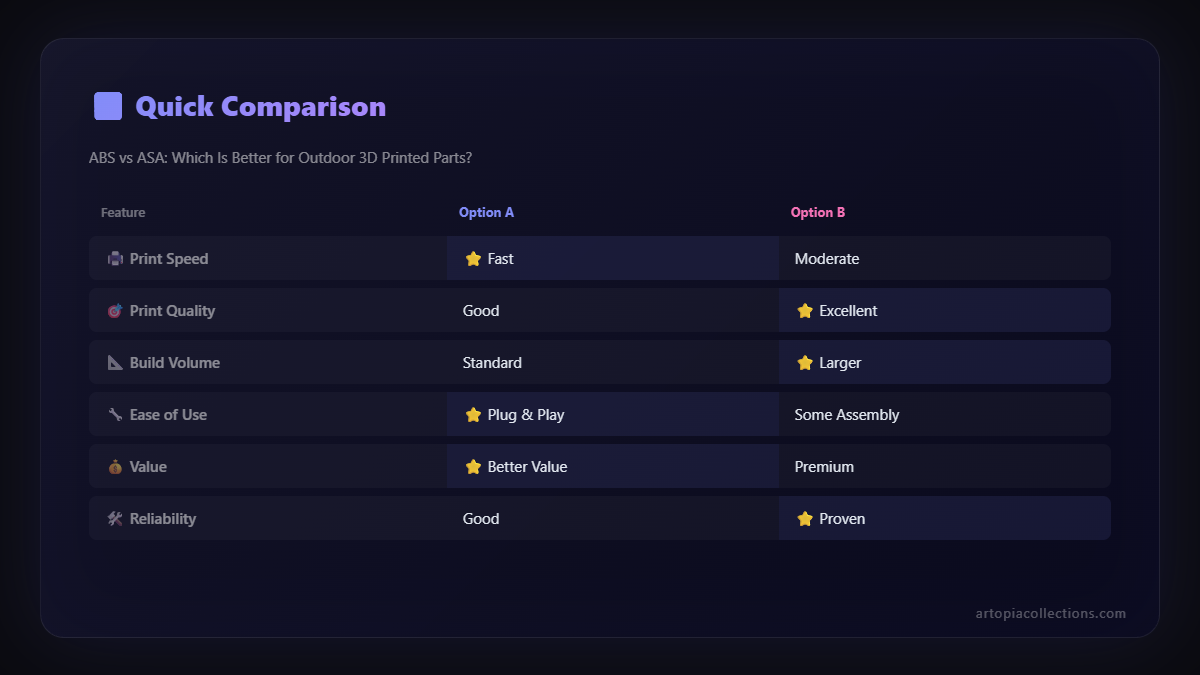
This is ASA's superpower. It wins hands down. ABS will degrade, crack, and become brittle when exposed to sunlight over time. ASA, on the other hand, is specifically engineered to resist UV radiation and harsh weather conditions, making it the clear choice for anything you plan to leave outdoors permanently. If your print is going to see the sun, even intermittently, go ASA.
2. Strength & Durability
Both ABS and ASA are strong, impact-resistant materials. They're definitely in the same league here. You'll get robust, tough parts from either. However, because ABS degrades in UV, its long-term strength outdoors will rapidly diminish, whereas ASA will maintain its mechanical properties for a much longer period. So, for *sustained outdoor durability*, ASA is superior.
3. Heat Resistance
They're pretty comparable here, both offering excellent heat resistance. They can handle high ambient temperatures without deforming, making them suitable for parts that might get hot in the sun, like car accessories or enclosures for electronics that generate heat. You won't see much difference between them in terms of thermal performance up to around 90-100°C.
4. Printability & Fumes
ASA is generally easier to print than ABS. It warps less, sticks better to the print bed, and is more forgiving with cooling settings. While both benefit significantly from an enclosed printer to maintain stable temperatures, ASA is simply less temperamental. And the fumes? As I mentioned, ASA's fumes are considerably milder, making the printing process a bit more tolerable, though good ventilation is still a must for any of these engineering filaments.
5. Cost
This is where ABS usually has an edge. A kilogram of decent ABS filament might cost you anywhere from â¹900 to â¹1300. ASA, being a more specialized polymer, typically ranges from â¹1400 to â¹1800 per kg. So, if budget is your absolute primary concern and your parts are strictly indoors or will be completely protected from UV, ABS is cheaper. But if it's for outdoor use, that extra â¹300-â¹500 for ASA is a small price to pay for longevity and peace of mind.
When to Choose Which? My Personal Recommendation
After years of messing around with both, here's my straightforward advice for us Indian makers:
Choose ABS if:
- Your part will be used strictly indoors.
- You need high strength and impact resistance for indoor applications.
- Budget is extremely tight, and you're willing to deal with the printing challenges.
- You have a fully enclosed printer with excellent ventilation, and maybe even a fume extraction system.
- You plan to acetone smooth the part for aesthetic reasons (though you can do this with ASA too).
Choose ASA if:
- Your part will see any amount of outdoor exposure â sun, rain, wind, temperature swings.
- You need long-term durability and resistance to weathering.
- You want an easier printing experience than ABS, with less warping and milder fumes.
- The higher cost is justified by the requirement for longevity and reliability outdoors.
- You're creating functional parts like drone components, outdoor sensor housings, garden tools, or custom automotive parts.
Honestly, for anything I sell through ArtOpia Collections that's destined for the great outdoors, I default to ASA. The peace of mind knowing my customers won't be calling me in three months with a broken, faded print is invaluable. The slightly higher filament cost is easily offset by not having to deal with warranty claims or negative feedback. It's just a better, more reliable material for this specific use case, period.
A Few Final Tips for Outdoor Prints (Regardless of Material, but Especially ASA!)
- Enclosure is Your Friend: I cannot stress this enough. For both ABS and ASA, an enclosure helps maintain a consistent temperature around your print, drastically reducing warping and improving layer adhesion.
- Good Bed Adhesion: Get your bed temperature right (usually 90-110°C for both), and use an adhesive like a glue stick, hairspray, or a PEI sheet.
- Ventilation: Always, always ensure good ventilation when printing ABS or ASA. Even if ASA smells milder, it still releases VOCs. Safety first, yaar!
- Layer Height and Infill: For outdoor functional parts, I usually go with a slightly larger layer height (e.g., 0.2mm to 0.28mm on a 0.4mm nozzle) and a high infill percentage (at least 40-50%, often cubic or gyroid) for maximum strength.
- Design for the Outdoors: Think about drainage if it's an enclosure. Consider thicker walls or ribs for structural integrity. And if it's a part that bears weight, always over-engineer it slightly.
So, there you have it. While ABS has its merits, when it comes to the harsh realities of outdoor living in India, ASA is the undisputed champion in my book. The initial investment in the filament is totally worth it for the superior UV resistance, durability, and easier printing experience.
What are your experiences? Have you had success with ABS outdoors by some magic trick I don't know about? Or are you also firmly in the ASA camp? Drop a comment below, I'd love to hear your thoughts and war stories from the world of outdoor 3D printing!