Chai Pe Charcha: Top 10 3D Printers for Your Small Business in 2026 â From an Indian EntrepreneurâÂÂs POV!
Hey there, fellow makers and aspiring entrepreneurs! Look, I get it. YouâÂÂre here because youâÂÂre tired of the same old "best 3D printers for beginners" lists, right? YouâÂÂre dreaming bigger than just printing a fidget toy. YouâÂÂre looking at 2026, and youâÂÂre thinking, "How can I actually make some *dhandha* (business) with this tech?" Well, *yaar*, youâÂÂve come to the right place. IâÂÂve been elbows deep in filament, battling power cuts, and celebrating perfect prints from my little setup here in India for years now. I run ArtOpia Collections, and trust me, IâÂÂve seen printers come and go, promising the moon but delivering⦠well, mostly spaghetti.
So, forget the generic tech reviews written by folks who probably just unboxed the thing. This is coming straight from the heart (and the print farm) of someone who actually *uses* these machines to pay bills. WeâÂÂre talking about real-world performance, reliability, and most importantly, value for money in the Indian market. WeâÂÂre in 2026 now, and the landscape has shifted big time since those heady days of 2023. Speeds are insane, precision is mind-boggling, and the convenience factor has skyrocketed. But the core challenge for small businesses remains: how do you pick a workhorse that wonâÂÂt break the bank or your spirit? LetâÂÂs dive in, grab a chai, and let me share my top picks for the small business warrior in you.
The Indian Business Blueprint for 3D Printing Success
Bef
ore we even get to the printers, let's set the stage. What does a small 3D printing business in India need?
*
Reliability: Downtime costs money, especially when you have client deadlines.
*
Speed: Time is money, literally. Faster prints mean more orders fulfilled.
*
Ease of Use: You donâÂÂt want to be a full-time technician. You want to be a creator.
*
Material Versatility: PLA is great, but sometimes you need PETG, ABS, Nylon, or even flexible TPU.
*
Affordability (Initial & Running): From the printer cost to filament and spare parts, every rupee counts.
*
Local Support/Community: Because when something breaks at 2 AM, you need help, not an international ticket.
Honestly, a lot of what I learned setting up
my own product lines at ArtOpia Collections has come from trial and error, figuring out which machines could actually keep up with demand and not just look good on a spec sheet.
1. Bambu Lab P1S (The Speed Demon Workhorse)
Okay, let's kick things off with a printer that, in 2026, is practically an industry standard for small businesses looking for serious speed and reliability without completely emptying their pockets. The
Bambu Lab P1S, or its natural successor (let's call it the P2S for now, as I'm predicting they'll have an iterative update by then), is a game-changer. ItâÂÂs got an enclosed build chamber, which is a HUGE plus for printing materials like ABS or ASA that warp easily in our often-dusty and temperature-fluctuating Indian environments. The CoreXY kinematics mean it's blazingly fast â we're talking about printing benchmark boats in under 20 minutes sometimes.
The P1S (or P2S) comes with a really solid, proven platform, and the option to add the
AMS (Automatic Material System) later is just brilliant. It means you can do multi-colour prints, or even run different materials for support structures, which opens up so many possibilities for product customisation. In my experience, even if you don't use multi-colour often, having the
AMS to auto-switch to a fresh spool when one runs out is a lifesaver for long prints. For a small business, this level of automation is invaluable. You're probably looking at around â¹75,000 - â¹90,000 for the printer itself, maybe â¹35,000 - â¹45,000 for the AMS unit. Yeah, it's an investment, but it *pays for itself*.
Cre
ality has really stepped up its game beyond the Ender series, and in 2026, the K1 Max (or its next iteration, maybe K2 Max?) is a strong contender, especially if you need a larger build volume without going full industrial. ItâÂÂs got that enclosed chamber, like the P1S, which is great, and its speed is right up there. The K1 Max's bigger build plate means you can print larger parts in one go, or batch print more small parts, which seriously boosts productivity.
The thing is, Creality has such a massive user base in India, and their after-sales support network, while sometimes a bit spotty, is generally more accessible than some of the newer players. Plus, finding spare parts or mods is usually a breeze. I've used the K1 Max for larger architectural models and custom enclosures, and it just churns them out. The built-in camera is also a nice touch for remote monitoring. Expect to shell out around â¹60,000 - â¹75,000 for this beast in 2026. ItâÂÂs a compelling package for the price.
3. Prusa MK4 (The Unyielding Workhorse)
Ah, Prusa. The name itself just screams "reliability" and "precision." In 2026, the
Prusa MK4 (or the inevitable MK5) remains the gold standard for many. While it might not always match the sheer speed of some CoreXY machines out of the box, its print quality, consistency, and the sheer joy of knowing it *just works* is unparalleled. For a small business where every print has to be perfect, especially for client prototypes or end-use parts, the MK4 is a strong contender.
Their support is legendary, and while direct Prusa India support can be tricky with customs and imports, the community here is vast and helpful. Prusa's philosophy of open-source and continuous improvement means youâÂÂre always getting a well-tested, robust machine. ItâÂÂs not the cheapest, often hovering around â¹85,000 - â¹1,10,000 in 2026, but itâÂÂs like buying a Toyota Fortuner; it just keeps going. And you know, sometimes slower and perfectly consistent is better than fast and failed.
4. AnkerMake M5C (The "Just Print It" Machine)
AnkerMake really shook things up with their focus on speed and ease of use. The M5C, or its future iteration, is basically the "set it and forget it" printer for someone who wants minimal fuss. ItâÂÂs not as feature-packed as an X1 Carbon, but for solid, fast prints of PLA or PETG, itâÂÂs brilliant. The assembly is super simple, and the app integration is slick.
If your small business is primarily focused on producing functional prototypes or parts that don't require super exotic materials, and you value a quick setup and reliable operation, the M5C is fantastic. ItâÂÂs especially good for those new to the business side of 3D printing who want to spend more time designing and less time troubleshooting. Plus, the price point is often very attractive, perhaps around â¹38,000 - â¹48,000 in 2026, making it an excellent entry point for reliable speed.
5. Creality Ender-3 V3 KE (The Accessible Powerhouse)
I know, I know. Another Ender. But hear me out! The Ender series has evolved dramatically, and the V3 KE (or its 2026 equivalent, perhaps a V4 K or something similar) isn't your grandpa's
Ender-3. This machine takes all the community-backed improvements, adds Klipper firmware out of the box, and cranks up the speed. It's an open-frame machine, so maybe not ideal for ABS without an enclosure, but for PLA and PETG, itâÂÂs incredibly capable for its price.
For new businesses, or as a secondary machine to handle overflow or specific material types, the V3 KE is brilliant. The sheer volume of online resources, modding options, and local community support for Ender machines in India is just unparalleled. If something goes wrong, someone, somewhere, has probably figured it out. ItâÂÂs the ultimate budget-friendly workhorse, probably still around â¹25,000 - â¹35,000 in 2026. And honestly, for that price, you could even get two and double your output! Check out
Creality Ender-3 V3 KE on Amazon.in if you're curious about the current model.
6. Anycubic Kobra 2 Pro (The Contender for Value)
Anycubic has been a strong player for a while, especially in the resin printing space, but their FDM machines are catching up rapidly. The Kobra 2 Pro (or the Kobra 3 Pro for 2026) is another excellent contender if you're looking for speed, an easy-to-use interface, and good print quality without breaking the bank. It comes with auto-levelling, which is a massive time-saver for small businesses where every minute counts.
The Kobra series is quite popular, and their ecosystem is growing. IâÂÂve found their machines to be fairly robust, and for the price, they deliver a very good printing experience. It's a great choice if you want something that's a bit more "plug and play" than the older Ender models, but still leaves you with enough budget for good filament. Expect this to be in the â¹30,000 - â¹40,000 range.
7. Elegoo Neptune 4 Pro (Klipper Power for the Masses)
Elegoo, mostly known for its resin printers (we'll get to those!), has made a solid entry into the FDM market with the Neptune series. The Neptune 4 Pro (or its 2026 iteration) is significant because it brings Klipper firmware as standard at a very competitive price point. Klipper is what gives many of the super-fast CoreXY machines their speed, and having it pre-installed with all the tuning done is fantastic.
This printer offers a lot of features typically found on more expensive machines â high speeds, auto-bed levelling, and a decent build volume. For a small business that wants to push the boundaries of speed and print quality on a budget, the Neptune 4 Pro is an absolute winner. It's probably going to sit around â¹30,000 - â¹40,000 in 2026, offering incredible value for its capabilities.
Okay, so we started with the P1S, and now we're talking about its elder sibling, the X1 Carbon. If your budget allows for it, and your small business requires top-tier performance, multi-material capabilities (especially engineering filaments), and minimal fuss, the X1 Carbon (or its future X2 Carbon model) is the ultimate choice. It's basically a print farm in a box. It comes with a
hardened steel nozzle and gears, which means you can print carbon fibre composites and other abrasive materials right out of the box â a huge plus for producing strong, functional parts.
The lidar sensor for automatic first-layer inspection, the AI print failure detection, and the overall polish of the Bambu Studio software make it a dream to operate. Yes, it's a significant investment, likely in the â¹1,20,000 - â¹1,50,000 range (with AMS), but it opens up doors to projects that other printers simply can't handle with the same ease or reliability. If you're doing high-value, complex prints for clients, this is your machine.
9. Anycubic Photon Mono M5S (Precision Resin Power)
Not every small business is about FDM. For jewellery designers, miniature painters, dental labs, or anyone needing incredibly high-resolution, smooth parts, resin printing is indispensable. In 2026, the
Anycubic Photon Mono M5S (or M6S) remains a top contender for its balance of speed, resolution, and build volume. The "S" in M5S stands for speed, thanks to its high-speed release film and faster print settings.
The M5S offers 12K resolution, which means details you can barely see with the naked eye. For intricate prototypes, custom jewellery molds, or highly detailed figurines, this is the way to go. The build plate is a decent size for most small items, and the auto-levelling feature is a blessing (no more fiddly paper tests!). YouâÂÂll need to factor in resin costs, PPE, and post-processing, but for specific niches, this is a money-making machine. Expect to pay around â¹40,000 - â¹55,000. And remember, always get good quality resin and proper ventilation! Here's a link to
Anycubic Resin Printers on Amazon.in to explore options.
10. Elegoo Saturn 3 Ultra (Larger Scale Resin Production)
Rounding out our list, if you need resin prints but at a slightly larger scale or for batch production, the
Elegoo Saturn 3 Ultra (or Saturn 4 Ultra in 2026) is the go-to. Elegoo has consistently delivered excellent resin printers, and the Saturn series offers a larger build volume than the Mono M5S while maintaining incredible detail (12K resolution, just like the Anycubic).
This means you can print more parts at once, or larger single pieces, reducing your per-part cost and speeding up production. It's also known for its reliable performance and robust build. For businesses producing larger quantities of smaller items or bigger single statues/prototypes, the Saturn 3 Ultra is an outstanding choice. It's a bit more expensive, probably around â¹55,000 - â¹70,000, but the increased capacity often justifies the cost. Just remember, managing resin waste and post-processing for a larger volume requires a bit more planning.
Final Thoughts from Your Fellow Maker
So there you have it, folks! My rundown of the top 10 3D printers IâÂÂd recommend for any small business looking to make a serious impact in 2026. This isn't just about the machines; it's about the ecosystem, the community, and the practicalities of running a business right here in India.
The thing is, no matter which printer you pick, the real secret sauce is *you*. Your creativity, your passion, and your willingness to learn and adapt are what will truly set your business apart. These machines are just tools, albeit incredibly powerful ones.
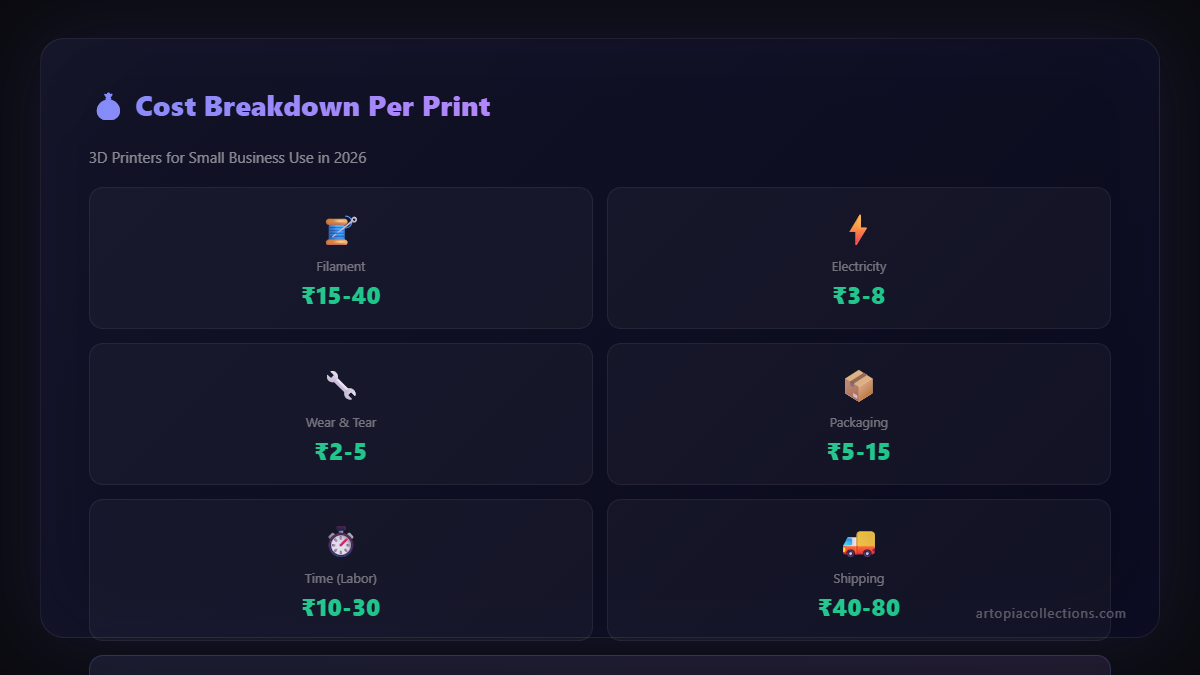
Remember to factor in not just the printer cost, but also good quality filament (local brands like eSUN, Overture, or even some Indian brands like iBot and Filaments.in are excellent), spare parts, electricity, and your own time. And honestly, don't be afraid to start small and scale up. That's exactly what I did with ArtOpia.
Good luck, and happy printing! May your print beds always be level and your first layers always perfect. And if you ever need advice, just drop a comment â weâÂÂre all in this together!


