Bambu Lab A1 Full Review After 6 Months: Long-Term Reliability
We put the Bambu Lab A1 through its paces for six months to evaluate its long-term reliability and performance. Discover what held up, what didn't, and if it's still a top contender after extensive use.

Bambu Lab A1 After 6 Months: Is It Still a Reliability Beast for My Indian Business?
Man, oh man. Six months. It feels like just yesterday I was tearing open that Bambu Lab A1 box, eyes wide with excitement. You know that feeling, right? That fresh-printer smell, the promise of effortless prints, especially coming from a farm of slightly finicky Creality machines. I mean, the hype around the A1 was real, and being able to snag one here in India felt like a win. My little 3D printing business, Artopia Collections, needed a workhorse, a printer that could keep up with custom orders, intricate designs, and basically churn out plastic magic without constant baby-sitting.
So, here we are, half a year down the line. Thousands of print hours. Countless filament changes with that snazzy AMS Lite. Has the A1 lived up to the hype? More importantly, for a small business like mine where downtime means lost money, has it proven to be *reliable*? That's the million-dollar question, or perhaps, the ₹50,000 question, considering what we pay for these machines here. Let's dig in, shall we?
The Initial Honeymoon: Fast, Pretty, Easy
When I first set up the A1, it was everything everyone said it would be. Auto-calibration was a dream – literally just pushed a button and walked away. The speed? Oh my god, the speed! Coming from a modified Ender 3 V2, this thing felt like a rocket. Prints that took hours were suddenly done in a fraction of the time. And the quality was just... crisp. Layer lines were practically invisible, especially with good quality PLA like eSun or Overture, which I stock up on from Amazon whenever there's a good deal (you know the drill, right? Always chase those sales!).
The AMS Lite, too, was a game-changer for multicolor prints. I've done some pretty complex pieces for clients, like custom corporate logos and intricately patterned vases, and the ease of swapping filaments without manually unloading and loading was just bliss. No more ruined prints because I forgot to change colours at 2 AM. Seriously, that thing makes my life so much easier. But initial impressions are one thing. What about when the new car smell wears off? What happens when it's not just a hobby printer, but a tool you depend on daily?
Putting the A1 Through Its Paces: The Business Grind
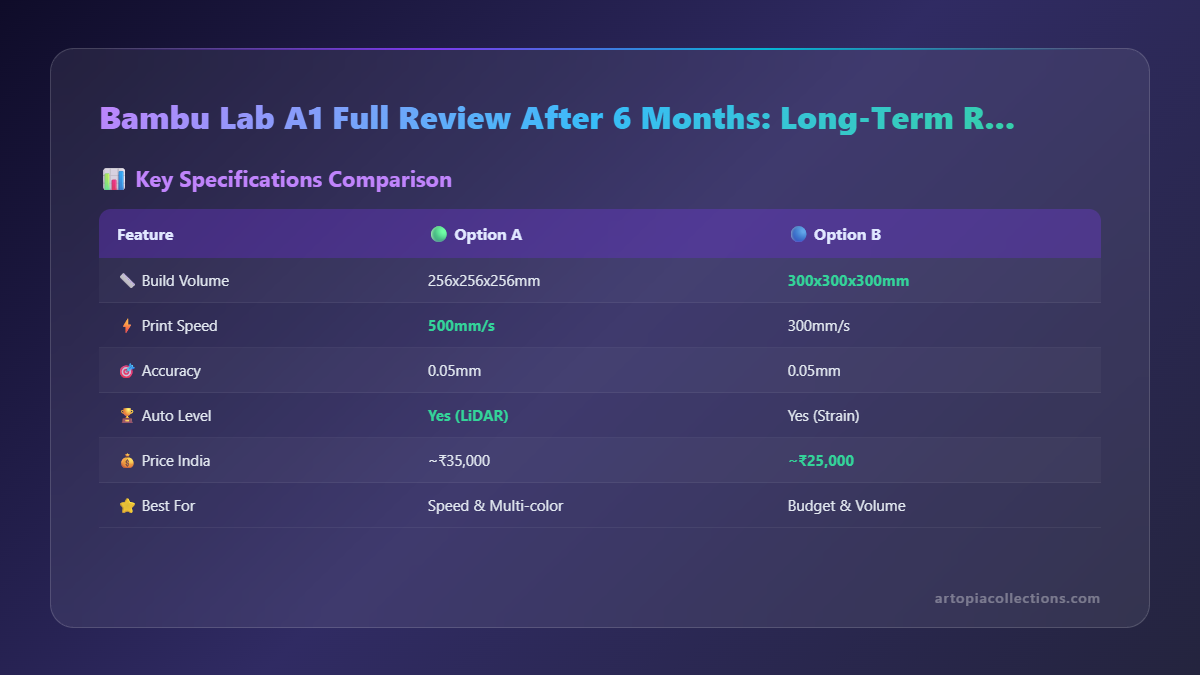 My business isn't just about printing cute little benchys. We do a lot of functional prototypes for local startups, custom art pieces, intricate miniatures, and even some small-batch manufacturing of everyday utility items. This means the A1 sees a variety of filaments – mostly PLA, PLA+, and PETG, but I've even pushed it with some tough ASA for specific outdoor applications. It runs pretty much all day, every day, often doing back-to-back 10-12 hour prints. Sometimes even longer. So, it's not just sitting pretty on a shelf; it's earning its keep.
In this demanding environment, reliability isn't just a buzzword. It's the difference between hitting deadlines and disappointing customers. It's the difference between profit and loss. And frankly, it's the difference between me getting a good night's sleep or waking up in a cold sweat wondering if my print failed again. My other printers, bless their hearts, sometimes demand attention like a toddler – constant bed leveling, nozzle clogs, thermal runaway errors. The A1, I hoped, would be the mature, self-sufficient sibling.
The Elephant in the Room: The Recall and My Experience
Okay, let's address the big one. If you've been in the 3D printing community, especially following Bambu Lab, you know about the A1's heated bed cable recall. Man, that was a moment of "oh no." I remember seeing the news pop up, and my heart sank a bit. Here I was, singing praises, and suddenly there's a potential safety issue. Honestly, my initial reaction was a mix of disappointment and worry. My A1 had been running perfectly, but a recall is a recall.
Bambu Lab's response, though, was pretty swift and (in my opinion) commendable. They immediately stopped sales, offered a choice between a full refund or a discounted upgrade to the A1 Mini or P1P/S, or a replacement heated bed and cable for those who wanted to keep their A1. I chose the replacement route, mostly because I loved the A1 and the AMS Lite combo too much to give it up. The process was smooth enough, and the new bed arrived in a reasonable timeframe, considering it had to ship internationally and then through Indian customs – which, let's be real, can be a whole adventure in itself sometimes!
Installing the new bed was straightforward enough for someone like me who's used to tinkering, but for a complete beginner, it might have been a bit intimidating. Still, the detailed guides Bambu Lab provided were excellent. Since replacing the bed, I haven't had a single issue related to that particular problem. It actually reinforced my trust in them a bit, seeing how they handled a major screw-up. It showed they stand by their products, which is crucial for long-term faith in a brand. So, while it was a bump in the road, it didn't derail my overall positive experience with the printer's reliability.
Long-Term Reliability: The Nitty-Gritty Details
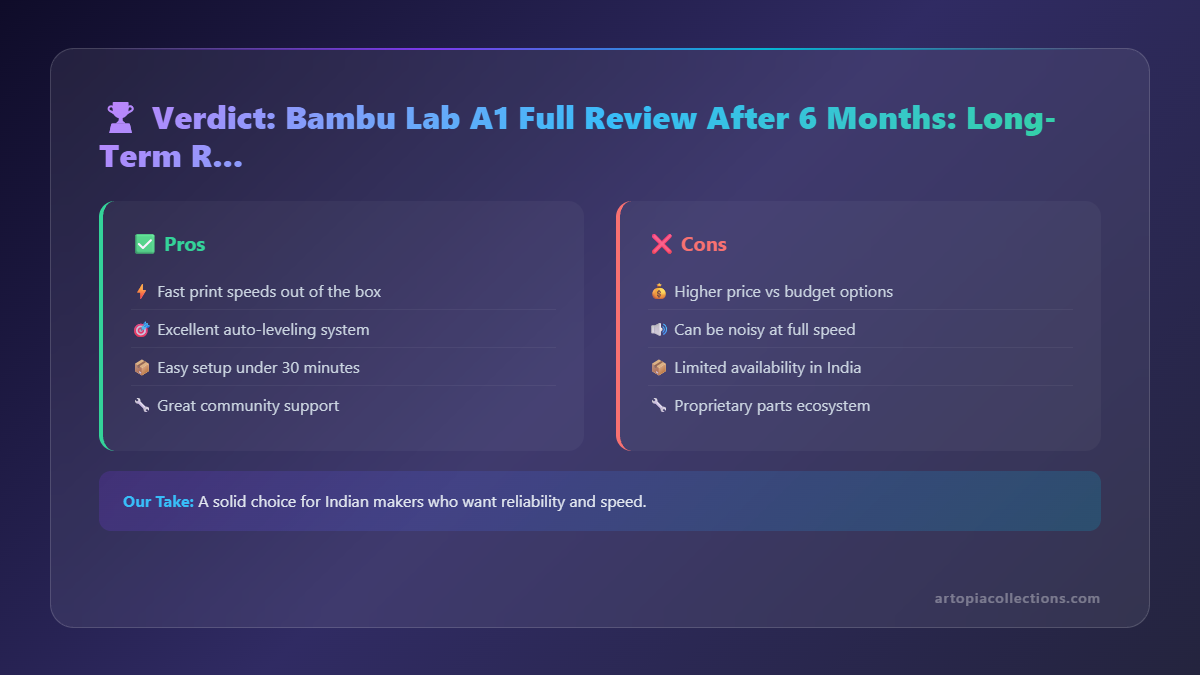 Beyond the recall, what about the day-to-day grind? Here's what I've observed over six months of constant use:
1. Print Quality Consistency: Still A-Game
This is probably what impressed me the most. After hundreds of prints, with various filaments, the print quality hasn't degraded one bit. Bed adhesion is still fantastic with the textured PEI plate (I just clean it with IPA every few prints, simple as that). The auto bed leveling (ABL) just works. I haven't had to manually level it once since setting it up, which is a blessing I never thought I'd experience. Extrusion is consistent, and even fine details come out beautifully. My clients have noticed the difference in quality, and that's a huge win for my brand image.
2. Mechanical Integrity: Holding Up Strong
The belts are still taut, the bearings are smooth, and the hotend has been a champ. I've only cleaned the nozzle a couple of times and replaced it once, mostly as a precaution after running a particularly abrasive glow-in-the-dark filament (note to self: abrasive filaments wear out nozzles, who knew, right?). Swapping out the hotend is super quick with Bambu's proprietary snap-on design – literally seconds. This is a massive improvement over older systems where you'd spend ages wrestling with tiny screws and thermal paste. Spare parts, like nozzles and hotends, are readily available online, though sometimes the shipping costs from abroad can sting a bit. I try to order a few at once to save on that.
3. AMS Lite Durability: A Surprising Hero
I was a little worried about the AMS Lite's long-term durability. All those moving parts, all that filament swapping. But it has been an absolute workhorse. I've run spools from various brands, some perfectly wound, some a bit messy, and it just keeps feeding. I haven't had a single filament tangle or feeding issue that wasn't user error (like forgetting to snip the end of a filament cleanly, oops). It's been incredibly reliable, which is fantastic because the multicolor capabilities are a big draw for some of my custom projects.
4. Maintenance & Downtime: Minimal!
This is where the A1 truly shines for a business. Downtime is almost non-existent. My maintenance routine is ridiculously simple: wipe the print bed, occasionally clean the carbon rods (which, by the way, are easily accessible), and check the nozzle. That's it. No constant calibration, no belt tightening every other week. This translates directly to more printing time and less fiddling, which means more revenue. I've had more issues with my older Creality machines in a week than I've had with the A1 in six months, seriously. For anyone running a business, this low-maintenance aspect is priceless.
5. Software and Connectivity: Rock Solid
Bambu Studio, along with the Bambu Handy app, is just phenomenal. Updates are frequent and stable. The remote monitoring and control features are a lifesaver. I can be at a client meeting or grabbing some chai, and check on my prints, pause them, or even start new ones from my phone. The connectivity has been flawless. No dropped connections, no weird errors. It just works, every single time.
Cost of Ownership: The Indian Perspective
Let's talk money, because for any business, it all comes down to the bottom line. The Bambu Lab A1, especially with the AMS Lite, isn't cheap. When I bought it, it was around ₹50,000 to ₹55,000 (prices fluctuate with imports and duties, of course). That's a significant investment for a small business here. But, honestly, it has paid for itself multiple times over in terms of efficiency and reliability.
Filament costs are a constant. I primarily use PLA and PETG. Good quality PLA+ from brands like eSun or Overture usually runs me around ₹1,800 to ₹2,500 per kg, depending on the colour and where I buy it from. Local Indian brands can sometimes be a bit cheaper, maybe ₹1,500, but the consistency isn't always there, which means more failed prints – a false economy, in my opinion. You can find some good deals on Amazon India for various PLA filaments, but always check reviews. For tools and accessories, like spare nozzles or print bed sheets, I often rely on local distributors or Amazon for generic items like a good set of calipers.
The low maintenance costs are a big factor. Less time fixing means more time printing. Less wasted filament on failed prints means more material going into sellable products. The electricity consumption is reasonable, too, especially compared to some of the bigger, older machines. So, yes, the initial investment is high, but the return on investment through reliability and efficiency makes it totally worth it for a business that relies on consistent output.
Who is the A1 Still For After 6 Months?
So, after six months, including a pretty significant recall event, would I still recommend the Bambu Lab A1? Absolutely, especially with the AMS Lite. It's still my go-to recommendation for:
- Small Businesses: If you need a reliable workhorse that requires minimal tinkering, this is it. The speed and quality reduce lead times, and the AMS Lite opens up new product possibilities.
- Hobbyists Who Value Time: If you're tired of constant calibration and print failures, and you want to spend more time designing and less time troubleshooting, the A1 is a dream.
- Anyone Wanting Multicolor: The AMS Lite is just fantastic. It elevates the creative possibilities immensely.
- Those Entering the Hobby: If you have the budget, start here. It will save you a lot of frustration.
Honestly, the only caveat now is that the printer *has* undergone a significant component replacement. But given Bambu Lab's handling of it, and my own flawless experience since, I don't see it as a deterrent anymore. It shows they're committed to their customers, which is a huge plus in my book.
My Final Verdict: A Reliability Champ!
My enthusiasm for the Bambu Lab A1 hasn't waned. If anything, it's grown stronger. Despite the heated bed cable recall, which they handled very well, this printer has been an absolute beast of reliability for my business. It has consistently delivered high-quality prints, required minimal maintenance, and basically just kept going, day in and day out. It’s allowed me to focus on design and client work, rather than troubleshooting. And that, my friends, is invaluable.
For me, the Bambu Lab A1, even after 6 months and a significant repair, remains one of the most reliable and efficient 3D printers I've ever owned. It's a game-changer, especially for small businesses in India looking to scale up their production without breaking the bank on industrial machines. It truly just works. And that's the highest praise I can give any tool.
What about you? Have you had a similar experience with your A1, or any other printer for that matter? Drop a comment below, I'd love to hear your thoughts!


