Building a 3D Printing Brand on Instagram: Content Strategy for Makers
Are you a 3D printing maker ready to elevate your brand on Instagram? This guide provides actionable content strategies to help you connect with your audience and showcase your creations.

Chalo, let's be real for a second. You've got your beautiful 3D printer humming in the corner, maybe it's an Ender 3 Pro you saved up for, or perhaps even a fancy Prusa Mini. You're churning out some seriously cool prints, right? You're spending late nights tweaking settings, battling stringing, calibrating beds, and finally, you hold this amazing creation in your hands. But then what? You post a quick pic on your personal Facebook or WhatsApp status, maybe get a few likes from family, and then... crickets. Sound familiar? Because, buddy, that was *exactly* my story when I first started Artopia Collections, my little 3D printing dream here in India. Getting noticed, building something beyond just "another guy with a 3D printer" – that's the real challenge. And honestly, Instagram, for all its quirks, became my secret weapon. It's not just for influencers or fashionistas; it's a goldmine for makers like us, if you play your cards right.
I remember when I first thought about making Artopia more than just a hobby. I was printing some cool articulated dragons and custom lithophanes for friends, and they'd say, "Wow, you should really sell these!" So, I thought, "Okay, let's do this." I had my trusty Creality Ender 3 S1 Pro, churning through spools of eSUN PLA+ and Overture PETG like there was no tomorrow. But the thing is, just having cool prints isn't enough. You need to show them off, tell their story, and connect with people who actually care about what you're doing. That's where Instagram stepped in. It’s not just about showing the finished product; it's about showing the *journey*. It's about letting people into your world, the messy, exciting, sometimes frustrating world of 3D printing.
For me, building a brand on Instagram isn't about chasing algorithms or becoming viral overnight. It's about consistency, authenticity, and providing value. It's about showing people that behind every print, there's a human, there's effort, there's passion. And trust me, that resonates. So, if you're a maker, a hobbyist looking to go pro, or just someone who wants to share their amazing prints with a wider audience, here’s how I’ve been approaching my content strategy, and honestly, it's been a game-changer for Artopia.
Beyond the Finished Product: Showing the Process, Not Just the Print
Look, anyone can snap a photo of a finished print. But what makes *your* finished print special? It's the journey. It's the filament spool unwinding, the nozzle gliding, the layers stacking up. That's pure magic to us, right? And it's pure fascination for others.
1. The "Behind the Scenes" Magic
This is gold, absolute gold. People are inherently curious. They want to see how things are made. For us 3D printers, this means:
- Time-lapses: Oh my god, time-lapses are addictive! Set up your phone, hit record, and let your printer do its thing. Show a cool print forming from nothing. Even a 30-second time-lapse of the first few layers can be captivating. I use a simple phone holder and the time-lapse feature on my camera, nothing fancy.
- The Messy Reality: Don't be afraid to show your workshop, even if it's a bit chaotic (mine usually is, to be honest!). Show the filament spools, the tools, the half-finished projects. It makes you relatable. People don't want perfect; they want real.
- Failed Prints & Troubleshooting: This is a big one. We all have failed prints. Instead of hiding them, share them! Talk about what went wrong, how you diagnosed it, and how you fixed it. "My first layer adhesion was terrible today, spent an hour figuring out it was my bed leveling – again!" That shows expertise and vulnerability. It's a fantastic way to connect. I've had so many DMs from people saying, "Hey, I had that exact same problem!"
2. Educate & Empower: Become a Knowledge Hub
 You've learned so much on your 3D printing journey, right? All those YouTube tutorials, forum dives, and countless hours of trial and error. Share that knowledge! This positions you as an expert and provides immense value to your audience.
- Quick Tips & Tricks: Short videos or carousel posts on common issues. "How to remove supports cleanly," "The ideal temperature for PLA in summer (it's different in India's heat, believe me!)," "Why is my print warping?"
- Filament Focus: Do a deep dive into different filament types. Show prints made with PLA, PETG, ABS, TPU. Explain their uses, pros, and cons. For instance, comparing a flexible TPU print (great for phone cases!) versus a rigid PLA print. People often ask me, "Which filament should I use for X?" – so I make content around that! You can find a wide range of filaments, like these PLA filaments on Amazon.in, and show how each behaves.
- Printer Maintenance: Quick guides on nozzle cleaning, bed leveling, firmware updates. These seem basic to us seasoned folks, but they are a lifesaver for beginners.
3. Showcase the "Wow!" Factor: High-Quality Product Photography
Okay, so while the process is crucial, the finished product still needs to shine. This is where you put on your art director hat. You're not just selling a piece of plastic; you're selling a creation, a solution, an experience.
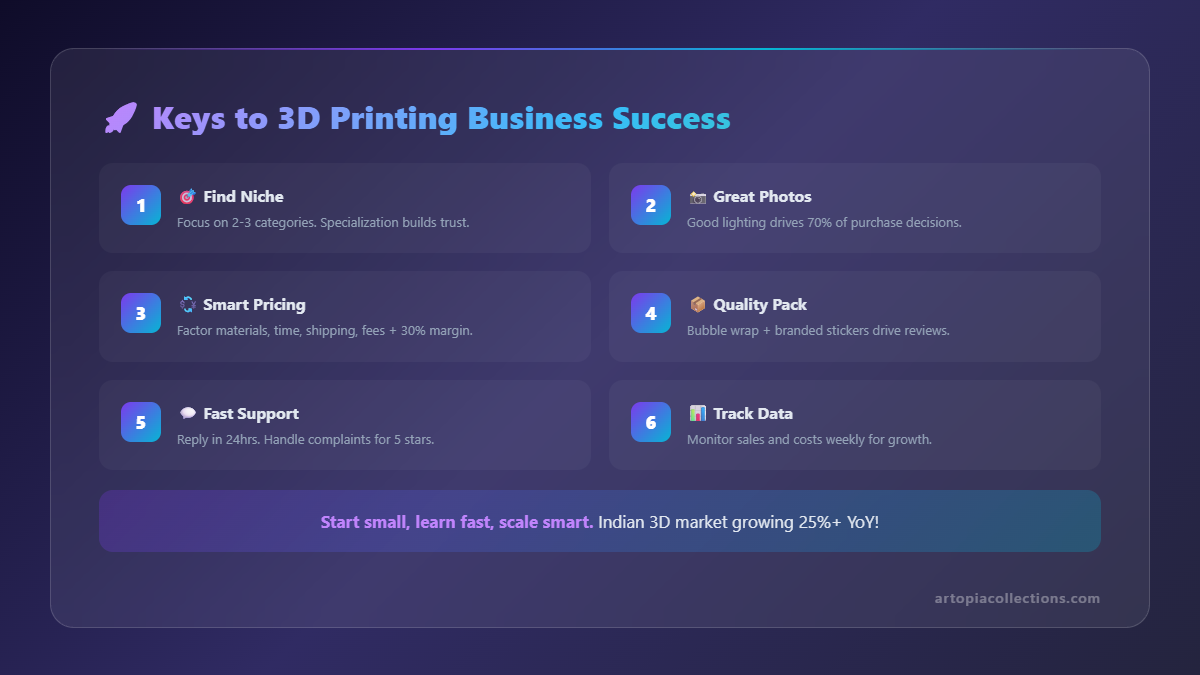
- Good Lighting is EVERYTHING: Seriously, you don't need a fancy studio. Natural daylight near a window is your best friend. Or invest in a couple of inexpensive LED lights. Bad lighting makes even the best print look dull and unappealing.
- Multiple Angles & Detail Shots: Don't just show one front shot. Show it from different angles, highlight intricate details, textures, and features. Macro shots can be fantastic for showing off layer lines (or the lack thereof!).
- Contextualize Your Prints: Don't just photograph a print on your workbench. If it's a planter, put a small plant in it and photograph it on a shelf. If it's a gaming prop, show someone holding it or next to other gaming accessories. This helps people visualize it in their own lives. We sell a lot of functional prints and decor items at Artopia, and showing them in a home setting or being used makes a huge difference. You can check out some of our collections here on our website!
- Use a Clean Background: A plain white, black, or even a subtly textured background helps the print stand out.
Finding Your Niche and Telling Your Story
The 3D printing world is vast. Are you into functional prints? Miniatures? Cosplay props? Custom gifts? Decorative items? Trying to do everything means you're not an expert at anything. For Artopia, we gravitated towards decorative pieces, custom lithophanes, and unique functional prints that combine utility with aesthetics. That's our sweet spot.
4. Storytelling: The Journey of a Print
 Every print has a story. From the initial idea or client brief to the CAD design, the slicing, the actual printing, and finally, the finished product. Document this journey.
"This custom lithophane started as a simple request from a customer who wanted to surprise their parents with a memory. We designed it, picked the perfect filament – I personally think a good quality white PLA works best for lithophanes – and watched it come to life over 12 hours. Seeing their reaction was priceless." That's a story. That connects.
Every print has a story. From the initial idea or client brief to the CAD design, the slicing, the actual printing, and finally, the finished product. Document this journey.
"This custom lithophane started as a simple request from a customer who wanted to surprise their parents with a memory. We designed it, picked the perfect filament – I personally think a good quality white PLA works best for lithophanes – and watched it come to life over 12 hours. Seeing their reaction was priceless." That's a story. That connects.
5. Engagement is a Two-Way Street
Instagram isn't just for broadcasting; it's for interacting. Respond to comments, reply to DMs, and actively engage with your followers. Ask questions in your captions, use polls in your stories, run Q&A sessions. "What's your biggest 3D printing challenge?" or "Which filament brand do you swear by?" These spark conversations and build a community around your brand. And community, my friend, turns followers into loyal customers.
Leveraging Instagram's Features: Reels, Carousels, and Stories
Instagram is constantly evolving, and so should your content strategy. Don't just stick to static photos.
- Reels are King: Short, snappy video content is dominating Instagram right now. Use Reels for time-lapses, quick tips, before-and-afters, or showing off a print in action. Add trending audio, use text overlays, and keep them engaging. They get far more reach than regular posts right now.
- Carousels for Depth: Use carousels (multi-image posts) to tell a story or share detailed information. First slide: "5 Tips for Perfect First Layers." Subsequent slides: one tip per slide, with an image or video demonstrating it. This is great for those educational posts I mentioned earlier.
- Stories for Day-to-Day: Use stories for quick updates, behind-the-scenes peeks, polls, Q&As, and showing the unfiltered, day-to-day life of your business. "Just cleaned my printer bed, wish me luck on this 24-hour print!" – totally normal, totally relatable story content.
Practical Tips for Indian Makers
Okay, here’s the real talk from my own experience here in India:
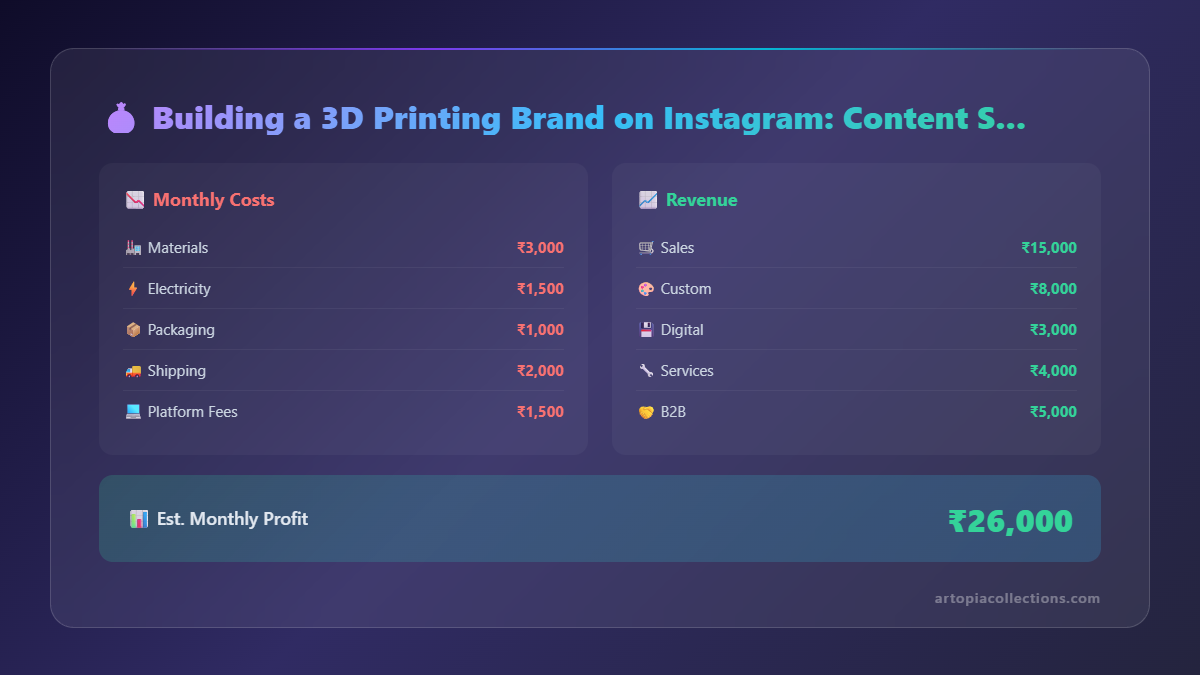
- Filament Sourcing: We're pretty lucky now; there are so many good local and international brands available. I often buy eSUN, Overture, and sometimes even local brands from Amazon.in or specific 3D printing stores online. A good kilo of PLA usually costs me anywhere from ₹900 to ₹1400 depending on the brand and type. Don't skimp on filament; it shows in your prints.
- Printer Choices: Most people start with something like a Creality Ender 3 or Anycubic Kobra Go. They’re fantastic entry points. I even use an Ender 3 S1 Pro for a lot of my orders. If you're looking to upgrade, something like a Prusa MK3S+ or even a higher-end Anycubic Kobra Max can be found on Amazon.in (check prices, they fluctuate!).
- Shipping & Logistics: When you start selling, factor in shipping costs. India has great courier services, but it can add up. Be transparent with your customers.
- Payment Gateways: UPI, PayTM, Google Pay – these are your friends for easy transactions.
- Language: While English is widely understood, don't shy away from using a little Hinglish or even full Hindi captions if your target audience is local. It adds a personal touch.
The Underlying Mantra: Authenticity & Consistency
Honestly, the biggest takeaway I can give you is this: be authentic. Be yourself. Show your passion, your struggles, your triumphs. People don't follow brands; they follow people and their stories. And consistency, my friend, is non-negotiable. It's better to post 3 times a week consistently than to post 7 times one week and then vanish for a month. The algorithm likes consistency, but more importantly, your audience *expects* it.
Starting Artopia Collections and building its presence on Instagram has been a journey, full of learning, late nights, and a lot of caffeine. But seeing people appreciate what I create, getting custom order requests, and building a small community around 3D printing here in India – that’s the real reward. So, stop just printing and start sharing. Your printer is humming; now let your brand buzz!


