Selling 3D Printed Educational Models to Schools and Colleges in India
This post explores effective strategies for selling 3D printed educational models to schools and colleges throughout India. Learn how to identify needs, showcase benefits, and navigate the Indian education market effectively.

From Hobby to Helping Hands: Why 3D Printed Educational Models are the Future of Learning in India (And How You Can Be Part of It!)
You know that feeling, right? That moment when you pull a perfectly sculpted print off the build plate, the smell of warm PLA still hanging in the air, and you just know you’ve made something cool. For me, that feeling has been the driving force behind everything I do with 3D printing. But lately, it’s been more than just "cool" – it's been about something truly meaningful. We're talking about taking those plastic creations and turning them into tools that literally shape young minds across India. Yep, I'm talking about selling 3D printed educational models to schools and colleges here in our homeland, and honestly, it’s an absolute game-changer. Both for the students, and for us small businesses.
Look, I've been tinkering with printers for years, ever since I got my first Creality Ender 3 – a workhorse, truly – and saw the potential. From little fidget toys to custom parts for my bicycle, it was all fun. But then a few years back, my cousin, who teaches science at a local school in Pune, asked me if I could print a scaled-down model of the human heart. Their existing plastic one was broken, and buying a new imported one was costing them an arm and a leg, if you'll pardon the pun. I said, "Sure, why not?" I downloaded a decent STL from Thingiverse, tweaked it a bit in Tinkercad, and an evening later, had a perfectly dissectible heart model. The look on his face, and then the excitement of his students when he showed it to them, that’s when the lightbulb truly went off for me. This wasn't just about printing; it was about impact.
Why India Needs This, And Why NOW is the Time
India’s education system, bless its heart, has traditionally been very rote-learning focused. Memorize, repeat, pass the exam. But things are changing, right? The New Education Policy (NEP) is pushing for experiential learning, hands-on activities, and a deeper understanding of concepts. And what's better for hands-on learning than physical models that students can touch, dissect, assemble, and truly interact with? Traditional educational aids are often expensive, imported, and sometimes, let's be frank, a bit flimsy. They break, and replacing them is a logistical nightmare and a budget killer for many institutions. Especially for government schools or smaller private colleges outside the big metros, every rupee counts.
This is where 3D printing steps in like a superhero with a spool of vibrant PLA. We can produce complex models – think a fully articulated human skeleton, a detailed plant cell, intricate molecular structures, or even topographical maps – right here, locally, and at a fraction of the cost of traditional alternatives. Plus, we can customize them! Need a specific part of a machine for an engineering college? Or a historically accurate artifact for a history class? No problem. The flexibility is just incredible. And that's the niche, my friends, that we, as small 3D printing businesses, can absolutely dominate.
What Kinds of Models Are We Talking About? The Sky's the Limit!
 Honestly, the range of educational models you can print is mind-boggling. I've personally supplied models for everything from primary school science projects to university-level engineering labs. Here are some of the popular ones I’ve found success with:
- Biology & Anatomy: Human organs (heart, brain, kidney), full skeletons, animal models, plant cells, DNA helices. These are always in high demand. Imagine a kid actually holding a 3D printed brain instead of just seeing a picture!
- Chemistry: Molecular structures (of literally anything!), crystal lattice models. Visualizing these complex structures can be a game-changer for understanding.
- Physics & Engineering: Gears, pulleys, engine parts, structural prototypes, architectural models. Engineering colleges are constantly looking for affordable prototypes.
- Geography: Topographical maps, globe sections, geological formations. You can even print scaled-down models of famous Indian landmarks!
- Mathematics: Geometric shapes, fractals, educational puzzles. Makes abstract concepts much more tangible.
And this list is just the tip of the iceberg. You can get really creative. One time, a local medical college wanted a specific bone model for a surgery practice session, something super detailed. Traditional models were ridiculously expensive. I designed and printed it for them using a high-resolution resin printer (a bit more specialized, I know, but worth it for the detail) and they were thrilled. The cost was perhaps ₹2,500 for a model that would’ve cost them upwards of ₹15,000 to import. That’s a win-win right there.
Getting Started: From Idea to Invoice
So, you’re hyped, right? You're thinking, "Okay, how do I actually DO this?" It’s not just about having a printer; it’s about understanding the market, the process, and how to approach these institutions.
1. The Right Tools (and knowing how to use 'em!)
First off, you need a reliable printer. My trusty Creality Ender 3 V2 has been an absolute workhorse for larger, less intricate models. For finer details, especially for biology or engineering, a resin printer like an Elegoo Mars or Anycubic Photon is a fantastic investment. But honestly, start with what you have. Most schools just need robust, clear models.
Filament choice is key. PLA is your best friend here. It’s affordable, easy to print with, and comes in a rainbow of colors. For models that need a bit more durability or chemical resistance, PETG is a good option. I usually stock up on eSun or Extrudr PLA – they’re readily available in India and reliable. You can find good deals on PLA filament on Amazon.in quite often, especially if you buy in bulk.
And software? Oh boy. For finding models, Thingiverse is a goldmine. Cults3D and Printables.com also have fantastic options, sometimes even specialized educational models. For customization, Tinkercad is great for beginners, and Fusion 360 is indispensable for more complex design work. Knowing how to slice effectively (Cura, PrusaSlicer) is also non-negotiable for quality prints.
2. Designing & Customization: Your Secret Sauce
This is where you differentiate yourself. Don't just print what's available online. Talk to the educators. What are their pain points? What specific topic are their students struggling with? Can you create a custom model? For example, instead of a generic plant cell, maybe a school wants a specific type of plant cell relevant to their local ecosystem. Or an engineering college needs a very particular gear assembly for their robotics club.
Being able to say, "Yes, we can design and print that for you," is incredibly powerful. It builds trust and shows you're not just a printer operator, but a solutions provider. I often visit schools, sit down with the teachers, and brainstorm ideas. Sometimes, they don't even know what's possible until you show them. A quick demo print right there can seal the deal.
3. Pricing Your Creations: The Balancing Act
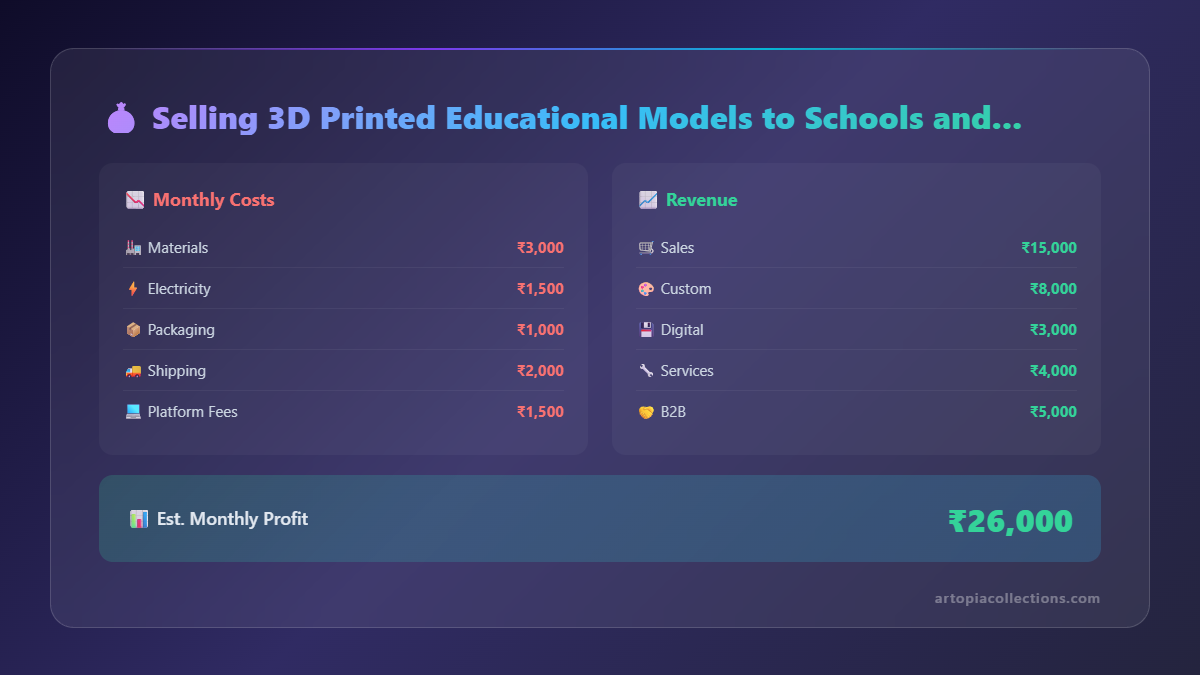
This is probably the trickiest part, right? You want to be competitive but also make a decent profit to keep your business running. Here's a basic breakdown of how I approach pricing:
- Filament Cost: This is easy. Calculate how much filament (in grams) your model uses and multiply by your filament cost per gram. A kilo of good PLA costs around ₹1,500-₹2,000.
- Electricity Cost: Printers don’t use a ton, but it adds up. A rough estimate is fine.
- Printer Wear & Tear: Account for nozzle replacements, bed surfaces, occasional parts. A small percentage of the print cost usually covers this.
- Design Time: If you're designing from scratch, charge for your time! Your skills are valuable. Even if you're just modifying an existing model, that's still your time and expertise.
- Post-Processing: Cleaning, sanding, painting, assembly – these take time.
- Profit Margin: This is your bread and butter. Aim for at least 50-100% markup on your direct costs, depending on complexity and market.
So, a detailed human heart model that uses, say, 150g of filament (costing ₹250-₹300) and takes 10 hours to print might be sold for ₹1,500-₹2,500. A simple geometric shape might be ₹200-₹300. Always provide a clear, itemized quote. For bulk orders, offer a discount – schools often appreciate that and it encourages larger purchases.
4. Marketing & Sales: Knocking on Doors (Literally!)
This isn’t just about putting up a website (though you should definitely have one – check out some of my own collections for inspiration at artopiacollections.com/products). It's about direct outreach.
- School Visits: My number one strategy. Call ahead, get an appointment, and bring a small portfolio of sample prints. Seeing is believing for educators.
- Workshops: Offer a free or low-cost workshop for teachers on "Integrating 3D Printing in the Classroom." This positions you as an expert and builds relationships.
- Pilot Programs: Offer a few models at a reduced price to a school for a trial period. Get testimonials! "See how much their students loved it!" is powerful.
- Local Fairs & Events: Set up a stall at education fairs, science exhibitions, or even local community events. Showcase your models.
- Word-of-Mouth: A happy school will tell another school. Do good work, and the referrals will come.
- Digital Presence: LinkedIn for connecting with principals/directors, Instagram for showcasing your cool prints.
In my experience, once you get your foot in the door with one school in an area, others tend to follow. Educators talk. They share resources, and when they see a tangible benefit at a reasonable cost, they’re usually very open to it.
Challenges? Yeah, A Few, But Totally Conquerable!
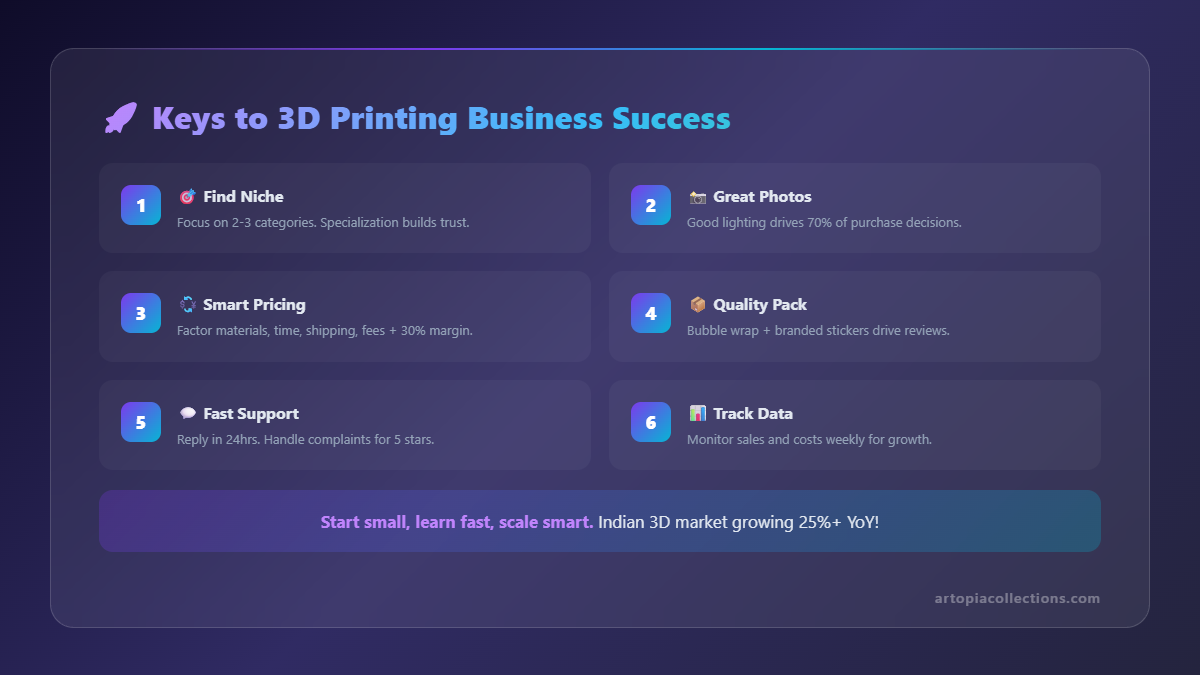 It's not all sunshine and perfect first layers, of course. There are challenges. The initial investment in printers and good software can be daunting. Convincing some older, more traditional educators can be tough sometimes, I won't lie. They might not immediately grasp the value. Quality control is also critical; you can't send a school a model with layer shifting or stringing. Every print needs to be top-notch.
But these are all things you can overcome with persistence, passion, and a commitment to quality. The potential market in India is enormous, truly vast. With millions of students and thousands of schools and colleges, the demand for affordable, high-quality, and customizable educational aids is only going to grow.
My Takeaway: It’s More Than Just Business
Honestly, this journey has been incredibly rewarding. Beyond the business aspect, there's a genuine satisfaction in knowing that the things I print are actively helping students learn better, sparking curiosity, and making complex subjects understandable. It's about empowering educators and enriching the learning experience for the next generation of Indians.
So, if you're a 3D printing enthusiast like me, looking for a way to turn your passion into something more impactful and sustainable, seriously consider the educational market. It's not just a niche; it’s a mission. And trust me, the smiles on those kids’ faces when they hold a perfect 3D printed model of the solar system? That’s priceless. That's why I do what I do. And I truly believe you can too.