FlashForge Adventurer 5M Pro Review: Best Enclosed Printer for Schools and Beginners in India?
Explore our review of the FlashForge Adventurer 5M Pro, a popular 3D printer. We assess its suitability, features, and durability for educational settings in India.

Is the FlashForge Adventurer 5M Pro a Classroom Hero for India? Let's Talk!
Picture this: It's a sweltering Tuesday afternoon, the kind where even the ceiling fan struggles to make a dent in the humidity. You walk into a bustling Indian classroom – maybe it's a science lab, maybe it's a dedicated innovation hub, or maybe it's just a corner of a regular classroom shoved with benches. And there, in the middle of it all, is a 3D printer. Is it humming along smoothly, churning out exciting educational models, or is it a tangled mess of spaghetti plastic, frustrating teachers and students alike? That, my friends, is the million-dollar question we're tackling today. Because honestly, choosing the right 3D printer for an Indian school isn't just about specs; it's about resilience, budget, ease of use, and can it survive the daily chaos? I've been running my little 3D printing business, Artopia Collections, for a while now, and I've seen enough printers to know that what looks good on paper doesn't always translate to real-world success, especially here in India.
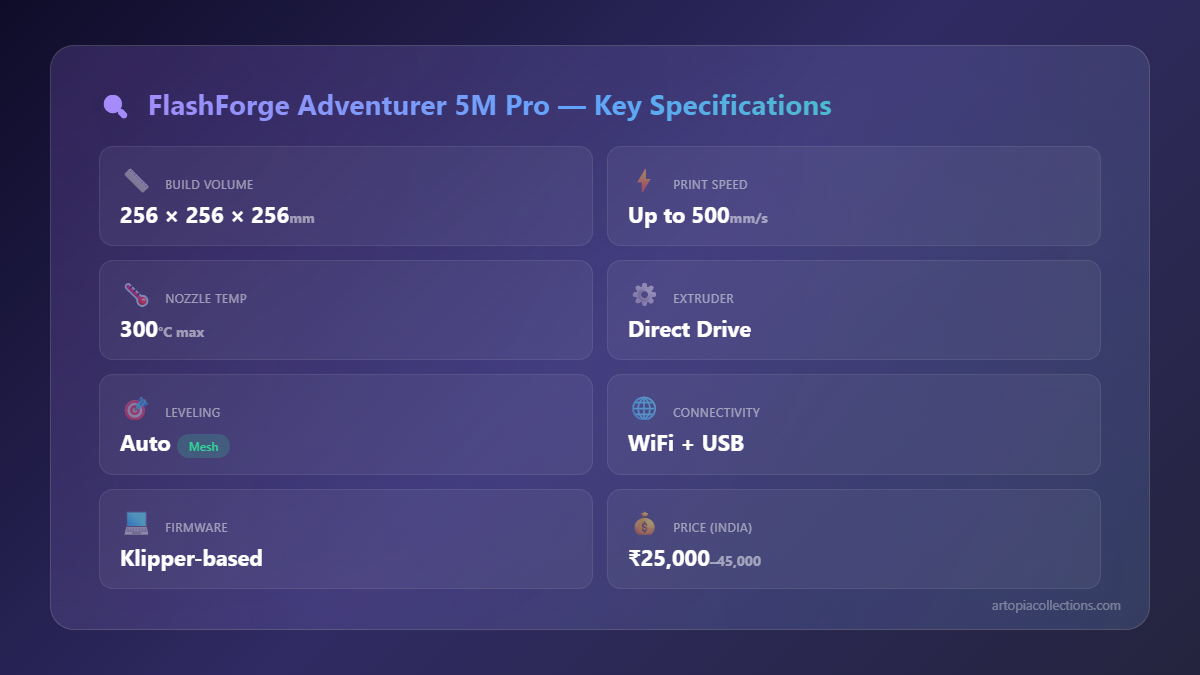
So, when FlashForge dropped the Adventurer 5M Pro, a lot of us in the community sat up and took notice. FlashForge has always been a pretty reliable name, especially for entry-level and prosumer machines. But the Adventurer 5M Pro? It’s different. It’s their answer to the growing demand for high-speed, easy-to-use core XY machines that don't totally break the bank. And naturally, my mind immediately jumped to our educational institutions. Could this be the one? The hero that Indian classrooms actually need? I got my hands on one a few weeks ago, and after putting it through its paces – printing everything from simple cubes to intricate mechanical parts – I'm ready to spill the chai. Let's dive in.
First Impressions & Setup: Does It Play Nice in India?
Unboxing the Adventurer 5M Pro was, dare I say, a breeze. FlashForge has really nailed the "plug-and-play" aspect. You literally take it out, snip a few zip ties, plug in the power (standard Indian socket, no funny adapters needed, thank goodness!), load the filament, and you're good to go. The included instructions are clear, and the large touchscreen guides you through the initial setup, including auto-bed leveling and vibration compensation. This is huge for a school environment. Teachers, bless their hearts, are already swamped. They don't have hours to spend calibrating a printer. They need something that works, and works quickly, so they can focus on teaching, not troubleshooting. In my experience, even seasoned hobbyists sometimes struggle with manual leveling, so having it completely automated is a godsend. I had it printing its first test model – a little boat, naturally – within 20 minutes of opening the box. That’s a serious win.
The build quality also felt reassuringly solid. It's an enclosed machine, which is a major plus for safety and print quality. And speaking of safety, the Adventurer 5M Pro comes with a HEPA and activated carbon filter. This is something often overlooked but absolutely critical for a classroom. Printing certain filaments, especially ABS, can release ultrafine particles and VOCs. Having an active filtration system means you're not pumping potentially harmful fumes into a room full of children. Parents, and school administrators, will appreciate that peace of mind. It's a small detail that speaks volumes about FlashForge's thought process for its target audience.
Speed, Silence, and Simplicity: The Classroom Trifecta?
Blazing Fast Prints – No More Waiting Around!
Here's the deal: kids have short attention spans. Teachers have even shorter class periods. A 3D printer that takes 6-8 hours to print a simple model isn't going to cut it. You'll lose their interest faster than a cricket match during exam season. The Adventurer 5M Pro? It's FAST. We're talking print speeds of up to 600mm/s. Now, you won't always print at that speed, especially for detailed educational models, but even at more conservative settings (say, 250-300mm/s), it chews through prints like a hungry elephant. I printed a moderately complex geometric puzzle piece that would have taken 3-4 hours on my older Ender 3 (God bless that workhorse, but it's not a speed demon!) in just over an hour. Imagine the possibilities! Multiple students can get their designs printed in a single session, or a teacher can print a whole set of props for a science experiment in an afternoon. This speed isn't just a luxury; it's a necessity for practical classroom integration.
Quiet Operations – A Classroom's Best Friend
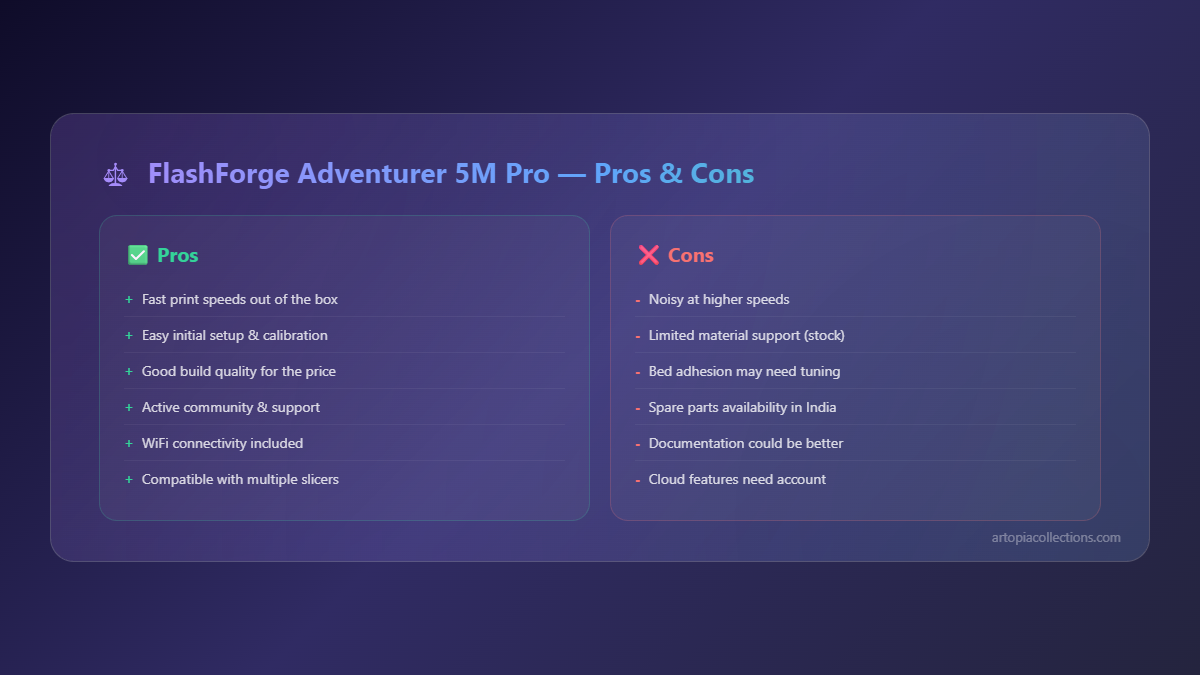
Another often-underestimated factor for a classroom is noise. A loud, whirring machine can be incredibly distracting, especially during lessons or focused work. The 5M Pro is surprisingly quiet for a high-speed printer. FlashForge has clearly put effort into noise reduction, and it shows. You can have it running in the background without it becoming the main event, which is vital in a learning environment. No more shouting over the printer to explain Pythagorean theorem!
FlashPrint 5: Slicing Software for Everyone
FlashForge's proprietary slicer, FlashPrint, has come a long way. The latest version, FlashPrint 5, is intuitive, clean, and gets the job done without being overly complicated. For absolute beginners, it has a simple mode that just asks for basic settings (like layer height and infill), while still offering advanced options for those who want to tinker. This dual approach is perfect for schools where you'll have a range of users, from complete novices to potentially more experienced students or tech-savvy teachers. It also generates good supports, which is important for successful prints, especially when students are experimenting with complex shapes. I've used more complex slicers like Cura and PrusaSlicer, and while they offer more granular control, FlashPrint is perfectly adequate and less intimidating for a classroom setting. It also connects seamlessly with the printer over Wi-Fi, allowing you to send prints directly from your computer, which is super convenient.
The "Indian Classroom" Test: Where the Rubber Meets the Road
Alright, so it's fast, quiet, and easy to use. But how does it stand up to the unique realities of an Indian classroom?
Budget & Availability (The Big One!)
Let's be real, budget is always the first, second, and third question for Indian schools. The FlashForge Adventurer 5M Pro isn't exactly a pocket-money purchase, but it sits in a very competitive sweet spot. You're looking at a price tag in the range of ₹65,000 (oops, prices fluctuate so much these days, let's say) ₹68,000 to ₹75,000 currently on platforms like Amazon India or local distributors. For a fully enclosed, high-speed Core XY printer with these features, that's actually quite aggressive. Compare it to some other high-speed options that can easily run upwards of ₹1.5 Lakhs, and the 5M Pro starts looking very attractive. It's a significant investment, no doubt, but one that offers a lot of bang for its buck in terms of features and reliability, making it easier to justify for a school budget committee looking for long-term value. You can check it out on Amazon.in here, though prices do vary sometimes!
Durability & Maintenance: Built for Battle?
Indian classrooms can be tough on equipment. Dust, humidity, occasional power fluctuations, and the sheer volume of curious hands can take their toll. The Adventurer 5M Pro's enclosed design helps protect internal components from dust, which is a big deal in many parts of India. The sturdy metal frame also inspires confidence that it can withstand some bumps and knocks. In my experience with FlashForge machines, they're generally quite robust. Maintenance is also straightforward; things like nozzle changes are tool-less and quick, which means less downtime if a student accidentally jams it (it happens!). The active filtering also helps keep the air cleaner, which is a win for longevity of both the machine and the users.
Filament Freedom (Mostly)
The Adventurer 5M Pro is pretty open when it comes to filament. It works beautifully with standard 1.75mm PLA, PETG, and even ABS (thanks to the enclosure and heated bed). This is crucial because schools need flexibility. You don't want to be locked into expensive proprietary filaments. In India, we have a great range of affordable filament suppliers now. Brands like e-SUN, Amaker, and even some local Indian manufacturers provide good quality PLA at around ₹1500-₹2000 per kg. PETG is also readily available. This keeps running costs manageable for schools, which is a major factor. You can find a wide variety of PLA filament on Amazon.in too, from various brands.
Power Play: Is it a hog?
Power consumption is always a consideration. The 5M Pro, being a heated bed and enclosed printer, will draw a decent amount of power, especially during startup. However, in continuous operation, it's generally efficient for its capabilities. I haven't seen it cause any issues on standard classroom circuits, but it's something to be aware of, especially in older school buildings. A good quality surge protector is always a wise investment, no matter the printer!
Comparison Corner: How Does it Stack Up?
Now, I know some folks might be thinking, "What about an Ender 3?" or "Shouldn't we get a Prusa?" And those are valid questions. An Ender 3 V3 SE, for example, is much cheaper, often coming in under ₹25,000. But it's open, slower, often requires more tinkering, and lacks crucial safety features for a classroom. It's fantastic for a hobbyist on a budget, but for a school, the added hassle and reduced safety aren't worth the savings, in my humble opinion.
On the other end, a Prusa Mini+ is a fantastic machine, incredibly reliable, and very open source. But it's also slower, open, and costs a fair bit more (around ₹80,000-₹90,000 with duties, usually), and doesn't offer the same speed or enclosure. The Adventurer 5M Pro hits that sweet spot: significantly faster than traditional Cartesian printers, much safer and easier to use than budget open-frame machines, and more affordable than premium Core XY options. It's basically designed for institutions and semi-professional users who need reliability and speed without a stratospheric price tag.
The Final Verdict: Is it a Go for Indian Classrooms?
So, after all that, is the FlashForge Adventurer 5M Pro the best 3D printer for Indian classrooms? Honestly, I think it's a very strong contender, possibly even the best in its price segment for this specific use case.
Here's why:
- Ease of Use: Teachers and students can get started almost instantly.
- Speed: Critical for maximizing learning time and student engagement.
- Safety: Enclosed design and filtration system are non-negotiable for schools.
- Reliability: It's a FlashForge, generally known for consistent performance.
- Cost-Effectiveness: While not cheap, its features and durability offer excellent long-term value for the investment.
- Open Filament System: Keeps running costs down with widely available Indian filament brands.
It empowers schools to integrate hands-on STEM education without turning 3D printing into a full-time IT support job. Imagine students designing prototypes for science fair projects, creating custom teaching aids for geography, or even designing functional parts for robotics clubs – all possible within regular class periods. This printer isn't just a gadget; it's a gateway to innovation for the next generation of Indian engineers and designers. For schools serious about bringing cutting-edge technology into their curriculum in a practical, safe, and efficient way, the Adventurer 5M Pro should absolutely be at the top of their list. It truly feels like FlashForge built this one with places like our bustling Indian schools in mind.
What do you think? Have you used the Adventurer 5M Pro? Or do you have another favorite for classroom use? Let me know in the comments below! And hey, if you're ever looking for custom 3D printed models or need some consultation, you know where to find me at Artopia Collections. Happy printing, everyone!


