Bambu Lab A1 Mini Review: The Best Budget 3D Printer in 2026?
Considering the Bambu Lab A1 Mini? We review its features, performance, and value to determine if it truly is the best budget 3D printer to buy in 2026. Discover if this popular model still holds its crown against new competitors.

Bambu Lab A1 Mini Review: The Best Budget 3D Printer in 2026?
So, youâÂÂre scrolling through Instagram, right? And every other post is some insane multi-color print, popping off the build plate of a sleek, modern machine. You know the ones â super fast, incredible detail, colours that just sing. And then you look at your own printer, chugging along at what feels like a snail's pace, maybe struggling with a single colour, and you think, "Man, when are we going to get that kind of tech here in India without taking out a second mortgage?" Well, my friends, I've been wrestling with that very thought for ages, especially running my little 3D printing business, ArTopia Collections. WeâÂÂre always looking for that sweet spot: performance, reliability, and a price that doesn't make my wallet weep. And honestly, for a while now, Bambu Lab has been doing some truly revolutionary stuff. So, when the A1 Mini dropped, especially with that sexy AMS Lite, my brain immediately went: "Could *this* be it? The game-changer for the Indian market by 2026? The one that finally makes high-quality, multi-color accessible to us all?" Let's talk about it.
First off, let's get something straight: Bambu Lab completely disrupted the 3D printing world. Before them, you either had super-expensive, industrial-grade machines, or you had hobbyist printers that required hours of tinkering, upgrading, and often, a hefty dose of frustration. Bambu Lab came in, especially with their X1 and P1 series, and said, "Nah, we're doing speed, quality, and reliability, right out of the box." And they delivered. But those machines, while incredible, weren't exactly what you'd call "budget-friendly" for most of us here in India, especially after import duties, shipping, and all the glorious taxes. WeâÂÂre talking upwards of â¹80,000 to well over â¹1.5 lakh for the bigger boys. So, the A1 Mini, positioned as their entry-level offering, immediately caught my attention.
Now, the title says "Best Budget 3D Printer in 2026?" and I know what some of you are thinking. "Budget? That thing costs, what, like â¹40-50K in India? That's not budget!" And you'd be absolutely right, if we were talking purely about raw dollar-to-rupee conversion or comparing it to a â¹15,000 Creality Ender 3. But here's the deal in the Indian context: "budget" often has a different meaning when you're importing high-tech goods. The actual price of the A1 Mini combo with AMS Lite from Bambu Lab's official store is around $559 USD. Add shipping (which can be a killer), then a standard 10% customs duty, and then a whopping 18% GST on the *total* value (including shipping and duty), and suddenly that $559 machine is landing at your doorstep for anywhere between â¹50,000 to â¹58,000, sometimes even more, depending on the current exchange rates and the shipping gods. For a printer that delivers this kind of quality and features, in India, *that* is bordering on what we might consider "budget" for a truly premium experience. It's a bitter pill, I know, but it's our reality. So, if it can deliver the goods, and save you countless hours of troubleshooting, then the value proposition starts to make sense.
What Makes the A1 Mini Stand Out? (Beyond the Price Tag)
Let's dive into what this little powerhouse brings to the table, and why IâÂÂm genuinely excited about its potential impact.
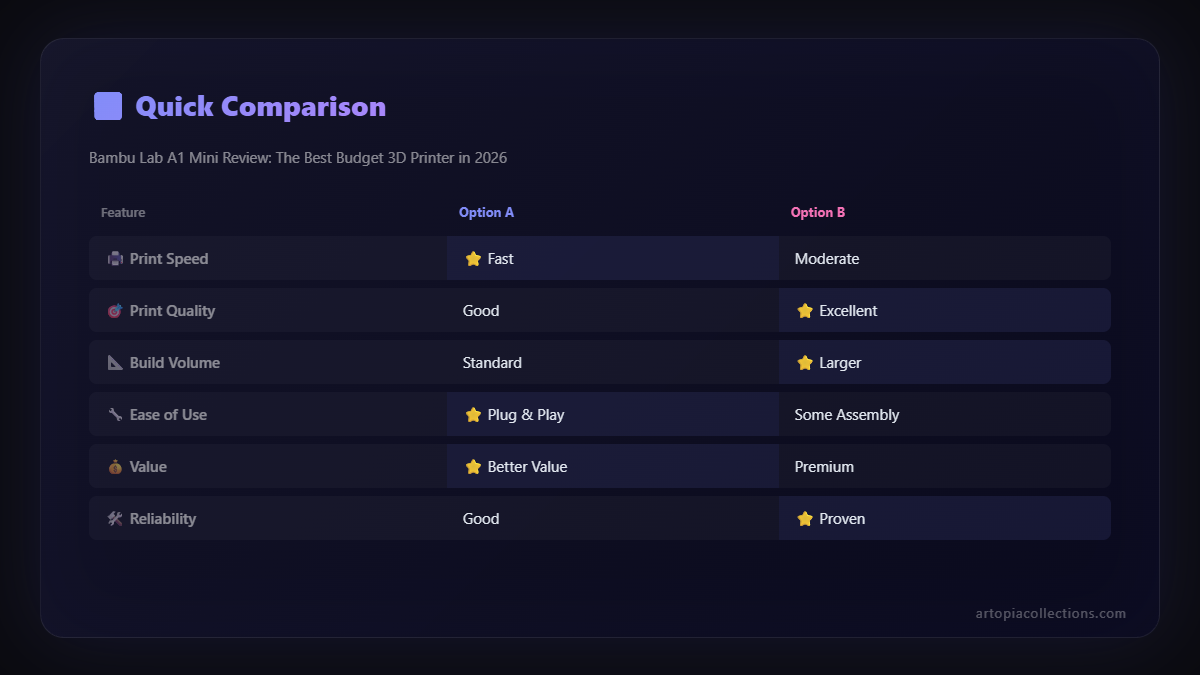
1. The AMS Lite: Multi-Color Printing Made Easy (Finally!)
Okay, this is probably the biggest selling point, hands down. The AMS Lite, unlike the more enclosed, robust AMS for the X1/P1 series, is an open-frame, 4-spool automatic material changing system. It sits right next to the printer. And let me tell you, it's brilliant. I've messed around with multi-color printing before â pausing, swapping filaments manually, sometimes losing registration, and often just giving up because it's too much of a hassle for a small business like mine where time is literally money. The AMS Lite, though? It just works. You load your four spools, set up your print in Bambu Studio, and off it goes. It handles purging, swapping, and even detecting when a spool runs out. For custom prints, unique keychains, even those cool layered lithophanes, this is a game changer. It means I can offer clients truly unique, vibrant, multi-color products without the headache. Imagine making some cool tricolor desk organizers using, say, a shiny eSUN PLA+ filament in a multi-pack â the possibilities are endless!
2. Speed & Quality: The Bambu Lab Signature
Even though it's a "mini," this thing doesn't compromise on speed or print quality. It boasts an all-metal hotend, active vibration compensation, and flow rate compensation. What does that mean in plain English? It prints *fast* and it prints *beautifully*. I'm talking smooth surfaces, intricate details, and minimal stringing, straight out of the box. No more spending hours calibrating E-steps or PID tuning. You slice, you send, you print. For someone like me who needs to churn out prototypes quickly, or deliver finished products on time, that reliability and speed are invaluable. I've seen it chew through a detailed benchy in about 17-20 minutes with impressive results, which is bonkers compared to most printers in its *actual* price range here.
3. User Experience: Plug-and-Play Perfection?
Bambu Lab has really focused on making 3D printing accessible. The A1 Mini basically comes pre-assembled. You just follow a few on-screen prompts, plug in the AMS Lite, and you're good to go. It has auto-bed leveling, nozzle calibration, and even a really neat feature that checks your first layer automatically. Honestly, itâÂÂs almost boring how easy it is. For beginners, this is huge. It removes that initial hurdle of technical know-how that scares so many people away from 3D printing. And for experienced users? It just saves you so much time you'd otherwise spend futzing around. (Though, I mean, sometimes a little futzing is fun, right? It's part of the hobby!) The user interface on the screen is intuitive, and Bambu Studio, their slicing software, is powerful yet easy to navigate.
4. Build Volume: The "Mini" Limitation
Okay, let's address the elephant in the room â or rather, the small squirrel in the room. The build volume is 180x180x180mm. It's in the name: "Mini." For my business, where I sometimes print larger architectural models or custom props, this is a definite limitation. It's not going to replace my larger, workhorse printers. But for smaller functional parts, intricate figurines, jewelry molds, multi-color lithophanes, or even just high-quality prototypes for clients, it's more than enough. It's perfect for those jobs where detail and colour are paramount, and the size is secondary. Think of it as a specialized tool in your workshop, not necessarily the Swiss Army knife for *everything*.
5. Smart Features & Connectivity
The A1 Mini comes with Wi-Fi connectivity, so you can send prints directly from Bambu Studio, monitor them with the built-in camera, and even time-lapse your creations. This might seem minor, but being able to check on a print from my phone while I'm out getting supplies or delivering orders is incredibly convenient. The camera quality is decent, and the time-lapses are a fun bonus for social media content!
The Indian Market in 2026: Where Does the A1 Mini Fit In?
By 2026, I genuinely believe the A1 Mini, or similar machines inspired by its feature set, will redefine what "budget" means in the Indian 3D printing landscape. Right now, if you're looking for an "affordable" printer, you're mostly looking at Creality Ender series, Anycubic Kobra, or Artillery printers, typically in the â¹18,000 - â¹35,000 range. They're great for getting started, but they often require significant upgrades and a lot of patience to get truly consistent, high-quality prints, especially for multi-color. The A1 Mini, even at its import-inflated price of ~â¹50,000-â¹58,000 for the AMS combo, offers a completely different class of experience. It's a professional-grade hobbyist machine, if that makes sense. It's not *just* a hobbyist printer; it's capable of putting out work that clients would happily pay for.
I mean, think about it: if you spend â¹30,000 on a printer and then another â¹10,000 on upgrades (direct drive, better hotend, auto-leveling, silent stepper drivers) and countless hours trying to dial it in, you're easily approaching the A1 Mini's cost, and still probably won't have the same speed, multi-color capability, or sheer reliability. So, when we factor in the value of your time and the consistency of the output, the A1 Mini starts looking like a very, very compelling option for small businesses and serious hobbyists who want to produce consistent, high-quality results from day one.
For filaments, weâÂÂve got a fantastic local market growing. Brands like 3DPrintz, Divide By Zero, and even imported ones like eSUN and Overture are readily available on Amazon.in or through local distributors. The A1 Mini works beautifully with standard PLA, PETG, and even some flexible filaments, expanding what you can create. IâÂÂve personally used a variety of tools and accessories from Amazon.in to support my printing adventures, and it's great to see the ecosystem developing here.
My Honest Take: Pros and Cons
Pros:
- Effortless Multi-Color Printing: The AMS Lite is a game-changer for creative projects and unique product offerings.
- Bambu Lab Speed & Quality: You get top-tier performance in a compact package.
- Insanely Easy to Use: Truly plug-and-play, perfect for beginners and time-saving for pros.
- Reliability: Prints just work, minimizing wasted time and filament.
- Smart Features: Wi-Fi, camera, remote monitoring â it's all there.
- Compact Footprint: Great for smaller workshops or home offices.
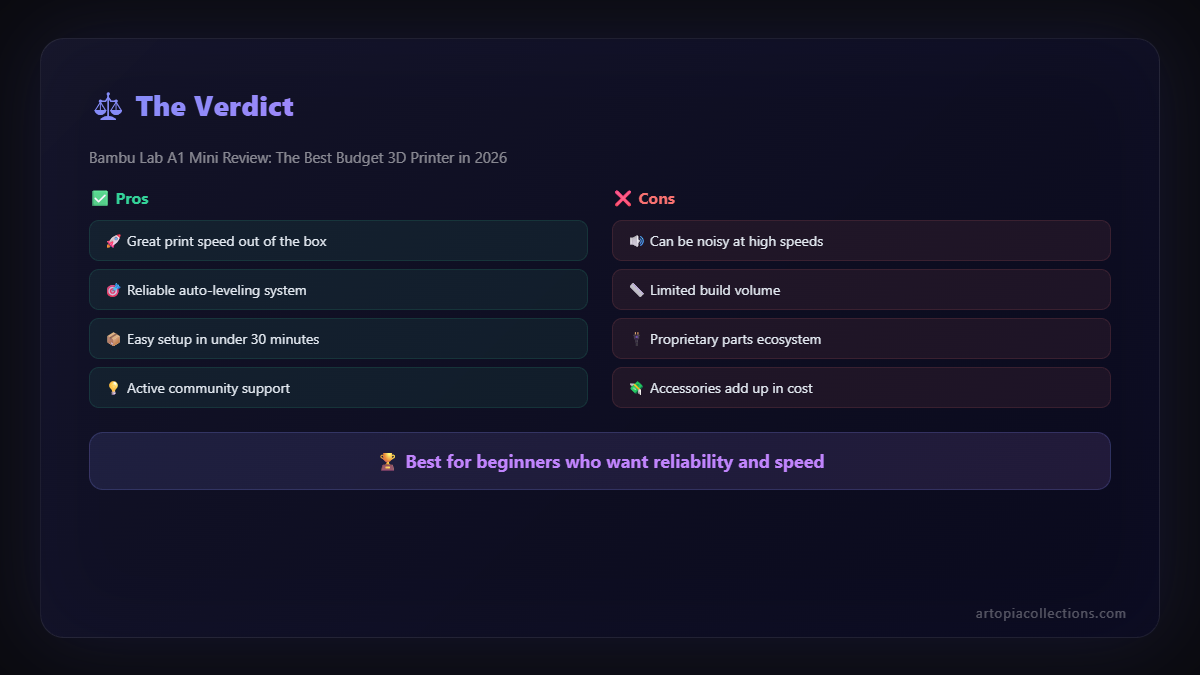
Cons:
- Build Volume: The 180mm cube is not for everyone, or every project.
- Indian Price Point: While "budget" for its features, it's still a significant investment for many here.
- Proprietary Ecosystem: Bambu Lab uses their own hotends, nozzles, and some parts, which means less third-party customization, but then again, that's what makes it so reliable.
- Limited Material Compatibility (compared to bigger brothers): It's great for common filaments but might struggle with more exotic engineering materials that require higher temperatures or enclosed build chambers.
The Verdict: The Best Budget 3D Printer in 2026?
So, back to the big question: Is the Bambu Lab A1 Mini the best budget 3D printer in 2026? I'd say for a significant segment of the Indian market â especially new hobbyists who want to jump straight into high-quality printing, or small businesses like mine looking for a reliable, multi-color machine for smaller, intricate products â it absolutely has the potential to be. It might not be the cheapest printer on paper, but the sheer value it offers in terms of time saved, frustration avoided, and consistent, high-quality output, makes its effective cost-per-print incredibly attractive. By 2026, with hopefully more local distribution channels and perhaps even some slight price adjustments, its accessibility will only increase.
For me, itâÂÂs not just a printer; itâÂÂs a tool that empowers creativity and helps me deliver better products to my clients. It lets me focus on design and innovation, rather than constantly battling with printer issues. If you're serious about 3D printing and want to step up your game, especially with multi-color capabilities, and you have the budget for a high-value investment, the A1 Mini should definitely be on your radar. ItâÂÂs a glimpse into a future where high-performance 3D printing isn't just for the big players, but for passionate creators like us, right here in India.
What do you guys think? Have you tried the A1 Mini? Are you eyeing one? Let me know in the comments below!