GST and Tax Rules for Selling 3D Printed Products in India 2026
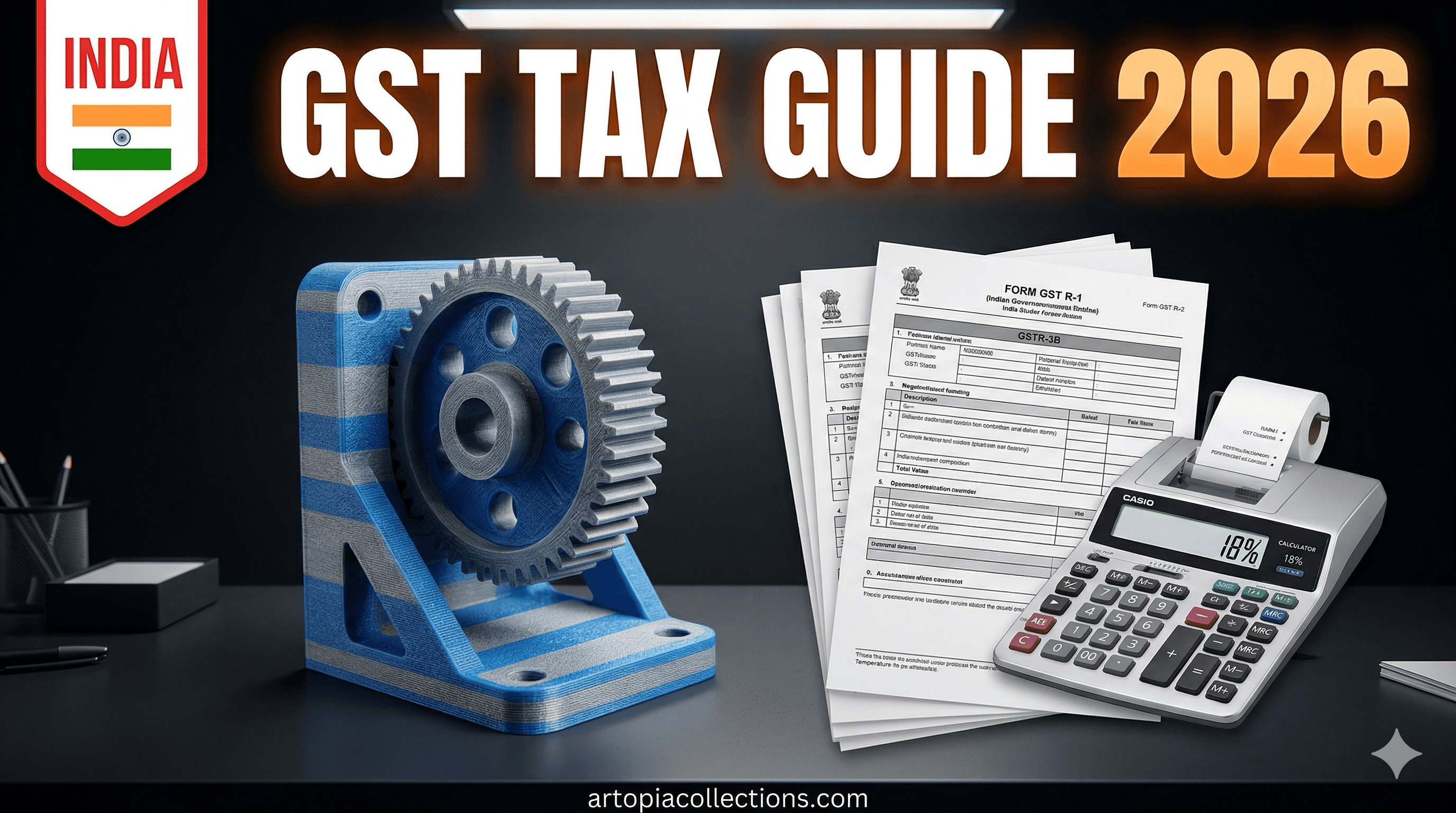
Understanding GST and tax regulations for 3D printed products in India can be complex for sellers. This comprehensive guide outlines the key rules and compliance steps for 2026 to ensure your business operates smoothly.
Chai garam, दिमाग ठंडा, and a freshly printed batch of goodies cooling on the print bed – that’s basically my happy place. You know the feeling, right? The smell of warm PLA, the whirring of stepper motors, watching a digital dream become a tangible reality layer by painstaking layer. It’s magic, honestly. But then, if you’re like me, trying to turn that magic into a sustainable little business here in India, the cold, hard reality of paperwork, deadlines, and the dreaded ‘T’ word – Taxes – comes crashing in. And it’s 2026 now, so things are pretty streamlined, but still, you gotta keep up. Today, let’s talk about something none of us *want* to talk about, but absolutely *have* to: GST and Tax Rules for Selling your awesome 3D Printed Products in India. Consider this your friendly neighbourhood printer-head’s guide.
Look, I get it. When I started out with just my trusty Creality Ender 3 (upgraded to a K1 now, thank goodness, those speeds are insane!), the last thing on my mind was HSN codes or input tax credit. I was just stoked people wanted to buy my custom phone stands or those quirky little planter pots. But here’s the deal: if you want this passion project to actually pay your bills, to grow, to let you buy that next fancy resin printer (oh, the dreams!), you absolutely cannot ignore the financial and legal side of things. Trust me, I’ve seen fellow creators stumble because they thought they could just fly under the radar. It’s not worth the stress, the fines, or the potential shutdown of your creative venture. So, buckle up, grab another chai, and let’s demystify this beast for 2026.
GST: The Grand Standard for Goods & Services (and 3D Prints!)
Alright, first things first: GST, or Goods and Services Tax. This is the big one. It's basically a consumption tax levied on most goods and services sold in India. For us 3D printing folks, it means that unless you're operating well below a certain turnover, you're going to need to register for GST and charge it on your products. The thresholds have been pretty stable for a while now, thankfully. As of 2026, generally, if your aggregate turnover crosses ₹40 lakhs in a financial year for goods (or ₹20 lakhs for services, but most of us are selling tangible products, so the ₹40 lakh limit usually applies), you have to register. Some special category states still have lower limits, like ₹20 lakhs for goods, so always double-check based on your specific state. My home state, for example, falls under the ₹40 lakh rule, which gave me some breathing room initially.
What Kind of GST Are We Even Talking About?
Once you’re registered, you’ll encounter a few terms:
- CGST (Central GST): Goes to the Central Government.
- SGST (State GST): Goes to the State Government.
- IGST (Integrated GST): This is for inter-state sales, i.e., when you sell your awesome 3D-printed coasters from, say, Karnataka to a customer in Maharashtra. IGST basically combines CGST and SGST into one.
You charge these to your customer, collect them, and then pay them to the government. Simple enough in theory, right? The practical part is record-keeping, which we’ll get to.
HSN Codes: Your Product's ID Card
This is where it gets a little nuanced for us because 3D printing isn't a single product category. You're printing everything from prototypes to artistic pieces, functional parts to jewellery. Each "type" of good has an HSN (Harmonized System of Nomenclature) code, which is basically an internationally recognised product classification system. When you sell a 3D-printed item, you need to use the HSN code that best describes that item, *not* a generic "3D printing service" code, unless you’re genuinely providing a service like prototyping or design *without* handing over a physical product. For example, if you print a plastic toy, you'd look for the HSN code for plastic toys. If it's a custom-made architectural model, you'd find the code for models. The tax rate (5%, 12%, 18%, 28%) will depend on this HSN code. It can be a bit of a research project initially, but once you figure out the codes for your most common products, you’re golden.
I personally spent a good few days poring over the GST portal and even spoke to my CA (Chartered Accountant) to get this right. For general plastic articles, you're often looking at HSN codes in Chapter 39, like 3926 for "Other articles of plastics". But you need to be precise. Don't guess here!
Input Tax Credit (ITC): Your Best Friend
This is probably the coolest part of being GST registered for small businesses. ITC means you can claim credit for the GST you've paid on your business purchases. Think about it: you buy filament (like a kilo of good quality eSun PLA+ which probably costs around ₹1,400-₹1,800, plus GST), replacement nozzles, even a new printer like the Anycubic Kobra 2 Neo, and you pay GST on all those inputs. When you sell your 3D-printed product, you charge GST to your customer. You don't have to pay the *full* GST you collected to the government; you can offset it by the GST you've already paid on your purchases. So, if you collected ₹1000 in GST from sales and paid ₹300 in GST on your filament and other supplies, you only need to deposit ₹700 to the government. This saves you a decent chunk of change and makes your cost of doing business lower. It's why getting your invoices right and keeping meticulous records is absolutely critical!
Income Tax: The Annual Reckoning
Beyond GST, there's your annual income tax. This is about what *you* earn from your business. Most small 3D printing businesses like mine start out as proprietorships – basically, you and your business are one and the same entity for tax purposes. You report your business income and expenses on your personal income tax return. If you ever scale up significantly, you might consider an LLP (Limited Liability Partnership) or a Private Limited Company, but that’s a whole different ballgame.
Presumptive Taxation (Section 44AD/44ADA): A Lifesaver for Small Businesses
Now, this is a gem, especially for service providers, but it also applies to businesses like ours selling goods. If your annual turnover is below ₹2 Crore (for businesses under 44AD) or ₹50 Lakhs (for professionals under 44ADA), you can opt for the presumptive taxation scheme. What does this mean? Instead of maintaining detailed books of accounts (which can be a nightmare for a small operator) and getting an audit, you can declare a certain percentage of your turnover as your taxable income. For businesses, it's generally 6% if you receive payments digitally (which most of us do these days, thankfully!) or 8% otherwise. For professionals (if you’re primarily offering design/prototyping services), it’s 50%.
So, if your 3D printing business, say, had a turnover of ₹30 lakhs in 2025-26, and you received all your payments online, you could declare 6% of ₹30 lakhs, which is ₹1.8 lakhs, as your profit. You then pay income tax on this ₹1.8 lakhs according to the applicable slab rates. This simplifies things immensely! I personally think this is a huge boon for passion-driven businesses like ours. It lets us focus more on creating and less on bookkeeping, though accurate records for turnover and expenses are still necessary if you want to claim lower actual profit.
Pricing Your Prints with Taxes in Mind
This is where the rubber meets the road. You can't just price your items based on filament cost and a bit of profit margin anymore. You need to factor in GST right from the start. Let's say you've calculated that a custom Lithophane lamp costs you ₹500 in materials (filament, LED, wiring) and you want a ₹300 profit. Your base price before GST is ₹800. Now, if the applicable GST rate is 18% (just an example, depends on HSN), you'd add 18% of ₹800, which is ₹144. So, your final selling price to the customer would be ₹944. You collect ₹944, deposit ₹144 to the government (minus any ITC you can claim, of course), and you're left with your ₹800. If you don't factor this in, you'll end up eating into your profit margin, or worse, making a loss.
It's important to be transparent with your customers too. Many small businesses show the price inclusive of GST and mention it, or show the base price and then the GST separately on the invoice. Whatever you choose, be clear. In my experience, customers appreciate clarity.
The Nitty-Gritty of Compliance: Filing & Record Keeping
So, you’re registered for GST. Now what? You need to file regular returns. The main ones are GSTR-1 (details of your outward supplies, i.e., sales) and GSTR-3B (a summary of your outward and inward supplies and payment of tax). These are usually filed monthly or quarterly depending on your turnover. For most small businesses, quarterly filing is an option if your turnover is below ₹5 crore, which is a big relief. But you still have to pay GST monthly if you make sales. It’s a bit of a juggle, but manageable.
Record keeping is paramount. Keep all your purchase invoices (especially those with GSTINs) for filament, printer parts, tools, packaging materials, shipping services – basically anything you buy for your business. And keep copies of all your sales invoices. I personally use a simple spreadsheet for my initial records and then transfer them to a basic accounting software like Zoho Books or even Tally for my CA. If you’re just starting, a clear Excel sheet can work wonders, but as you grow, investing in a proper system is a no-brainer. There are many affordable options available now. I'd also recommend keeping track of your specific printer settings for different filaments – it's not tax-related, but it's part of your operational records! For example, my Creality K1 runs Overture PETG perfectly at 250C with a bed temp of 80C, but for eSun PLA+, I drop the nozzle to 210C.
And speaking of tools, make sure you have the basics sorted. A good set of allen keys, some precise side cutters, and a deburring tool can save you so much grief. You can find some excellent tools, like this handy set, on Amazon.in. Having the right setup, from your printer to your post-processing tools, makes all the difference in producing quality prints that customers are happy to pay for.
My Personal Take & Some Tips
Honestly, when I first started, the tax stuff felt like a massive mountain. I procrastinated. I ignored it. I even considered just keeping it as a hobby. But then I saw the potential, the joy of creating things people wanted, and decided to dive in. My biggest piece of advice: find a good Chartered Accountant (CA) early on. They might seem like an added expense, but trust me, they save you so much time, stress, and potential errors. They know the ins and outs, the latest updates (like any minor tweaks to GST rates or filing procedures in 2026), and can guide you. It’s an investment, not an expense.
Another tip: leverage online platforms. Selling your 3D prints on marketplaces or your own website makes it easier to track sales, generate invoices, and handle payments. And don't forget to showcase your best work! If you want to see some of the cool stuff we've been printing lately, check out our collection over at Artopia Collections. We put a lot of love into each piece.
Also, stay updated. Tax laws, even in 2026, can see minor amendments. Follow reputable financial news, your CA will keep you in the loop, and keep an eye on the official GST portal. Ignorance isn't bliss when it comes to taxes; it's just a pathway to trouble.
For anyone looking to upgrade their setup or get started, a solid FDM printer is still the backbone of most small businesses. The Creality Ender 3 V3 KE is fantastic for the price, but if your budget allows, something like the Anycubic Kobra 2 Pro or even the Creality K1 (which I absolutely adore for its speed!) is a game-changer. And always, *always* invest in good quality filament. It makes a world of difference in print quality and reduces failed prints. I've had great success with Overture and eSun PLA+ – you can grab a spool or two to try out from Amazon.in. Good filament means less post-processing, happier customers, and ultimately, better profits.
Running a small 3D printing business is incredibly rewarding. It’s a creative outlet, a problem-solving challenge, and a way to bring unique ideas to life. Don't let the "boring" stuff like taxes scare you away. Embrace it as part of the journey. Understand the rules, stay compliant, and you'll be able to focus on what you love most: making awesome things, one layer at a time. Happy printing, my friends!