PLA vs PETG: Which Filament Should You Use and When?
Choosing between PLA and PETG is crucial for successful 3D prints. Discover their unique properties, ideal uses, and learn exactly when to pick each filament for your projects.
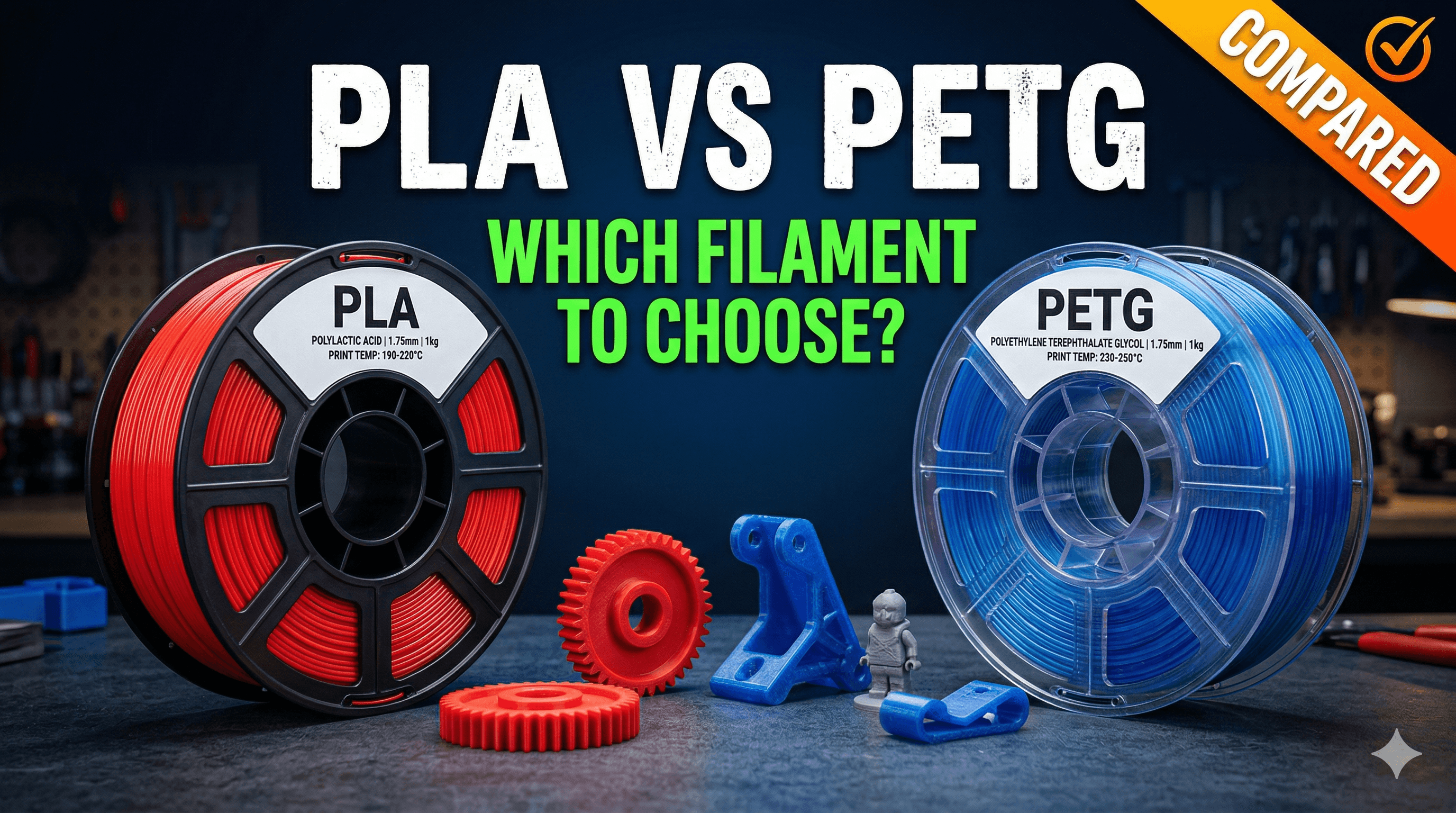
PLA vs PETG: Which Filament Should YOU Use and When? (From a Fellow Indian Maker!)
Alright, my fellow 3D printing enthusiasts, let's be real for a moment. Youâve just gotten your first 3D printer â maybe it's a trusty Ender 3 V2, or perhaps you've splurged on something fancier like a Prusa Mini. You're unboxing that beautiful machine, eyes gleaming with possibilities, and then it hits you: the filament. The very soul of your print, the stuff that transforms digital dreams into tangible reality. And *bam*, you're immediately slapped with choices. PLA? PETG? ABS? TPU? It feels like trying to choose your favourite biryani without tasting any of them first, right? Honestly, for most beginners and even many seasoned makers, the big showdown often comes down to two heavyweights: PLA and PETG. I've been running my small 3D printing business, Artophia Collections, right here from my little workshop in Bangalore for a few years now, and trust me, Iâve probably printed miles of both these materials. I've had my fair share of triumphs, and oh, the headaches! The stringing, the warping, the failed prints â itâs all part of the journey. But through all that, Iâve learned a thing or two about when to reach for which spool. So, let's grab a chai, settle in, and talk about the nitty-gritty of PLA and PETG, not like some dry technical manual, but like we're just two friends geeking out over our printers.The OG: PLA (Polylactic Acid) â Your Best Friend, Mostly
You know, PLA is where almost everyone starts, and for good reason. Itâs like the gentle giant of the filament world. When I first got my hands on a 3D printer, an old Anet A8 (yeah, I started with a fire hazard, don't judge!), PLA was all I knew. And honestly, it was amazing.Why I (and everyone else) Love PLA:
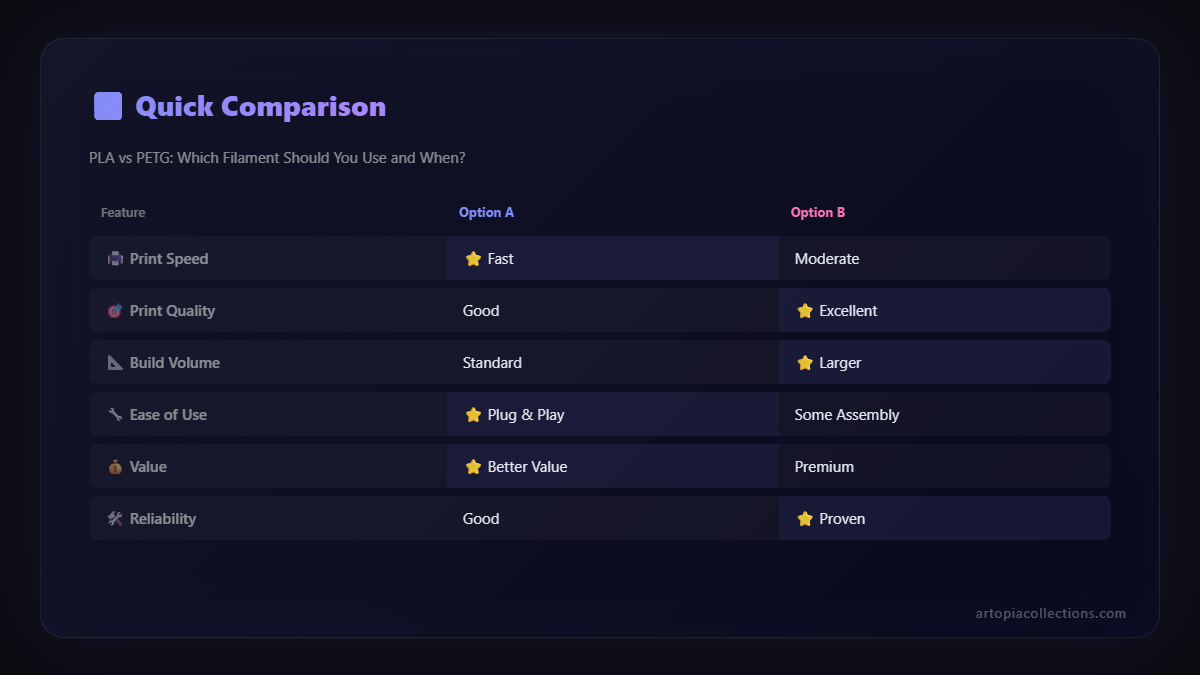
- Beginner-Friendly: This is the big one. PLA is incredibly easy to print. It doesn't need a heated bed (though I always recommend one for better adhesion, especially for larger prints), it prints at relatively low temperatures (around 190-220°C for the nozzle), and it's very forgiving. You can usually just load it up, pick some standard settings in your slicer like Cura or PrusaSlicer, and hit print.
- Minimal Fumes: Unlike some other filaments (looking at you, ABS!), PLA barely produces any fumes. It actually has a slightly sweet, almost popcorn-like smell when printing, which is pretty unobtrusive. You don't need a fancy enclosure or industrial-grade ventilation for it, making it great for home use.
- Looks Fantastic: PLA prints come out looking sharp. It has a nice, sometimes slightly glossy, finish, and it's available in an incredible array of colours. Seriously, walk into any filament store or browse Amazon.in, and you'll see every shade under the sun â matte, silk, glitter, glow-in-the-dark. It's fantastic for aesthetic pieces, models, and anything that needs to look good on a shelf.
- Dimensionally Stable: It doesn't warp much compared to other materials, which means your prints stay true to their design dimensions. This is super helpful when you're printing parts that need to fit together precisely.
But, PLA Isn't Perfect (No Spoilers, But It's a Bit Brittle):
Here's where the gentle giant shows its Achilles' heel. PLA has some significant limitations, especially if you're looking to print functional parts.
- Brittle: This is probably its biggest drawback. If you drop a PLA print, especially one with thin walls or intricate details, there's a good chance it'll snap or chip. It's not great for parts that need to withstand impact or significant stress. I've had so many customer prototypes, especially for mechanical fittings, just snap during testing. It's frustrating, but it's the nature of the beast.
- Low Heat Resistance: This is another major one. PLA starts to soften at relatively low temperatures, around 50-60°C. Leave a PLA print in a hot car during an Indian summer, or near a window where the sun bakes it, and you'll come back to a sad, droopy mess. I learned this the hard way with a phone stand I made for my dashboard â it looked like a Salvador Dalà painting after just one sunny afternoon!
- UV Degradation: Over time, especially outdoors, PLA can become brittle and degrade when exposed to UV light. So, not ideal for outdoor garden ornaments or window frames.
Cost: A good quality 1kg spool of PLA, say from eSun, Overture, or even local Indian brands, typically costs anywhere from â¹1200 to â¹1800. Sometimes you can find deals for â¹1000-â¹1100, especially during sales. Check out some options for PLA filament on Amazon.in here.
The Workhorse: PETG (Polyethylene Terephthalate Glycol) â The Bridge Material
Okay, so you've outgrown PLA's limitations. You want something stronger, more durable, something that won't melt into a puddle in your car. That's when you look at PETG. For me, shifting to PETG felt like a significant upgrade, almost like graduating from a scooter to a proper motorcycle. It took some getting used to, but the rewards are definitely worth it.Why I Rely on PETG for Tougher Prints:
- Strength and Durability: This is where PETG shines. It's significantly stronger than PLA, less brittle, and has a good amount of flexibility, making it much more impact-resistant. Think of it as PLA's tougher, more resilient cousin. For any functional parts, jigs, fixtures, or anything that's going to be handled a lot, PETG is my go-to.
- Higher Temperature Resistance: PETG can comfortably handle temperatures up to 80°C or even 90°C before it starts to soften. This means those car parts, outdoor enclosures, or even kitchen gadgets won't deform under heat. This was a game-changer for my business, allowing me to offer more robust products.
- Chemical Resistance: It's also more resistant to a range of chemicals than PLA, which can be important for certain applications.
- Food Safe (Mostly): The raw material (PET) is food-safe (think water bottles!), but 3D printed objects aren't truly food-safe due to the porous nature of layer lines where bacteria can grow. Still, for short-term contact, it's a better bet than PLA.
The PETG Personality Quirks (A Bit More Demanding):
Now, PETG isn't without its challenges. If PLA is a polite guest, PETG is that friend who needs a bit more attention but is a blast once you get to know them.
- Tricky to Print (Initially): PETG requires higher printing temperatures (220-250°C for the nozzle, 70-80°C for the bed), and it can be notoriously stringy and prone to oozing. Seriously, my early PETG prints looked like they'd been attacked by a spider! You'll need to dial in your retraction settings (distance and speed) meticulously. In my experience, a retraction distance of 5-7mm at 40-50mm/s on a Bowden setup, and 0.8-1.5mm at 30-40mm/s on a direct drive, usually works well. But every printer, every filament brand, is a little different, so be ready to experiment.
- Adhesion Issues (Sometimes Too Good!): While PETG adheres well to itself (leading to strong layer adhesion), it can sometimes stick *too* well to the build plate. I've heard horror stories, and experienced a few myself, of prints fusing to glass beds and ripping chunks out! A layer of glue stick or hairspray is almost mandatory to create a release layer.
- Hydroscopic: PETG absorbs moisture from the air, which can lead to popping, poor layer adhesion, and weakened prints. You absolutely need to keep it dry, either in a filament dryer box or airtight containers with desiccant. I've got a whole setup for drying my PETG spools, especially during the monsoon season here.
- Abrasive: Over long print times, PETG can be a bit more abrasive than PLA, potentially wearing down brass nozzles faster. If you're printing a lot of it, consider investing in a hardened steel nozzle.
Cost: PETG usually runs slightly higher than PLA. You're looking at around â¹1400 to â¹2200 for a 1kg spool from brands like eSun, Overture, or even some good local ones. Sometimes you can find value packs. You can explore some PETG filament options on Amazon.in here.
So, When Should You Use Which? My Practical Guide
This is the million-dollar question, isn't it? After all the technical talk, it boils down to application. Hereâs how I decide for my personal projects and for Artophia Collections customer orders:Reach for PLA When:
- You're a beginner: Seriously, learn the ropes with PLA. Master your printer, understand your slicer, and get consistent prints.
- Printing decorative items: Vases, intricate models, figurines, cosplay props, ornaments. Anything that sits on a shelf and looks pretty.
- Prototyping: If you're just testing a design, checking dimensions, or doing a quick fit test, PLA is cheap, fast, and easy. No point wasting expensive filament on a design you might change.
- Toys (for gentle play): Small toys, board game pieces, things that won't be thrown around much.
- Anything that won't experience heat or stress: Indoor display items, desk organizers, pencil holders.

Basically, if it's not going to be structural, exposed to direct sunlight or high temperatures, or constantly handled roughly, PLA is probably your best bet. It's affordable, prints beautifully, and is just a joy to work with. For example, many of our aesthetic home decor items and artistic prints you see on our Artophia Collections products page are often made from high-quality PLA because the visual appeal is key, and they won't be under heavy stress.
Go for PETG When:
- You need functional parts: Brackets, mounts, enclosures, gears, mechanical parts â anything that needs to hold up under some strain.
- Outdoor applications: Garden stakes, camera enclosures, bird feeders, anything exposed to the elements (though for extreme longevity, something like ASA might be better, but that's a whole other beast).
- Parts for hot environments: Components for your 3D printer itself (fan shrouds, motor mounts), car interior parts (just be mindful of extreme temperatures, PETG isn't invincible), kitchen items (again, short-term contact only).
- You need impact resistance: Cases for electronics, drone parts, anything that might get bumped or dropped.
- Flexibility is desired: While not as flexible as TPU, PETG has a decent amount of give compared to the rigidity of PLA, making it more forgiving.
In short, if your print needs to *do* something, *hold* something, or *endure* something, PETG is the superior choice. It's a bit more effort to print, but the strength and durability payoff is immense.


