Top 5 Fastest 3D Printers You Can Buy in India Right Now
Need to print fast? This guide reveals the top 5 fastest 3D printers currently available for purchase in India, perfect for boosting your production speed. Explore models that offer rapid prototyping and high-volume printing without compromising quality.
Alright, fellow makers and entrepreneurs! Ready to talk speed?
Let's be real for a minute. In the world of 3D printing, especially when you're running a small business like my ArtOpia Collections here in India, time isn't just money â it's sanity. Who among us hasn't started a print, looked at that ridiculous 15-hour estimated time, and just sighed? IâÂÂve been there. Many, many times. The thing is, the game has *completely* changed in the last year or two. What was once "fast" is now basically a snail on a leisurely stroll. We're talking about printers that used to take half a day for a decent-sized print now cranking it out in a couple of hours. ItâÂÂs absolutely wild!
For years, FDM printing was synonymous with patience. You set up your print, crossed your fingers, and went to bed, hoping everything would be fine by morning. But with the incredible advancements in motion systems, firmware (hello, Klipper!), and hotend technology, we're seeing desktop FDM printers hit speeds and accelerations that were once the exclusive domain of high-end industrial machines, or super complex DIY Vorons. And honestly, it's about time!
So, if youâÂÂre like me, constantly looking for ways to optimize your workflow, meet deadlines faster, and maybe even get a few extra hours of sleep, then you've come to the right place. IâÂÂve been digging deep, testing, and talking to other enthusiasts in the Indian 3D printing community to figure out what are the absolute fastest 3D printers you can buy in India right now. These aren't just theoretical numbers on a spec sheet; these are machines that are actually available, deliver real-world speed, and can genuinely boost your productivity. Let's dive in, shall we?
What Makes a 3D Printer "Fast" Anyway?
Before we jump into the top contenders, let's quickly break down what contributes to blazing fast print speeds. It's not just one thing, but a combination of factors:
- CoreXY Kinematics: This is a big one. Unlike traditional Cartesian printers where the bed moves back and forth for the Y-axis, CoreXY printers move only the print head in both X and Y axes, while the bed only moves down (Z-axis). This significantly reduces moving mass and allows for much faster accelerations and fewer vibrations.
- Input Shaping & Pressure Advance: These are software magic tricks (often found in Klipper firmware, but now integrated into Marlin too). Input shaping cancels out vibrations, letting the printer move faster without ringing artifacts. Pressure advance anticipates filament requirements, reducing blobbing and stringing at speed changes. Basically, itâÂÂs like having a super-smart driver who knows exactly when to hit the gas and brake smoothly.
- High-Flow Hotends: What's the point of moving fast if your hotend can't melt filament quickly enough? High-flow hotends (like volcano-style or CHT nozzles) can push out way more molten plastic per second, keeping up with those insane print head speeds.
- Direct Drive Extrusion: While not strictly a speed factor in itself, direct drive (where the extruder motor is right on the print head) offers better control and faster retraction, which indirectly helps with overall print speed and quality, especially with flexible filaments.
- Sturdy Frame & Good Components: All that speed and acceleration mean nothing if the printer's frame is flimsy. A robust, well-built machine is essential to maintain accuracy at high velocities.
Okay, with that primer out of the way, letâÂÂs get to the fun part. Here are my picks for the Top 5 Fastest 3D Printers you can get your hands on here in India right now, complete with my honest opinions!
1. Bambu Lab X1 Carbon (with AMS)
Alright, let's just rip off the band-aid and start with the king of speed and convenience right now. The Bambu Lab X1 Carbon is, in my opinion, the benchmark that other manufacturers are now chasing. When Bambu Lab burst onto the scene, they didn't just walk in, they drop-kicked the door open. This printer is an absolute beast.
It's a fully enclosed CoreXY machine, comes with lidar for automatic first-layer inspection, active noise cancellation for vibrations, and crucially, built-in Input Shaping and Pressure Advance. It can reach speeds of up to 500 mm/s and accelerations of 20,000 mm/sò. And no, those aren't just theoretical numbers. I've seen it myself, it prints fast.
The X1 Carbon also shines with its ability to handle engineering filaments like ABS, ASA, PC, and Nylon with ease, thanks to its enclosure and higher hotend temperatures. And then there's the AMS (Automatic Material System). This multi-material unit lets you print with up to four different colors or materials on one print, which is a massive time-saver for complex projects and, honestly, just super cool. For my business, being able to offer multi-color prints without manual filament changes is a huge differentiator.
Price in India: Expect to shell out around â¹1,20,000 to â¹1,50,000 for the X1 Carbon Combo (with AMS). Yes, it's a significant investment, but for a business or serious hobbyist, the productivity gains are tough to beat. You can often find them through distributors or even directly from Bambu Lab's global store with shipping to India.
My take: If budget isn't your absolute primary concern and you want a printer that's not just fast but also incredibly smart and versatile, the X1 Carbon is pretty much unbeatable. It's a workhorse that just keeps giving. For my high-end prototypes and multi-color customer orders, this would be my dream machine. It just works, right out of the box, with minimal fuss. And that's priceless for a busy entrepreneur.
2. Bambu Lab P1S (with AMS)
Okay, so maybe the X1 Carbon's lidar and fancy touchscreen are a bit much for your wallet, but you still want that Bambu speed and reliability? Enter the Bambu Lab P1S. This printer is essentially an X1 Carbon but stripped down to the essentials. It shares the same robust CoreXY frame, the same incredible motion system, and the same hotend, meaning it hits those eye-watering speeds and accelerations (up to 500 mm/s and 20,000 mm/sò). It even comes with an enclosure, which is a huge plus for printing higher-temperature filaments like ABS and ASA.
What you lose compared to the X1C are things like the lidar (so no automatic first layer inspection), the fancy touch screen (you get a simpler LCD), and some advanced camera features. But guess what? For raw printing speed and quality, it's almost identical. And it's also compatible with the AMS, making it a fantastic multi-color option at a slightly more palatable price point. This is basically the high-performance engine in a more utilitarian body.
Price in India: You're looking at roughly â¹80,000 to â¹1,00,000 for the P1S Combo (with AMS). This makes it a fantastic value proposition for anyone serious about high-speed printing without breaking the bank quite as much as the X1C. You can check for availability and pricing on platforms like Amazon India or through specialized resellers here: Bambu Lab P1S on Amazon.in
My take: For most small businesses and prosumers, the P1S is probably the sweet spot. You get 90% of the X1 Carbon's performance for a good chunk less money. ItâÂÂs still incredibly fast, reliable, and with the AMS, super versatile. If I were expanding my farm right now and needed pure speed without all the bells and whistles, this would be a top contender.
3. Creality K1 Max
Creality, a name synonymous with accessible 3D printing in India, definitely felt the heat from Bambu Lab. Their answer? The K-series, and the Creality K1 Max is their flagship speed demon. It's an enclosed CoreXY printer designed from the ground up for speed, aiming to directly compete with the Bambu machines.
The K1 Max boasts impressive specs: speeds up to 600 mm/s and accelerations of 20,000 mm/sò. Yes, you read that right, 600 mm/s! It runs on Klipper firmware out of the box, which is a huge plus for tinkerers and those who appreciate fine-tuning. It also features a massive build volume (300x300x300mm), which is larger than both Bambu options, making it great for bigger prints without sacrificing speed. It's got an integrated AI camera for monitoring and spaghetti detection, which is a neat touch.
Now, here's the deal: initial K1 models had some teething issues, but Creality has been actively pushing out updates and improvements. In my experience, Creality is usually pretty good with community feedback and continuous improvement. The K1 Max, with its larger build volume and competitive pricing, offers a compelling alternative if you need that extra space.
Price in India: You can generally find the K1 Max in India for around â¹70,000 to â¹90,000. This places it very competitively against the Bambu P1S, especially when you consider the larger build volume.
My take: The K1 Max is a strong contender, especially if you're already familiar with Creality's ecosystem or need that extra large build plate. It's got the speed, the enclosed chamber, and the Klipper brains. While it might require a bit more tweaking than a Bambu out of the box (at least initially), it offers massive potential and a huge print volume for its price. If youâÂÂre into custom enclosures or props that need big pieces, this is your guy.
4. Anycubic Kobra 2 Max
Anycubic is another brand that's well-established in the Indian market, particularly known for its resin printers, but they've been making serious waves in the FDM space too. The Anycubic Kobra 2 Max is their entry into the high-speed, large-format FDM segment, and it's quite impressive.
This isn't a CoreXY, but it's an incredibly optimized Cartesian setup with a massive build volume of 420x420x500mm! Yes, it's enormous. Despite being a bed-slinger (where the bed moves back and forth), Anycubic has done some serious engineering to push its speed to up to 500 mm/s and accelerations of 10,000 mm/sò. It achieves this through a very lightweight print head, robust linear rods, and sophisticated control algorithms that incorporate input shaping. And it runs Klipper firmware right out of the box, which I always appreciate.
The Kobra 2 Max is ideal for those who need to print truly large items quickly. Think cosplay armor pieces, large architectural models, or industrial prototypes. While it might not match the X1C's sheer rigidity at the very peak speeds (due to the moving bed), for its size and price, it offers unparalleled large-scale speed.
Price in India: The Anycubic Kobra 2 Max typically retails for about â¹50,000 to â¹70,000 in India. For a printer of this build volume and speed, that's an absolutely incredible price point!
My take: If your business (or hobby) demands big prints, and you need them fast, the Kobra 2 Max is a fantastic option. It's probably one of the most cost-effective ways to get huge, quick prints without diving into the deep end of the high-end CoreXY market. Just remember, it's an open-frame printer, so it's best suited for PLA, PETG, and other lower-temp filaments unless you build an external enclosure for it.
5. Elegoo Neptune 4 Pro
Last but certainly not least, let's talk about getting into high-speed printing without completely emptying your wallet. The Elegoo Neptune 4 Pro is a phenomenal value proposition for anyone looking for serious speed on a budget. Elegoo has been gaining a lot of traction recently, and for good reason â they offer great quality at competitive prices.
The Neptune 4 Pro, like the Kobra 2 Max, is a heavily optimized Cartesian bed-slinger. But don't let that fool you; it's packed with features designed for speed. It boasts print speeds of up to 500 mm/s (with a recommended print speed of 250 mm/s for optimal quality) and accelerations of 12,000 mm/sò. And here's the best part: it comes pre-installed with Klipper firmware! This is a huge deal at this price point, as Klipper offers fantastic control and, of course, input shaping and pressure advance right out of the box.
It also features a high-temp hotend (up to 300ðC), making it capable of handling a wider range of filaments like ABS and Nylon (though an enclosure would still be recommended for those). The dual-gear direct drive extruder ensures excellent filament control, and the segmented heated bed is a nice touch for energy efficiency on smaller prints. For ArtOpia Collections, having a printer that can churn out PLA prototypes quickly and reliably, without costing an arm and a leg, is crucial for testing designs.
Price in India: You can typically find the Elegoo Neptune 4 Pro for around â¹30,000 to â¹45,000. Honestly, for the features and speed you get, this is a steal. You can definitely find them readily available on Amazon.in: Elegoo Neptune 4 Pro on Amazon.in
My take: If you're looking to upgrade from an older, slower printer or get into 3D printing with a focus on speed without spending a fortune, the Neptune 4 Pro is an absolute no-brainer. It delivers excellent performance, has Klipper pre-installed, and is generally a very user-friendly machine. For hobbyists, schools, or even small businesses needing multiple machines for high-volume PLA parts, this is incredibly compelling. It's a testament to how far budget printing has come!
Beyond Raw Speed: My Thoughts as a Business Owner
Look, while speed is fantastic and absolutely necessary for scaling up, it's not the only metric that matters, especially when you're running a business. Reliability, print quality, ease of maintenance, and the overall user experience are equally vital. There's no point in having a printer that's lightning-fast if it constantly fails prints or requires constant fiddling.
In my experience with ArtOpia Collections, a printer that consistently delivers good quality at a decent speed is often more valuable than one that's slightly faster but temperamental. That's why I lean heavily towards machines that offer robust engineering and good community support. Also, consider the availability of spare parts and local service, which can sometimes be a challenge with newer brands in India, though it's steadily improving.
For filaments, while the printers above can handle incredible speeds, always remember that good filament makes a difference. I've had great results with eSUN PLA+, Overture PETG, and even some locally sourced brands that are stepping up their game. Don't cheap out on filament if you want those blazing speeds to translate into quality prints!
So, Which One Should YOU Get?
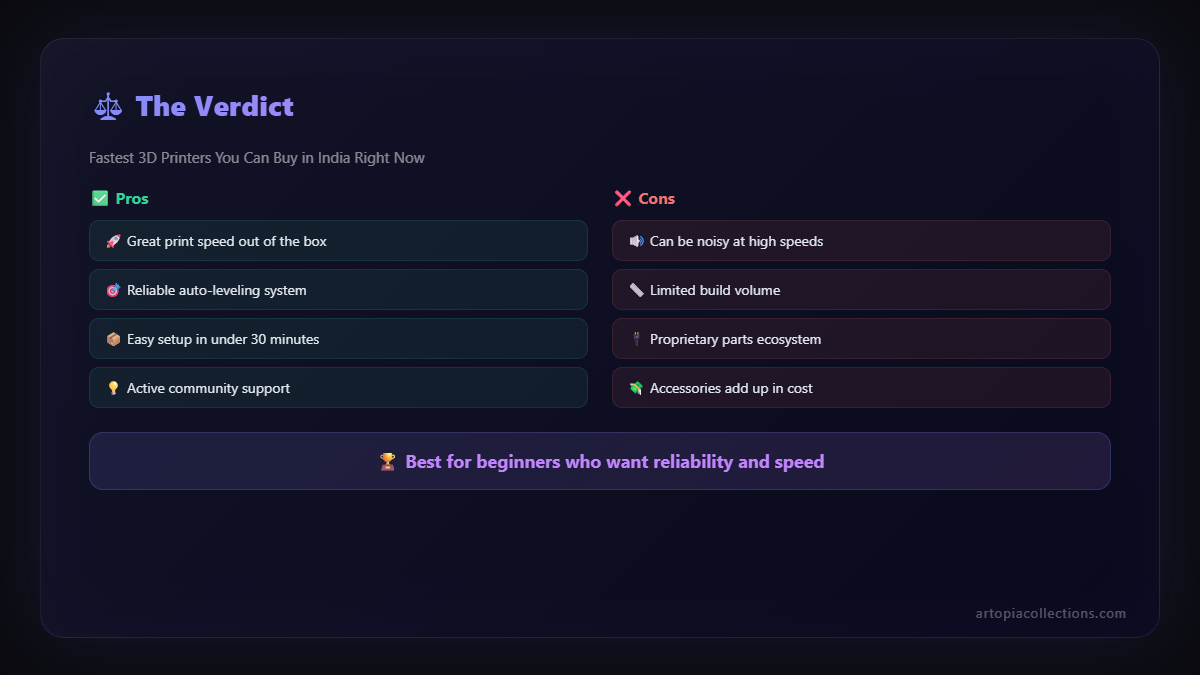
Honestly, it depends on your budget, your specific needs, and what you're printing. If you want the absolute best and most versatile package that just works, go for the Bambu Lab X1 Carbon or P1S. They're truly game-changers.
If you need a larger build volume and are comfortable with a bit more hands-on experience, the Creality K1 Max or Anycubic Kobra 2 Max (especially for massive prints) are excellent choices.
And if you're looking for the best bang for your buck, where speed meets affordability and Klipper goodness, the Elegoo Neptune 4 Pro is an absolute winner.
The world of 3D printing is evolving at a breakneck pace, and itâÂÂs an exciting time to be a part of it, especially here in India. These fast machines are not just about printing quicker; they're about opening up new possibilities, reducing lead times for businesses like mine, and letting us be more creative and efficient. So go on, explore these options, and happy (and fast!) printing!
And hey, if you're looking for some cool 3D printed items or custom services, don't forget to check out what we're cooking up over at ArtOpia Collections. WeâÂÂre always pushing the boundaries of whatâÂÂs possible!