Artillery Sidewinder X4 Plus India Review: Price, Setup, and Print Quality
Dive into our comprehensive review of the Artillery Sidewinder X4 Plus, exploring its features, performance, and value for money. This guide also provides a step-by-step setup process specifically for users in India, addressing local considerations.
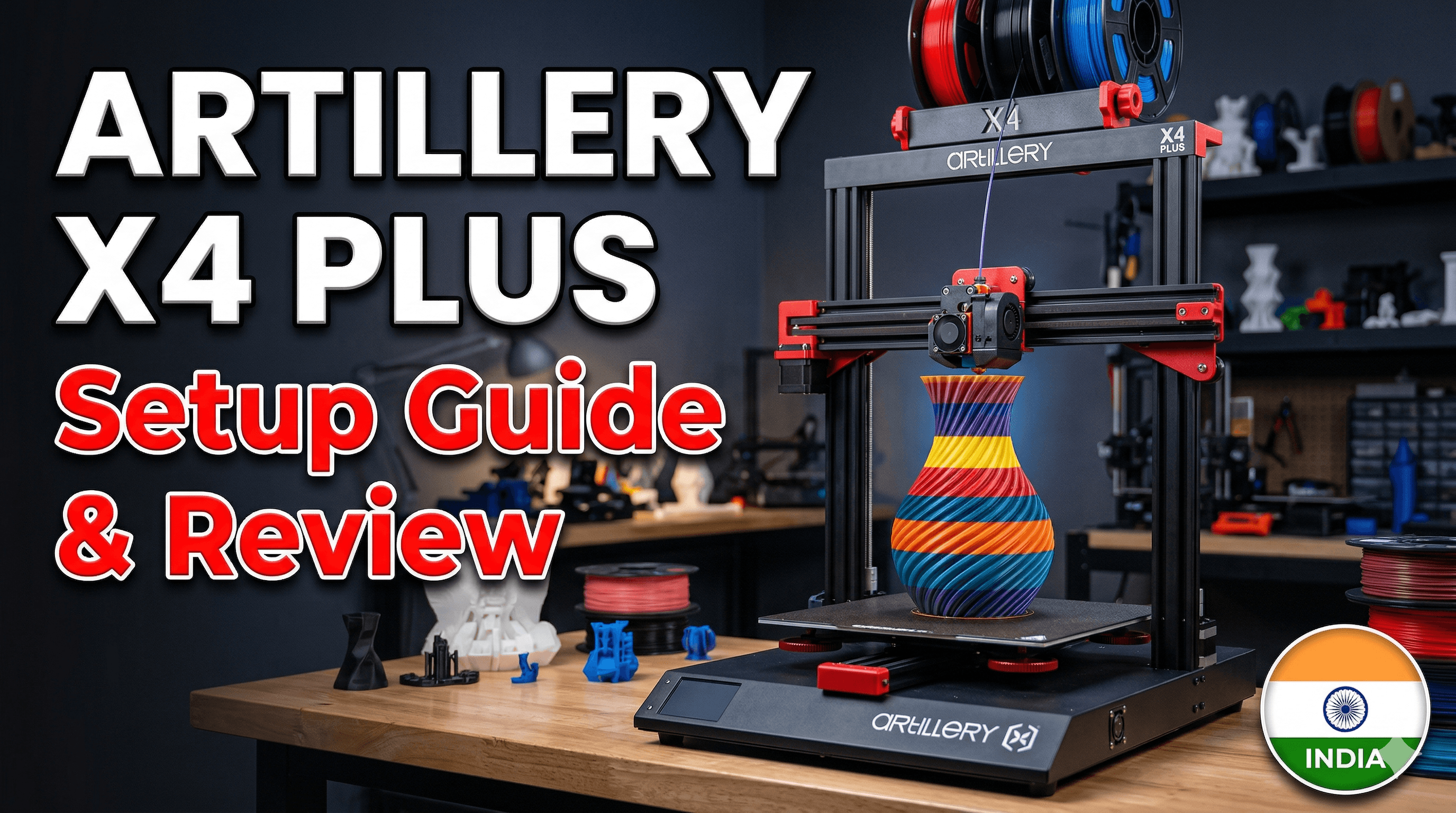
The Artillery Sidewinder X4 Plus: A Beast for Indian Makers? My Honest Review & Setup Guide!
You know that feeling, right? That little jolt of excitement when a new, shiny box lands on your doorstep, promising untold creative possibilities. Well, when the Artillery Sidewinder X4 Plus showed up at my workshop here in Chennai, let me tell you, it wasn't just a jolt – it was a full-blown thunderstorm of anticipation! I’ve been running Artopia Collections for a few years now, churning out custom prints for customers across India, and I'm always on the lookout for a machine that can keep up with demand, especially one that understands our unique Indian market quirks. So, when Artillery announced this monster, I knew I had to get my hands on it.
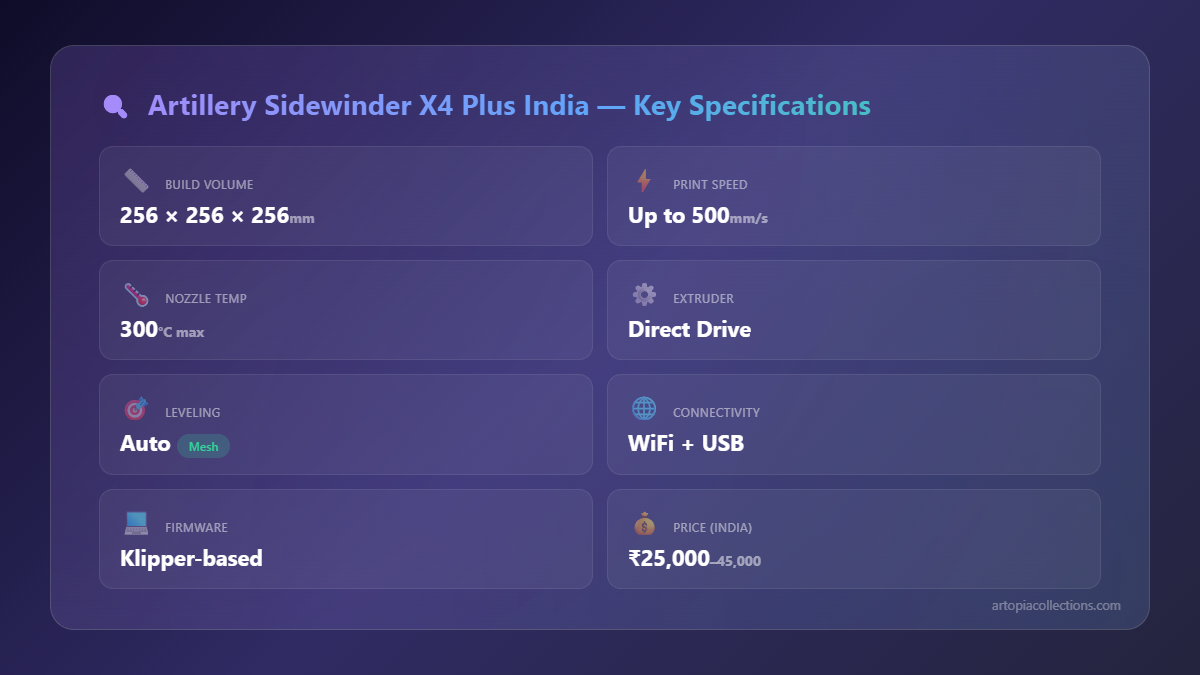
Artillery, if you remember, made a name for itself with the Sidewinder X1, a machine that, despite its quirks, was a groundbreaking large-format direct-drive printer for its time. And honestly, I still have a soft spot for it. But the 3D printing world moves fast, faster than a Chennai express train sometimes, and the X4 Plus is Artillery’s clear answer to the current high-speed Klipper craze. It’s got a massive build volume – 300x300x400mm, mind you – and promises speeds that would make your old Ender-3 blush. But the real question, the one that keeps us Indian makers up at night, is: how does it really perform on our often-unpredictable power grids, with our unique import challenges, and for our budget-conscious businesses?
Unboxing & First Impressions: Built Like a Tank, But What About the Finesse?
So, the box arrived, surprisingly well-packaged. Artillery usually does a decent job with packaging, and this was no exception. Inside, everything was snug, protected by custom-fit foam. Assembly, to my pleasant surprise, was pretty straightforward. It’s mostly pre-assembled, much like its predecessors. You basically attach the gantry to the base, connect a few wires, and you're good to go. It took me about 20-25 minutes, max. I mean, compare that to some DIY kits I've wrestled with in the past – this was a breeze!
The first thing you notice about the X4 Plus is its sheer size. It’s substantial, feels robust. The all-metal frame is a welcome sight. No flimsy plastic parts here! And it looks… professional, you know? Like it means business. But, and this is a crucial "but" for Indian buyers, always, always, always check your voltage switch before plugging it in. Artillery printers typically have a 115V/230V selector switch. Make sure it's set to 230V for India. Plugging it into a 230V socket with the switch on 115V is a quick way to fry your new, expensive toy. Trust me, I’ve seen it happen to eager new users. It's a small detail, but critical!
Diving Deep into the Features: Why This Printer Matters (or Doesn't)
Okay, let’s talk features because this is where the X4 Plus tries to stand out from the ever-growing crowd of Klipperized printers. And there are some serious upgrades here:
1. Klipper Firmware Pre-installed & Input Shaping
This is the big one. Gone are the days of Marlin on Artillery machines. The X4 Plus comes with Klipper right out of the box, running on an ARM 64-bit SOC. What does this mean for you? SPEED, baby! They claim 600mm/s print speed and 10000mm/s² acceleration. While I haven't quite pushed it to those theoretical limits for regular production (quality is key for my business, after all), I can tell you it's significantly faster than any Marlin-based printer I’ve owned. And the best part? Klipper means input shaping and pressure advance are built-in. This dramatically reduces ringing and ghosting, even at higher speeds. For me, that translates to smoother walls and cleaner details, which means less post-processing time and happier clients.
2. Linear Rails on X and Y Axes
This is a fantastic upgrade. Linear rails provide much smoother, more precise movement compared to traditional V-slot wheels. They’re also more durable and require less maintenance. I've had issues with V-slot wheels wearing out over time, especially with heavy usage. The linear rails on the X4 Plus feel solid and contribute to the printer's overall accuracy. It's a premium feature that I really appreciate, especially for printing intricate parts for my custom design collection.
3. Direct Drive Extruder & Auto-Leveling
Artillery has always been good with direct drive, and the X4 Plus continues that tradition. It’s a dual-gear direct drive extruder, which means excellent control over filament, especially for flexible materials like TPU. And speaking of convenience, it has a 49-point auto-leveling system. No more fiddling endlessly with bed screws. You run the auto-level, and it just works. It’s not a fancy inductive probe, more like a CR-Touch style sensor, but it gets the job done reliably, which is what matters when you’re trying to meet deadlines.
4. Large Build Volume: 300x300x400mm
This is where the "Plus" really shines. A 300x300mm build plate is fantastic for larger prints. I often get orders for cosplay props, architectural models, or bigger functional parts, and having that extra vertical space (400mm!) is a game-changer. No more slicing large models into multiple pieces and gluing them together. It saves so much time and effort, not to mention makes for stronger final products.
5. Other Noteworthy Bits
- PEI Spring Steel Plate: Comes standard. Prints stick well when hot, pop right off when cool. It’s the gold standard these days, and I wouldn’t buy a printer without it.
- WiFi Connectivity & Web UI: Being Klipper-based, it has a web interface (Fluidd or Mainsail, depending on the specific build) allowing you to control and monitor your prints from your phone or computer. Super convenient for managing prints remotely, especially when I’m multitasking around the workshop.
- LED Light Bar: A small but useful addition. Good for monitoring prints in dimly lit spaces.
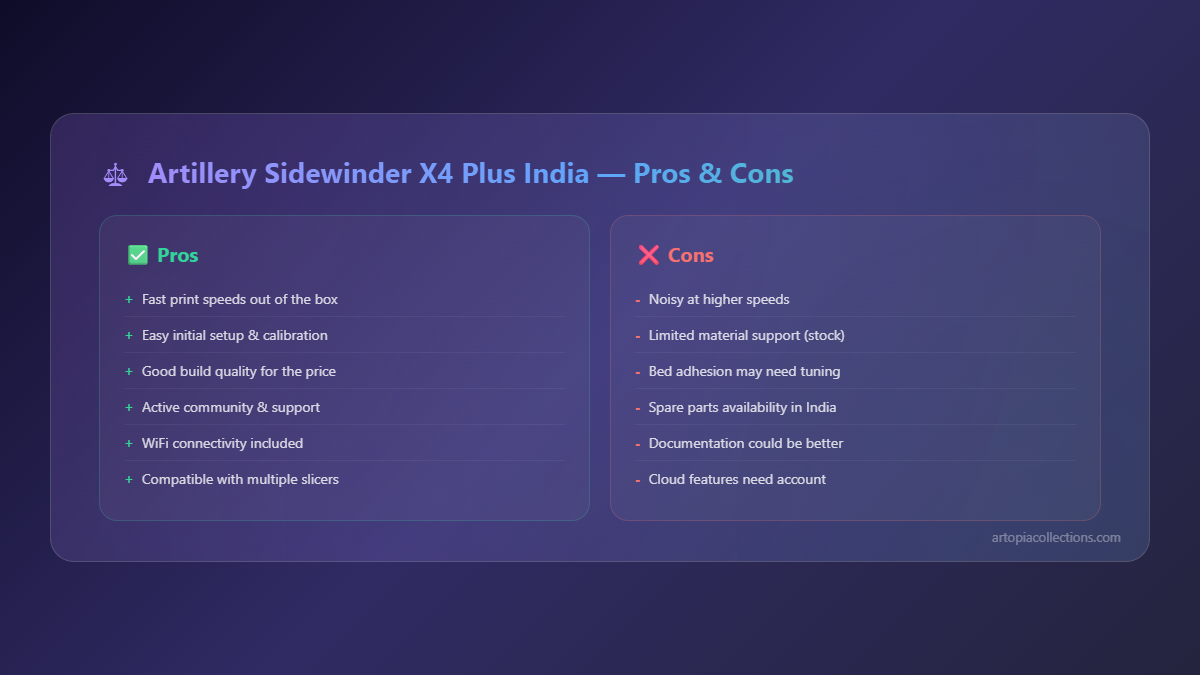
- Noise: Now, this is interesting. At normal speeds, it’s not too bad. But when you crank it up to those advertised Klipper speeds, it can get a bit loud. The cooling fans really kick in. It's not a deal-breaker for a workshop, but if you’re planning on having this in a bedroom, just be aware.
Printing Performance: The Real Test in Indian Conditions
Alright, so how does it actually print? I’ve run through kilos of eSun PLA+, some Overture PETG, and even a roll of local Indian TPU through this machine. And honestly, I’m impressed. The prints are consistently good. Calibration out of the box was decent, but a quick flow calibration and a PID tune definitely improved things further. The surface finish, especially with input shaping, is remarkably smooth. I've printed some intricate prototypes for clients, and the detail retention is excellent.
One thing I’ve noticed is the sheer speed doesn't compromise quality as much as I expected. I'm usually printing at around 250-300mm/s for production work, not the advertised 600, but even at those speeds, it’s spitting out parts way faster than my old machines, with comparable or even better quality. This is a huge win for my business, as time is money, especially when you're fulfilling custom orders.
I also tested some exotic filaments. Carbon fiber PLA printed beautifully, and flexible filaments were a breeze thanks to that direct drive. No clogging, no under-extrusion issues. It handles various materials with aplomb.
The Elephant in the Room: Price, Availability, and Indian Realities
Here’s the deal for Indian buyers. Artillery has historically been a bit tricky to get your hands on directly here. Often, they come via third-party importers or online stores, sometimes with a significant markup, and sometimes without proper warranty support. As of my review, the Artillery Sidewinder X4 Plus isn't as widely available on major Indian e-commerce platforms as, say, an Ender-3 variant. You might find it on specialized 3D printing stores or need to pre-order.
Price-wise, for a machine with these features and build volume, I'd expect it to retail somewhere between ₹60,000 to ₹68,000, depending on the importer, taxes, and current exchange rates. This puts it squarely in the mid-to-high range for hobbyists but a solid investment for a small business like mine, especially considering its speed and capacity. It’s certainly more expensive than an Ender-3 V3 SE (which is around ₹20-25k) but offers a much larger build volume, linear rails, and Klipper out of the box, putting it closer to a Creality K1 Max in terms of features, which costs upwards of ₹80k-₹90k.
After-sales support is another critical factor in India. With any imported printer, local service centres can be scarce. You're often reliant on online communities and perhaps the importer for basic troubleshooting. So, having some technical know-how or being willing to learn is a must. Thankfully, Artillery printers are generally robust, and parts are often standard, so finding replacements for common wear-and-tear items (like nozzles, thermistors, etc.) isn't usually an issue.
Power fluctuations are a real concern here. While the printer has a decent power supply, I always recommend using a good UPS (Uninterruptible Power Supply) or at least a high-quality surge protector for any expensive electronics, especially something that runs for hours like a 3D printer. It's cheap insurance, trust me. You can find decent surge protectors for ₹500-₹1000 online. A good tool kit is also essential for any minor maintenance.
Who is the Artillery Sidewinder X4 Plus For?
So, after all this, who do I think this printer is perfect for?
- Small Businesses: If you're running a custom print service like Artopia, the large build volume and high speed are massive advantages. It means faster turnaround times and the ability to take on bigger projects.
- Advanced Hobbyists: If you've outgrown your smaller, slower printer and want to dive into Klipper without the hassle of setting it up yourself, this is a great step up. The larger volume is a huge plus for enthusiasts who love printing helmets, intricate dioramas, or functional prototypes.
- Anyone needing a reliable workhorse: It feels like a solid, dependable machine. If you need a printer that can just keep going, day in and day out, this is a strong contender.
It's probably not for absolute beginners unless you're ready for a slightly steeper learning curve than, say, an Ender-3. While Klipper is powerful, it does have more settings to tinker with if you want to optimize beyond the default profiles.
My Verdict: Artillery's Comeback Kid is a Contender
The Artillery Sidewinder X4 Plus is a very impressive machine. It takes the best of Artillery's legacy (large build volume, direct drive) and blends it with modern demands (Klipper, linear rails, speed). For makers in India, it offers a compelling package, especially if you can get it at a reasonable price with some level of local support.
Would I recommend it? Absolutely, with the caveats about availability and support mentioned. If you're looking to upgrade to a large-format, high-speed Klipper machine and value robust build quality, the X4 Plus should definitely be on your radar. It's a fantastic workhorse that's proving its worth in my busy workshop, churning out quality prints reliably and quickly. And honestly, in this fast-paced world of 3D printing, having a machine that just works, and works well, is priceless. Happy printing, folks!
India Pricing: The Artillery Sidewinder X4 Plus is available on Amazon India and AliExpress for approximately INR 28,000-35,000. It offers a 300x300x400mm build volume, making it one of the most affordable large-format printers in India. Spare parts are available through Artillery's India support channel.