Bambu Lab A1 Combo vs Anycubic Kobra 3 Combo: Multi-Color Printer Showdown for India
Looking for a multi-color 3D printer in India? We pit the Bambu Lab A1 Combo against the Anycubic Kobra 3 Combo to help you decide which is best for your vibrant prints.
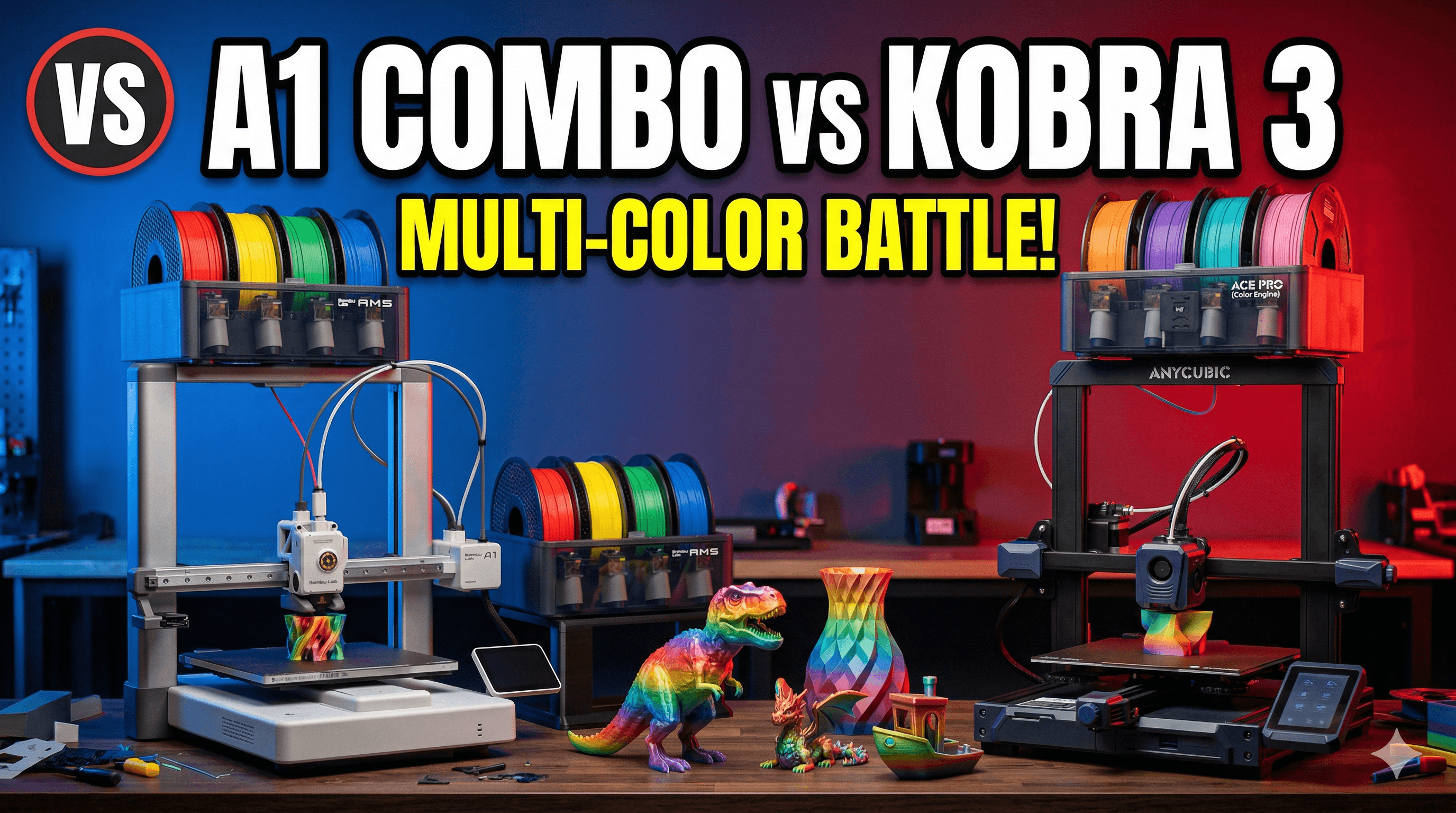
Chalo, dosto! You know that feeling, right? That itch, that burning desire to make something truly *pop* with color, not just a single-tone wonder. For us folks running small 3D printing businesses here in India, getting into multi-color isn't just a fancy trick; it's a game-changer. It means more intricate designs, custom branding for clients, and just, well, cooler stuff to show off. But picking the *right* machine? Uff, it's a whole battlefield out there, especially when you've got giants like Bambu Lab and Anycubic throwing their hats into the ring with their latest multi-color offerings. And believe me, when I say I've been obsessing over these two, I mean it – late nights, YouTube rabbit holes, the whole nine yards. So, today, let's talk about the big showdown: the Bambu Lab A1 Combo versus the Anycubic Kobra 3 Combo. Which one's going to earn its stripes in our Indian workshops?
The Contenders: A Quick Intro, My Way
First off, let's get acquainted. We've got the Bambu Lab A1 Combo. Now, Bambu Lab, they basically swooped in and changed the game for many of us, right? Their X1C and P1S were revolutionary. The A1 is their latest, more "budget-friendly" (term used very loosely here in India, let's be real) offering, but it brings that signature Bambu speed and polish, combined with their AMS Lite system for multi-color goodness. It's a bed-slinger, yeah, but a really souped-up one.
Then, on the other side of the ring, we have the Anycubic Kobra 3 Combo. Anycubic, bless their hearts, they've been a staple for years. Many of us probably started with an Ender 3 or an Anycubic Mega X, didn't we? They're known for good value, and the Kobra series has been pretty solid. This Kobra 3, it's their answer to the multi-color craze, packing their own "ACE" (Anycubic Color Engine) system. It's also a bed-slinger, a direct competitor to the A1 in many ways.
Honestly, the thing is, both these printers are trying to give us, the makers, more bang for our buck in the multi-color space. But where do they actually stand when the rubber meets the road? Or, you know, when the filament meets the hotend?
Multi-Color Magic: AMS Lite vs. ACE – This is Where the Battle Really Heats Up
Okay, let's get to the core of it: the multi-color systems. Because without these, they're just, well, regular printers, aren't they?
Bambu Lab's AMS Lite: The Refined Performer
The AMS Lite on the A1 Combo is Bambu's more accessible version of their original AMS. It's an open-frame unit, usually sitting next to the printer, holding up to four spools. And let me tell you, it's pretty slick. Loading filament is generally smooth; you just pop the spool in, feed the filament a bit, and the system takes over. It feels robust, engineered properly, and that's something I appreciate as a business owner – reliability. Less fiddling means more printing.
Pros:
- Reliability: In my experience, it just works. Filament changes are quick and relatively error-free.
- Spool Compatibility: It's quite forgiving with different spool sizes and types, which is great because here in India, we get all sorts of spool dimensions from different brands.
- Integration: It's deeply integrated into Bambu Studio, making multi-color slicing a breeze.
- Waste Management: While there's always purge, Bambu's system is pretty efficient.
Cons:
- External Unit: It sits outside, takes up desk space. Not a huge deal, but something to consider in a cramped workshop.
- Noise: Sometimes the filament feeding can be a bit noisy, but it’s not a deal-breaker.
Anycubic's ACE System: The New Kid on the Block
The ACE system on the Kobra 3 is Anycubic's answer to Bambu. It also supports four colors, and it’s a modular unit that clips onto the printer frame itself, which is a neat design choice, saving a bit of desk space compared to the AMS Lite. It’s a newer design, so there’s a bit less real-world data out there, but early reviews seem promising.
Pros:
- Integrated Design: Sits on the printer, saving precious desk space. That’s a big plus for many of us.
- Cost: Generally, the Kobra 3 Combo is expected to be more affordable than the A1 Combo.
- Potential: Anycubic has a track record of improving their products with firmware updates, so there's potential for this system to get even better.
Cons:
- Newness: Being new, it might have some teething issues that only long-term use will reveal.
- Filament Path: Some users have expressed concerns about the filament path potentially being more convoluted, which *could* lead to snags or breaks with certain filaments. I haven't personally seen enough of this to confirm, but it's something to watch.
Print Quality & Speed: Can Anycubic Catch Up to Bambu's Mojo?
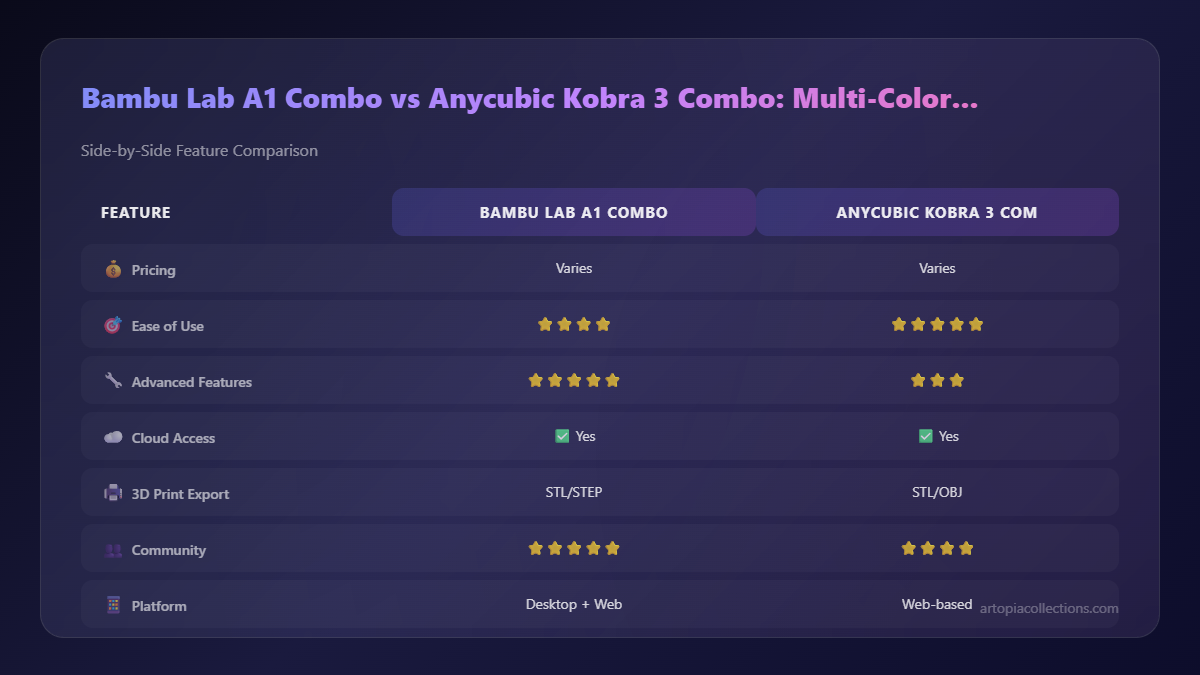
This is where Bambu Lab really shines, let's be honest. The A1, despite being a bed-slinger, benefits from Bambu's core acceleration algorithms and vibration compensation. Prints come out fast, and they look incredibly clean, even at those higher speeds. Layer lines are tight, overhangs are managed well, and bridging is usually top-notch. For my business, where time is literally money and quality is everything, this consistent performance is a godsend. I use a lot of PLA and PETG from brands like eSun or Overture – easily available here on Amazon.in – and the A1 just handles them beautifully. Even our local Indian brands like 3DPrintz or Real Filament perform admirably.
The Anycubic Kobra 3, on the other hand, is also pushing for speed. Anycubic has been upping their game significantly. The Kobra series is generally quite capable. It'll be fast, yes, and likely produce very good quality prints. But matching Bambu's out-of-the-box consistency and speed-to-quality ratio is a tall order. From what I’ve seen, it's definitely competitive, but Bambu often feels a step ahead in terms of sheer refinement and how little tuning you need to do to get great results. My experience tells me that for a demanding small business, less calibration means less downtime, and that's critical.
So, for sheer print quality *and* speed combined, especially with multi-color projects that involve a lot of retracts and purges, the A1 still holds a slight edge in my book. It just feels more...dialed in.
User Experience & Software: The Ecosystem Matters
Okay, let's talk about the whole package. It's not just the hardware, right? The software, the interface, the ease of getting a print from your CAD program to your print bed – that’s a huge part of it.
Bambu Lab's Ecosystem: Polished and Integrated
Bambu Studio is genuinely fantastic. It's based on PrusaSlicer, so it's powerful, but Bambu has added so much functionality and seamless integration with their printers. Setting up multi-color prints, sending them to the printer over Wi-Fi, monitoring progress with the camera (if you add one, it's an optional upgrade for A1) – it's all buttery smooth. The touchscreen interface on the A1 is intuitive. You unbox it, run the setup wizard, and you’re basically printing in like 15-20 minutes. That kind of out-of-box experience is gold for someone who just wants to get work done.
Anycubic's Ecosystem: Solid, But Maybe Not as Seamless
Anycubic usually ships with a modified version of PrusaSlicer or Cura profiles. They work, they're perfectly functional, but they don't have the same level of deep integration that Bambu Studio offers with Bambu printers. The Kobra 3 will likely have a decent touchscreen, and it'll connect via Wi-Fi, but that cohesive, almost Apple-like experience of Bambu is hard to beat. For many users, this isn't a deal-breaker. But if you’re looking for that "just works" simplicity, Bambu has really set a high bar.
The Price Tag: Indian Market Realities
Alright, let's talk brass tacks: money. Because for us in India, every Rupee counts, especially when you’re building a business. Prices fluctuate, import duties, GST, seller margins – it all adds up. But here’s my estimate:
- Bambu Lab A1 Combo: You're probably looking at anywhere from ₹58,000 to ₹70,000, depending on the retailer, current offers, and shipping. It’s a significant investment, but you’re paying for the brand's reputation for speed and reliability.
- Anycubic Kobra 3 Combo: My strong suspicion is that Anycubic will price this more aggressively to compete. I'd expect it to be in the range of ₹45,000 to ₹58,000. This could make it a very attractive option for someone looking to get into multi-color without breaking the bank quite as much.
So, there's definitely a noticeable price difference. If you're on a tighter budget, the Kobra 3 Combo is probably going to look very tempting. But you have to weigh that saving against what you potentially gain in terms of ease of use, speed, and consistency with the Bambu.
Maintenance, Support, and Indian Availability
This is a crucial point for us, isn't it? Getting parts, finding reliable local support – it can be a headache. Both Bambu Lab and Anycubic have official (or semi-official) presences and resellers in India. However, my personal experience has been that getting parts for Bambu Lab printers can sometimes involve a bit of a wait, as they often ship from overseas or through specific distributors. Anycubic, being a more established brand with a wider range of products, *might* have slightly better local parts availability, especially for common components. That's a big "might," though, as the Kobra 3 is new.
For my business, I honestly try to stock up on common consumables and wear-and-tear parts for my printers anyway. Nozzle replacements, PTFE tubes, spare hotends – these are things you just need to have on hand. It helps minimize downtime. And if you're looking for quality filaments or specific tools, check out my products at Artopia Collections – we try to keep a good stock of what printers really need!
My Verdict: Which One for Your Indian Workshop?
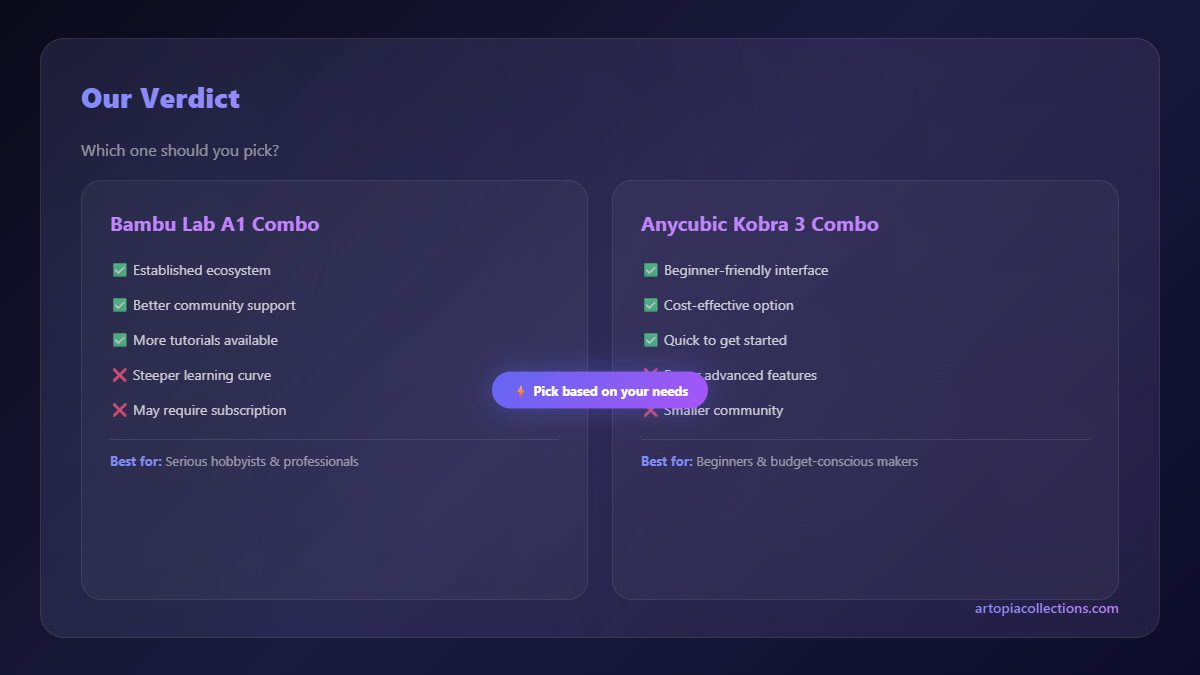
Okay, so, here's the deal. If I had to pick *one* right now, for my small 3D printing business, where reliability, speed, and consistent quality are paramount, and where I can't afford to waste hours debugging or tinkering, I'd lean towards the Bambu Lab A1 Combo.
Why? Because it offers an incredibly refined user experience, fantastic print speed and quality right out of the box, and a multi-color system (the AMS Lite) that just feels incredibly reliable. The slightly higher price is an investment that, in my view, pays for itself in saved time and fewer headaches. When you're running orders, meeting deadlines, you need a machine that's a workhorse, not a project.
But, and it's a big but, if your budget is strictly constrained, and you’re willing to maybe do a little more tinkering, a little more calibration, or you're just a bit more patient with a newer system, the Anycubic Kobra 3 Combo could be an excellent alternative. Anycubic has a great track record of improving their machines, and the integrated ACE system is a smart design. It will undoubtedly offer fantastic value for its price point. It just might not be quite as "plug-and-play" as the Bambu, especially initially.
Ultimately, both these machines are pushing the boundaries of accessible multi-color printing. The best choice for *you* will depend on your specific needs, your budget, and how much you value an utterly seamless experience versus a potentially more affordable entry point.
What do you guys think? Have you pre-ordered either of these? Or are you sticking to your single-color workhorses for now? Let me know in the comments below! I'd love to hear your thoughts.


