Bambu Lab vs Creality: The 3D Printer War Explained
Bambu Lab and Creality are at the forefront of the 3D printer market, each offering unique advantages. Discover their models, compare performance, and find out which brand truly dominates the modern 3D printer war.
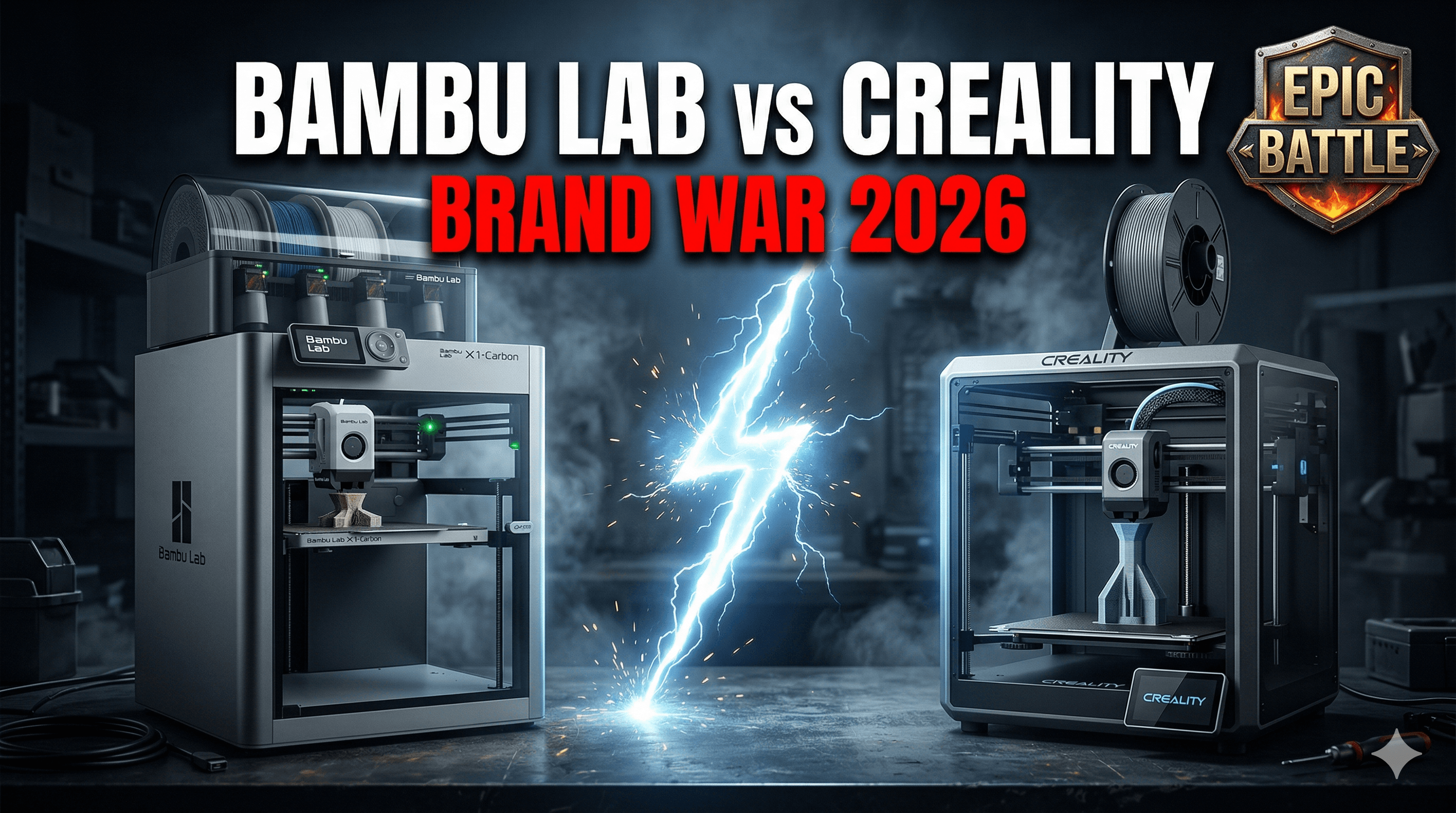
Bambu Lab vs Creality: The 3D Printer War Explained (and Why It Matters for My Business!)
Phew! What a whirlwind the last couple of years have been in the 3D printing world, right? I mean, seriously, if you told me five years ago we’d be printing at these speeds and with this level of reliability straight out of the box, I probably would’ve laughed you out of my workshop. But here we are, smack dab in the middle of what I like to call the "3D Printer War," and the main contenders? None other than the established giant, Creality, and the absolute game-changer, Bambu Lab.
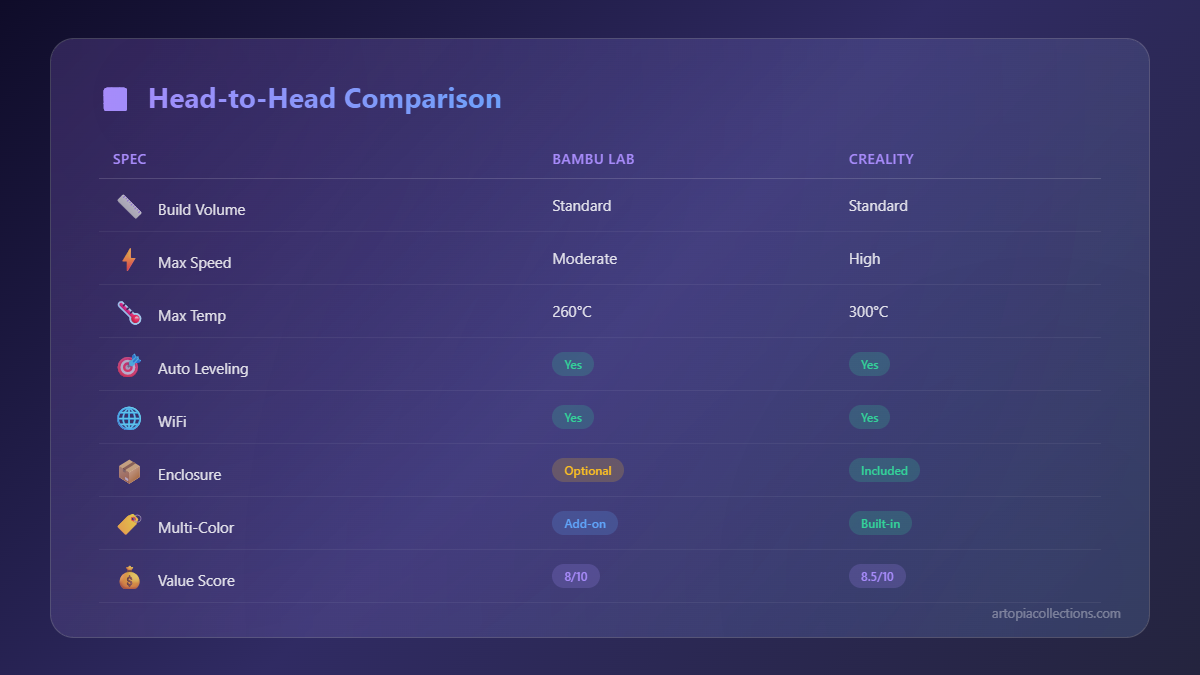
For us folks running small businesses like my Artoopia Collections here in India, this isn't just some tech-head debate; this is about our livelihoods, our ability to deliver quality products quickly, and ultimately, our bottom line. Every rupee, every print hour, every failed print – it all adds up. So, let's dive into this epic showdown and I'll tell you what I've seen, what I've struggled with, and where I think each brand shines.
The Rise of the Dragon: Bambu Lab's Impact
Remember when Bambu Lab first burst onto the scene with the X1 Carbon? It felt like someone had just dropped a Ferrari into a parking lot full of Ambassadors and Marutis. Suddenly, everyone was talking about incredible speeds, multi-colour printing with the AMS, and prints that just... worked. Out of the box. No endless tinkering, no PID tuning nightmares, no trying to figure out why your first layer was suddenly acting like a mischievous poltergeist. And honestly, for a business owner, that "just works" part is like a dream come true.
Before Bambu, if you wanted speed and reliability, you were often looking at industrial machines costing lakhs upon lakhs of rupees. But then the X1C came along, offering that kind of performance for around ₹1,30,000 to ₹1,40,000 (depending on import duties and where you manage to snag one). That's a significant investment for a small Indian business, no doubt, but the promised uptime and speed meant a potentially massive increase in output.
Then came the P1P, then the P1S, and more recently, the A1 series – smaller, more affordable options that still carry that Bambu DNA of speed and polish. The P1S, for instance, often retails for about ₹90,000-₹1,00,000, making it a serious contender for folks wanting that Bambu magic without shelling out for the X1C's LIDAR and touchscreen. And the A1 Mini? Man, that little beast at around ₹40,000-₹50,000 with AMS Lite is just incredible value for a home user or even small batch production of smaller items. It's basically a plug-and-play experience, which is revolutionary in a hobby often associated with endless troubleshooting.
The thing is, Bambu Lab didn't just give us faster printers; they gave us an integrated ecosystem. Their Bambu Studio slicer, their handy mobile app, the way the AMS just *works* to swap filaments – it's all so seamless. It makes managing multiple prints, even when I'm out getting supplies or meeting clients, incredibly easy. I can monitor progress, pause prints, and even start new ones from my phone. That's a huge time-saver and lets me focus on the creative side of Artoopia Collections rather than constantly babysitting machines.
But, and here's the kicker, it's not all sunshine and rainbows. That integrated ecosystem also means it's pretty closed-source. You're locked into their way of doing things, and while their way is usually good, it does limit customisation and repairs down the line. If something breaks, especially a proprietary part, you're at the mercy of their customer service and parts availability. And in India, for a company that doesn't have a massive local presence yet, that can be a real headache. I’ve heard stories (and had a few minor scares myself) about longer wait times for support or parts when something goes wrong. That downtime can be brutal for a business.
The Old Guard Fights Back: Creality's Evolution
Now, let's talk about Creality. For years, they were the undisputed kings of the budget 3D printer market. The Ender 3, the CR-10 – these machines were the gateway drugs for countless enthusiasts and small businesses like mine. My very first "serious" printer for Artomia was a modified Ender 3, and I spent countless hours learning, tweaking, and upgrading it. It taught me so much, honestly, about how these machines work, what makes a good print, and how to fix almost anything that went wrong.
But then Bambu Lab came and punched them right in the face with speed and reliability. Creality couldn't just sit there. They had to respond, and their response came in the form of the K1 and K1 Max. These printers were a clear attempt to mimic Bambu's speed and enclosed design. The K1, you can often find for around ₹50,000-₹60,000 here in India, which is significantly less than a Bambu P1S, let alone an X1C. On paper, it promised similar speeds, enclosed printing for higher-temp filaments, and auto-levelling. It was a direct shot.
And then there's the Ender 3 V3 series, particularly the KE and SE models. These are absolute workhorses for the price. The Ender 3 V3 KE, for example, often comes in at about ₹30,000-₹35,000, offering decent speed, Klipper firmware out of the box (which is huge for customisation), and auto-levelling. The Ender 3 V3 SE is even more budget-friendly, often around ₹20,000-₹25,000. These aren't trying to be Bambu killers, but they're making high-speed, easy-to-use printing accessible to a much wider audience, which is incredibly important for growing the hobby and getting new talent into the industry.
The strength of Creality has always been its massive community. If you have a problem with an Ender 3, chances are a thousand people have had the same problem, and a hundred videos on YouTube will show you exactly how to fix it. Parts are abundant and cheap. You can modify these machines into oblivion, swapping out hotends, adding custom firmware, building enclosures – you name it. For someone who loves to tinker and learn, it's a paradise. And for a business starting on a shoestring budget, being able to fix things yourself with readily available parts is a massive cost-saver.
However, the biggest Achilles' heel for Creality, in my experience, has always been quality control. When they work, they work great, especially after some initial setup and maybe a few tweaks. But sometimes, you get a lemon. And when you're running a business, you can't afford that inconsistency. The K1, especially in its early days, had a lot of issues that needed user fixes, which kind of defeats the "just works" promise they were trying to make. I've personally spent more hours than I care to admit troubleshooting brand new Creality machines for clients or for my own farm. It's frustrating when you just want to get prints out the door.
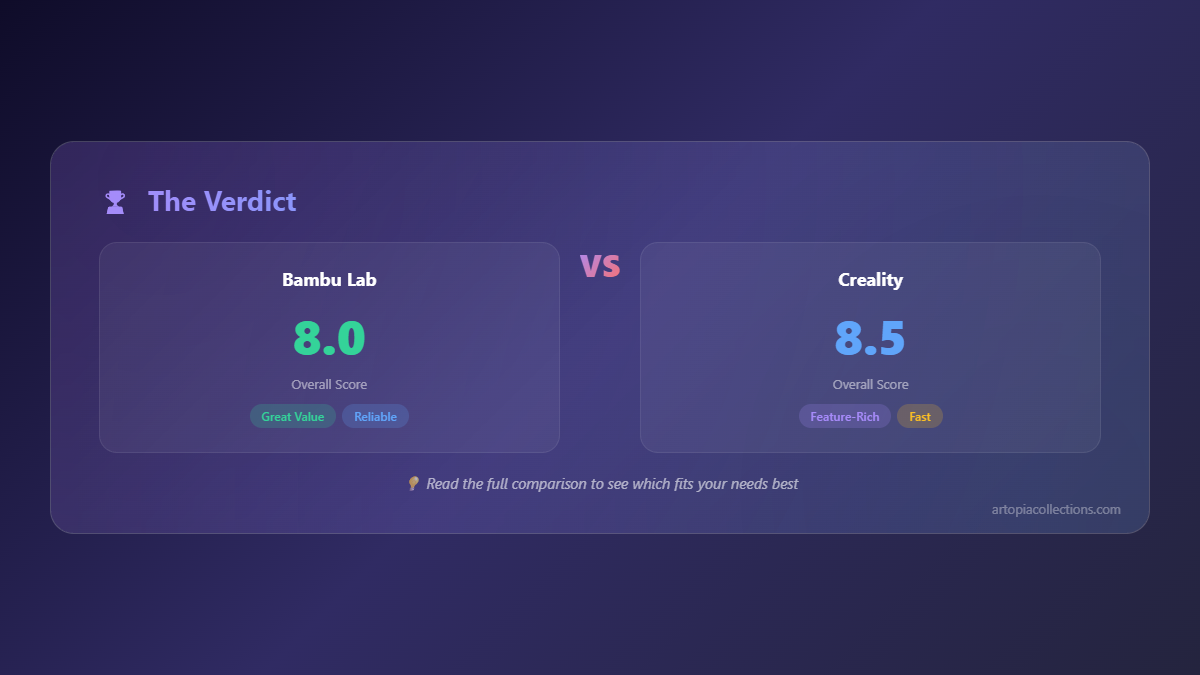
The Showdown: My Business Perspective
Okay, so who wins this "war"? Well, it's not that simple, is it? It really depends on what you need, your budget, and your tolerance for tinkering.
Speed and Quality: This is where Bambu Lab absolutely shines. Their X1C and P1S are just blisteringly fast, and the print quality, straight out of the box, is consistently superb. For detailed figurines, intricate architectural models, or anything that needs a really smooth surface finish, Bambu is often my go-to. Creality's K1 series is trying to catch up, and they've made huge strides, but they still have a bit of a way to go to match Bambu's overall refinement and consistency. But for general utility prints or prototypes, a well-tuned K1 or even a V3 KE can definitely hold its own at good speeds.
Ease of Use & Reliability: No contest here, in my opinion. Bambu Lab wins hands down. From unboxing to printing your first perfect print, it's an incredibly smooth experience. They've genuinely focused on the user experience. For a business, this means less time troubleshooting, more time printing, and fewer failed prints eating into filament costs and deadlines. Reliability, especially over long print jobs, is paramount, and Bambu has generally delivered on that promise.
Ecosystem and Software: Again, Bambu's integrated approach with Bambu Studio and the AMS is fantastic. It's clean, intuitive, and powerful. Creality's software, Creality Print, has improved, but it's still not as polished or as feature-rich as Bambu Studio (though you can always use PrusaSlicer or Cura with Creality machines, which is a bonus). The Creality ecosystem is more fragmented, relying on a broader range of open-source tools and third-party solutions.
Price Point: Creality still holds the crown for affordability, especially at the entry-level and mid-range. For someone looking to get into 3D printing without breaking the bank, or for a business that needs to scale up a print farm with many machines, Creality offers significantly lower cost-per-machine. You can buy two or even three Ender 3 V3 KEs for the price of one Bambu P1S. If you're okay with a bit of setup and maintenance, that cost difference is a huge factor. For buying filament, for example, I always look for bulk deals on sites like Amazon.in, and having more machines to load with different colours or materials makes sense. You can find some great PLA options here: PLA Filament on Amazon.in.
Customer Service & Parts (India Specific): This is a mixed bag for both, honestly. Neither has a super robust, direct-to-consumer support network in India like you'd find for, say, a mobile phone brand. For Bambu, you're usually dealing with international support, which can mean delays. For Creality, you often rely on the reseller you bought from, or the huge online community. Parts for Creality are generally easier to find and cheaper to replace here in India, often from local distributors or even via Amazon. For specific Bambu parts, you might be looking at international shipping, which means more cost and more waiting. This is a critical point for my business; downtime is lost revenue, so knowing I can fix something quickly is a big deal. For tools or even a spare printer as backup, having access to things like an Ender 3 V3 KE is invaluable – check out options here: Creality Ender 3 V3 KE on Amazon.in.
Modding & Open Source: If you're a tinkerer, a modifier, someone who loves to dive deep and truly understand (and customise) every aspect of your machine, then Creality is still your playground. The open-source nature of much of their hardware and firmware means endless possibilities. Bambu Lab, while fantastic out of the box, is much more of a black box. You use it as intended, and that's usually great, but don't expect to easily swap out major components or flash custom firmware without significant effort (and potentially voiding warranties).
So, Who's It For?
Look, it really boils down to this:
- If you want a premium, high-performance machine that "just works" with minimal fuss, offers exceptional speed and quality, and you're willing to pay for it and accept a more closed ecosystem – Bambu Lab is probably for you. It's perfect for professional designers, small businesses with strict deadlines, or hobbyists who just want to print, not tinker.
- If you're on a tighter budget, love to learn and tinker, want the flexibility of an open-source ecosystem, or need to build a large print farm on a budget – Creality is still an incredibly strong contender. Their newer machines like the K1 and Ender 3 V3 series show they're serious about competing on performance too, but they still carry that DIY spirit.
My Verdict for Artoopia Collections
For my business, Artoopia Collections, I've actually found myself using a mix. For critical, high-detail client projects where speed and absolute reliability are non-negotiable, my Bambu machines are running almost non-stop. The ability to print a multi-colour piece with the AMS, for example, without having to manually swap filaments, saves me hours and opens up possibilities for more complex designs.
But I also still rely heavily on my (upgraded and well-loved) Creality machines, especially for bulk orders of simpler parts, or for experimentation where I might be trying out new filaments or pushing boundaries and don't mind a potential print failure. They're also fantastic for when I need to quickly prototype something without tying up my more expensive Bambu machines. And frankly, having that deeper understanding of 3D printing from my early days with Creality has made me a much better operator and problem-solver, no matter what machine I'm using.
This "war" is a fantastic thing for us consumers and businesses. It's pushing both companies to innovate faster, improve their products, and offer incredible value. The competition is fierce, and honestly, the real winners are all of us who get to enjoy better, faster, and more affordable 3D printing technology. The future of 3D printing in India is looking incredibly bright, and I, for one, can't wait to see what these giants come up with next!


