Bambu Lab X1 Carbon vs P1S Is the Upgrade Worth Rs 40000 More
Deciding between the Bambu Lab X1 Carbon and P1S? This post breaks down the key differences and features to help you determine if paying Rs 40,000 more for the X1 Carbon is a worthwhile upgrade for your 3D printing setup.
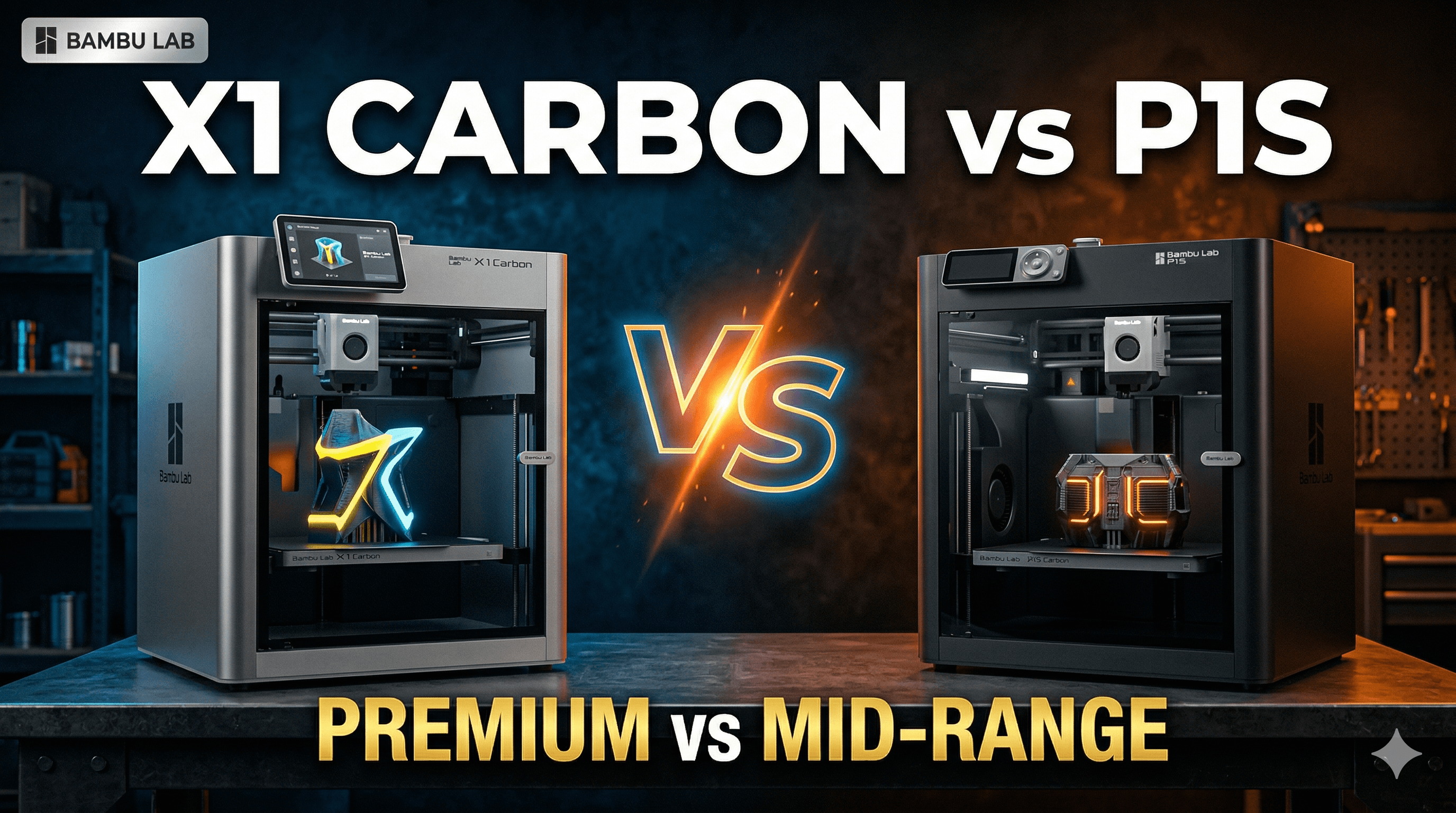
Bambu Lab X1 Carbon vs P1S: Is the Upgrade Worth ₹40,000 More for Your Indian 3D Printing Business?
Alright, so you're probably here because you've seen the hype, maybe you've even got a trusty Ender 3 chugging along, but your eyes, like mine, have been caught by the shiny, speedy machines from Bambu Lab. And now you're at that crossroads, aren't you? The classic dilemma: Bambu Lab X1 Carbon, the undisputed king, or the P1S, the incredible value proposition. But here's the kicker for us in India – that price difference isn't just a few dollars, it's a solid ₹40,000 (or even more, depending on where and when you buy it, and whether you're adding the AMS unit). That's not pocket change, especially when you're running a small business like my Artopia Collections here, where every rupee counts towards raw materials, salaries, or maybe just a better cup of chai. So, let's talk about it, friend, because I've been down this rabbit hole myself, and I've got some thoughts.
First off, can we just take a moment to appreciate what Bambu Lab has done? Seriously, they came in like a storm, completely shook up the 3D printing world. Before them, a reliable, fast, multi-material printer was either a pipe dream or something that cost you an arm and a leg and required a PhD in printer calibration. Now? Now you can get one that basically just works. It's been a game-changer for businesses like mine, allowing us to deliver complex, high-quality prints to clients without losing our minds to constant tweaking and failed prints. But that doesn't mean the choice between their two top models is easy.
The Contenders: X1 Carbon vs. P1S – What's the Real Difference?
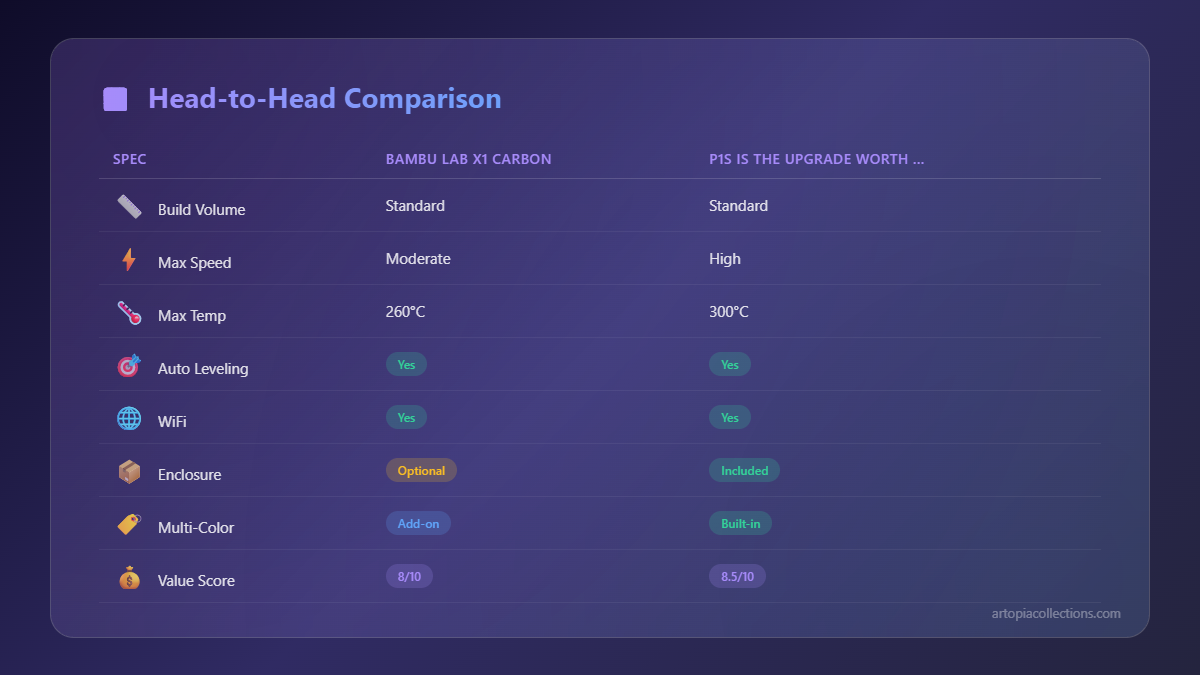
Okay, let's break it down. We're talking about two phenomenal machines here. Both of them offer incredible speed, fantastic print quality right out of the box, and that coveted Bambu Lab ecosystem, especially if you add the AMS (Automatic Material System), which honestly, if you're serious about your business, is practically non-negotiable. Printing multi-color or multi-material parts effortlessly is just... chefs kiss. But, and this is a big "but," they're not identical, and that ₹40,000 difference isn't just for bragging rights.
The Bambu Lab P1S: The Smart Investment for Many
Let's start with the P1S. This printer, especially with the AMS, will set you back somewhere in the range of ₹80,000 to ₹90,000 in India. And for that money, you're getting an absolute beast. It's basically an enclosed P1P, which means it can handle a wider range of filaments like ABS and ASA much better than an open-frame printer. Speed? Oh yeah, it's fast. Reliability? Top-notch. And for many hobbyists or even small businesses just starting out, this is probably the sweet spot.
What you get with the P1S:
- Blazing fast print speeds, thanks to its core XY motion system.
- An enclosed build chamber, making it suitable for ABS, ASA, and other temperature-sensitive filaments.
- Compatibility with the AMS for multi-material printing (a must-have, in my opinion).
- Excellent print quality right out of the box.
- A robust and reliable workhorse.
It's an amazing machine, truly. If your primary goal is to print PLA, PETG, and occasional ABS/ASA for clients, and you're not constantly pushing the boundaries with exotic engineering filaments, the P1S is an absolute winner. It's a massive upgrade from anything in its price range from a few years ago. And it's what a lot of folks here are opting for, and rightfully so.
The Bambu Lab X1 Carbon: The Professional Powerhouse
Now, let's talk about the X1 Carbon. This is Bambu Lab's flagship, and with the AMS, you're looking at an investment typically around ₹1,20,000 to ₹1,30,000. That's a significant jump from the P1S. So, what exactly do you get for that extra ₹40,000?
This is where the distinction becomes crucial for a business like mine. The X1 Carbon comes packed with features that, on the surface, might seem like luxuries, but in a professional setting, they translate directly into saved time, saved material, and ultimately, saved money.
The key upgrades that justify the X1C's price tag:
- LiDAR Sensor: This, my friends, is HUGE. The X1C uses a micrometer-resolution LiDAR system to automatically calibrate flow rates for each specific filament you use. It also performs an initial layer inspection. What does this mean in real terms? Less failed first layers, incredibly consistent flow, and less need for you to manually tweak settings. For a business producing hundreds of parts, this reliability is priceless. It means I can confidently start a print and walk away, knowing it's going to lay down that perfect first layer.
- Hardened Steel Nozzle & Extruder Gears: This isn't just a fancy add-on; it's fundamental for specific types of work. If you're planning to print with abrasive filaments like carbon fiber reinforced PA (Nylon-CF), glass fiber reinforced PETG (PETG-GF), or even glow-in-the-dark PLA (which is surprisingly abrasive!), the X1C comes ready to roll. The P1S doesn't, and you'd have to buy and install these parts separately, which adds cost and time. For custom parts that need to be strong and lightweight using these engineering materials, the X1C is built for it.
- AI Failure Detection (Spaghetti Detection): I cannot stress enough how much this saves me. The X1C has a more advanced camera and AI that can detect if your print has gone rogue – if it's delaminated, or worse, turned into a giant ball of spaghetti. When it detects a failure, it pauses the print, notifying you. This means you don't come back to find a ruined print, a clogged nozzle, and wasted hours of print time and hundreds of rupees worth of filament. For businesses running prints overnight or when you're busy with other tasks, this feature is a lifesaver.
- Higher Resolution Camera & Touch Screen: While the P1S has a camera, the X1C's is higher resolution and allows for better monitoring and even crisp timelapses. The touch screen on the X1C is also a significant quality-of-life upgrade over the P1S's small, segmented LCD. It's just a nicer, more intuitive user experience, especially when you're quickly changing settings or monitoring multiple printers.
- Vibration Compensation: The X1C employs advanced vibration compensation, meaning it can maintain incredibly high print quality even at ludicrous speeds. While the P1S is fast, the X1C often edges it out slightly in terms of overall surface finish and dimensional accuracy at the highest speeds, especially on intricate parts.
- Enclosed and Filtered: Both are enclosed, but the X1C also has a built-in activated carbon filter for managing fumes from filaments like ABS and ASA, which is a big plus for workspace air quality.
So, Is the ₹40,000 Upgrade Worth It for Your Business? My Honest Opinion from India
Here's the deal, boiled down to my experience running a small 3D printing service in India. That ₹40,000 difference is substantial, no doubt. But for me, and for many businesses serious about growth and professional output, it's absolutely worth it. Let me explain why.
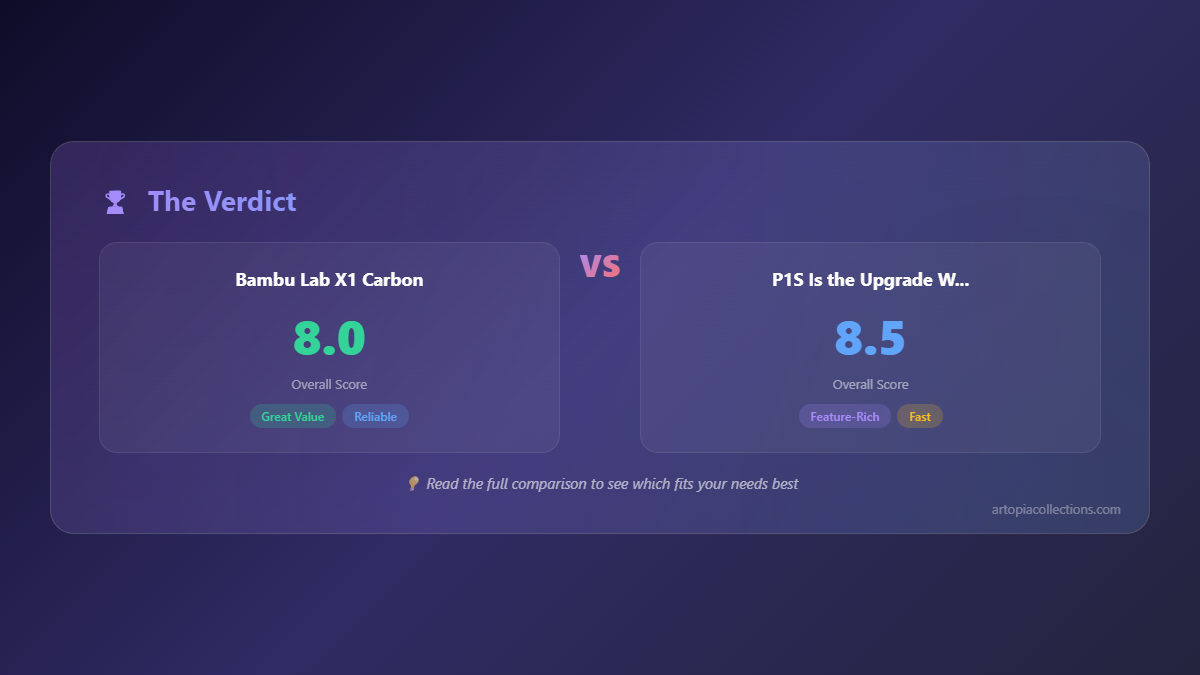
You should seriously consider the X1 Carbon if:
- You frequently print with engineering or abrasive filaments: If your clients demand parts in PA-CF, PETG-CF, PC, or even glow-in-the-dark materials, the X1C's hardened components and precise flow calibration are non-negotiable. The cost of replacing brass nozzles frequently on a P1S, plus the downtime, would quickly eat into that ₹40,000 saving. We often make custom jigs, fixtures, and drone parts that need that extra strength, and for that, the X1C is a dream.
- Reliability and Consistency are Paramount: For client work, a failed print isn't just wasted filament; it's lost time, a missed deadline, and potentially a damaged reputation. The LiDAR and AI spaghetti detection on the X1C significantly reduce the chances of catastrophic failures. This peace of mind allows me to focus on design, customer service, or other aspects of the business, rather than constantly babysitting the printer. That translates to higher output and happier clients.
- Time is Money (and for us, it really is): The automation features of the X1C – automatic flow calibration, first layer inspection, AI detection – mean less manual intervention from me or my team. Less time fiddling, more time printing. In a high-volume setting, these small efficiencies compound into significant savings over months.
- You want the best possible surface finish and accuracy: While the P1S is excellent, the X1C's vibration compensation and finer controls can sometimes result in a marginally superior finish, especially on very complex geometries. For high-end prototypes or aesthetic pieces, that subtle difference can matter to a client.
- You need advanced monitoring and remote capabilities: The better camera and processing power make remote monitoring and management smoother, which is helpful when I'm out meeting clients or sourcing materials.
Conversely, the P1S is likely enough, and an excellent choice, if:
- Your primary materials are PLA, PETG, and occasional ABS/ASA: If these are your bread and butter, the P1S handles them beautifully. You can always upgrade the hotend to hardened steel later if needed, but it's an extra step.
- You're more budget-conscious and just starting your business: ₹40,000 is a lot to invest when you're growing. The P1S offers 90% of the X1C's performance for significantly less. You can put that saving towards more filament, other tools, or marketing.
- You don't mind a bit more manual calibration: You'll need to do some more manual flow calibration checks and keep an eye on your first layers more closely.
In my experience, the biggest differentiator isn't just the features list, it's the reliability and automation that the X1 Carbon brings to a professional setup. Imagine this: a big order comes in. You load up your printers with some eSun PLA+ (you can find good deals on eSun PLA+ filament on Amazon.in, by the way, always good to stock up!), hit print, and the X1C just... goes. It checks itself, calibrates itself, and if something goes wrong, it tells you. That kind of hands-off operation is incredibly valuable when you're managing multiple projects, dealing with clients, and trying to grow a business here in India.
The cost of wasted filament from a failed print, especially if it's an expensive engineering grade, can quickly add up. A kilogram of PA-CF can set you back ₹4000-5000 easily. One big spaghetti mess, and a significant chunk of that ₹40,000 saving is gone. Plus, think about your time. Your time is worth money. The X1C saves me time. Lots of it.
I personally have both P1S units and X1 Carbon units running in my setup. The P1S printers are absolute workhorses for PLA and PETG parts, especially for items that don't need super tight tolerances or abrasive materials. But when a client comes asking for a functional prototype in strong nylon or a batch of custom drone parts made from carbon fiber filled composite, the X1 Carbon is the one I rely on without a second thought. I also recommend having a spare hardened steel nozzle assembly on Amazon.in on hand, even for your P1S, just in case you need to dabble with more robust materials.
Final Thoughts: It's About ROI and Your Business Needs
Ultimately, the decision comes down to your specific business model and budget. If you're running a hobby business on the side, or primarily doing aesthetic prints in PLA, the P1S is phenomenal and will serve you incredibly well. That ₹40,000 can go a long way in other areas of your business.
But if you're serious about offering a wide range of materials, needing absolute reliability for client deadlines, minimizing waste, and valuing your time above all else, then the Bambu Lab X1 Carbon is, in my very honest opinion, absolutely worth that extra ₹40,000. It's an investment that pays for itself in peace of mind, saved materials, and ultimately, a more professional and profitable business. It's not just a printer; it's a sophisticated manufacturing tool. Choose wisely, and happy printing!


