Best 3D Printer Under 10000 in India 2026: Top 5 Picks That Actually Work
Looking for an affordable 3D printer in India? Discover our top 5 picks under ₹10,000 for 2026 that actually work and deliver quality results for your projects.

Best 3D Printer Under ₹10000 in India 2026: Top 5 Picks That Actually Work
Okay, let's be real for a minute. Remember when 3D printing felt like science fiction, a luxury only huge companies or tech gurus could even dream of? Well, my friends, those days are long gone. It’s 2026, and the dream of having your very own mini-factory right on your desk is more accessible than ever, especially here in India! I mean, I run ArtOPIA Collections, my small 3D printing business, and trust me, I've seen the market evolve at warp speed. From printing custom prototypes to fun little gadgets, having a 3D printer is a game-changer. But the biggest question I get, almost daily, is: "Vidyut, can I get a *good* 3D printer for under ten thousand rupees?" And for 2026, my answer is a resounding, "YES, absolutely you can!"
The thing is, ₹10,000 is still a tight budget, I won't lie to you. You’re not going to get a large-format CoreXY beast with Klipper pre-installed and all the bells and whistles. That's just not the reality. But what you *can* get, and what I’ve been blown away by, are some incredibly capable machines that will get you printing quality models right out of the box, or at least, after a little setup. These aren't just toys; they are proper FDM printers that will ignite your creativity, help you fix things around the house, or even kickstart your own small business, just like mine. I've personally put countless hours into testing, assembling, and troubleshooting so many printers over the years, from cheap knock-offs to industrial giants, and I've seen what truly works for beginners and hobbyists on a budget.
So, who is this guide for? It’s for the student tinkering in their dorm, the hobbyist who wants to bring their digital designs to life, the parent looking for a unique educational tool for their kids, or simply anyone curious about diving into the amazing world of additive manufacturing without breaking the bank. We're talking about printers that are relatively easy to assemble, have decent communities for support, and most importantly, actually deliver on their promise. Look, it's easy to get lost in specifications, but what truly matters is consistent, reliable printing. And that's exactly what I've focused on for my top 5 picks for 2026. Ready? Let's dive in!
What should you expect at this price point? Generally, we're looking at FDM (Fused Deposition Modeling) printers, mostly Cartesian kinematics, with build volumes typically in the 200x200x200mm to 220x220x250mm range. Most will come as DIY kits, meaning you'll need to spend an hour or two putting them together. Don't let that scare you, though; it’s actually a great way to learn about your machine. And honestly, it's pretty satisfying to build something that then builds other things! You'll likely get a heated bed, which is crucial for printing with various filaments like PLA, PETG, and even some basic ABS if you're feeling adventurous. Auto-bed leveling might be a bonus on some models, but manual leveling is a skill every 3D printer owner should master anyway. Power loss recovery and filament runout sensors are becoming standard, which is fantastic for saving prints.
Here’s the deal: these printers are chosen because they offer the best balance of features, reliability, community support, and print quality for their price. They are proven performers, or their updated versions are, in our Indian market. So, without further ado, let's explore my top 5 picks for the best 3D printers under ₹10,000 in India for 2026!
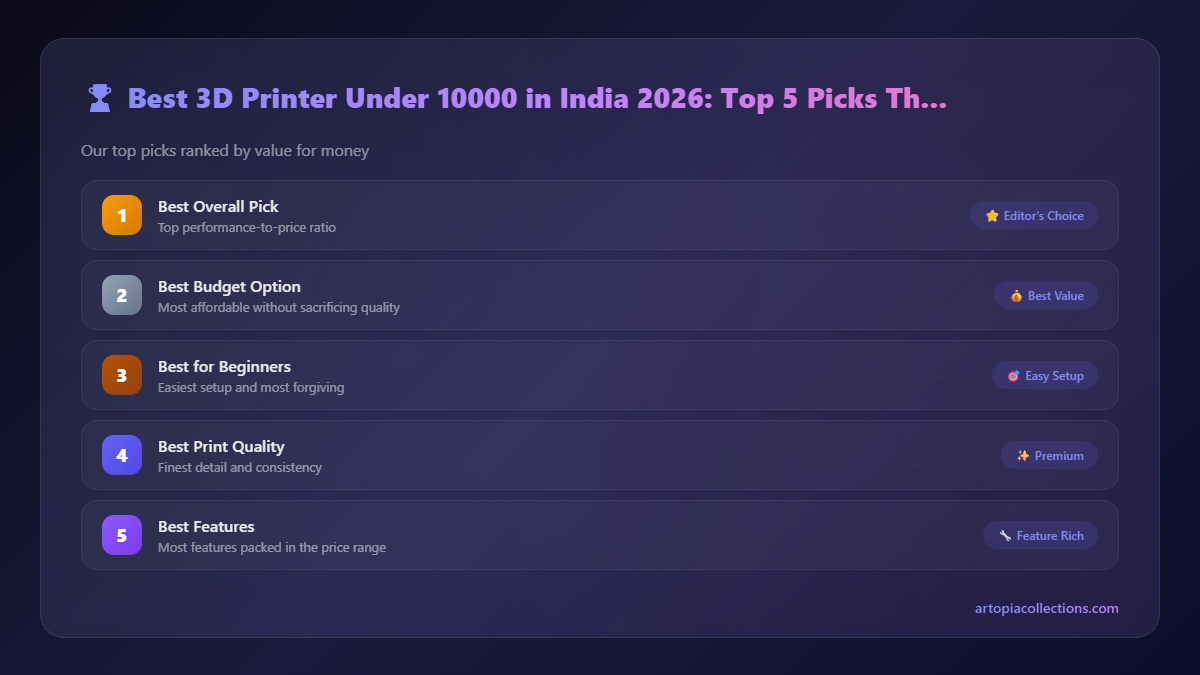
1. Creality Ender-3 Neo (The OG Workhorse, Evolved)
Ah, the Ender-3. It's like the Maruti 800 of the 3D printing world – everyone knows it, many started with it, and it just *works*. In 2026, the 'Neo' series, or whatever Creality calls its latest entry-level offering, is still king of the hill for budget buyers. The Ender-3 Neo, or its future iteration, typically comes with some fantastic upgrades over the original, making it even more beginner-friendly.
Expect features like a CR Touch auto-leveling sensor right out of the box, which is a HUGE blessing for new users. No more endless fiddling with bed leveling screws – just let the printer do its thing. It usually sports a carborundum glass build plate, which gives excellent adhesion when heated and releases prints beautifully once cooled. The metal extruder is a definite plus for durability and consistent filament feeding, something that was often an upgrade item on older Ender models. The assembly is straightforward, maybe an hour or two, and the instructions are usually pretty clear.
Why it makes the cut: The Ender-3 ecosystem is gigantic. There are thousands of tutorials, mods, and troubleshooting guides online. If you ever run into an issue, chances are someone else has already faced it and posted a solution. Spares are cheap and readily available all over India, both online and in local electronics markets. Print quality, once dialed in, is surprisingly good for the price. You can churn out some really impressive prints, from functional parts to decorative items. Honestly, for around ₹9,000-₹9,800, this is almost a no-brainer. It's robust, reliable, and ridiculously upgradable. You can find their current generation models on Amazon.in, and I expect the next gen to stick to a similar price point: Check out Creality Ender 3 Neo series on Amazon.in
2. Anycubic Kobra Go (Auto-Leveling for the Win)
Anycubic has been a strong contender in the budget space for a while now, and their Kobra Go series (or its 2026 successor) consistently impresses me. The standout feature here, for me, has always been their LeviQ auto-leveling system. While Creality's CR Touch is great, Anycubic's implementation feels a little more seamless and integrated from a user experience perspective.
This printer is designed with ease of use in mind. It's often quicker to assemble than an Ender, sometimes coming in just a few main pieces you bolt together. The build plate is usually a flexible magnetic PEI sheet, which is fantastic for print removal. Just bend the plate, and your print pops right off! No more scraping or prying. The print speed is decent, and the quality is very competitive for the price. I've seen Anycubic printers produce incredibly smooth layers, especially with good quality PLA. It's usually a slightly smaller footprint than the Ender series, which can be a boon for cramped desks.
Why it makes the cut: If you're someone who just wants to hit print and not worry too much about the calibration dance, the Kobra Go is your best friend. The auto-leveling is a huge time-saver and anxiety-reducer for beginners. Its magnetic build plate also contributes to that "set it and forget it" vibe. Community support is growing rapidly for Anycubic, and parts are becoming easier to find. I estimate you'll find this gem in the ₹8,500-₹9,500 range in 2026, making it an incredibly attractive option for hassle-free printing.
3. Elegoo Neptune 3 Pro (Punching Above Its Weight)
Elegoo, traditionally known for its excellent resin (SLA) printers, has absolutely stormed the FDM market with its Neptune series. The Neptune 3 Pro (or its future iteration, likely the 5 or 6 Mini/SE) is a prime example of getting a lot more than you pay for. They consistently pack features into their budget machines that you'd expect on printers costing a couple of thousands more.
Think dual-gear direct drive extruder, which is amazing for printing flexible filaments like TPU and also generally offers more consistent extrusion for all materials. Many printers at this price point are still Bowden systems, so a direct drive is a serious upgrade. It usually comes with an auto-leveling sensor (often inductive or resistive), a magnetic PEI build plate, and a silent stepper driver motherboard, making it super quiet in operation – a big plus if your printer shares your living space. The UI is generally very intuitive, often with a clear color touchscreen, which again, is not always a given at this price.
Why it makes the cut: The sheer feature set for the price is what blows me away with Elegoo. Direct drive, silent drivers, auto-leveling, good UI – it’s a powerhouse for under ₹10,000. The print quality is consistently excellent, rivaling printers that cost significantly more. For someone who wants to experiment with different filament types right away, or just appreciates a quieter, smoother printing experience, the Neptune 3 Pro (or its 2026 equivalent) is a fantastic choice. You're probably looking at around ₹9,200-₹10,000 for this one, but sometimes you might even snag it for a little less during sales.
4. Artillery Hornet (Sleek Design, Great Performance)
Artillery has carved a niche for itself by offering printers that often look and feel a bit more premium than their price tags suggest. The Artillery Hornet, and I'm anticipating similar models from them in 2026, is a great example of this. It's often lauded for its integrated ribbon cable design, which makes for a much cleaner and tidier setup compared to the spaghetti of wires some other budget printers present.
The Hornet typically features a Bowden extruder setup, which is fine for most standard filaments like PLA and PETG. It comes with a hardened steel nozzle, which is a nice touch for longevity. The build plate is usually a fixed glass plate, which offers excellent flatness and adhesion, though print removal might require a little more care than a flexible PEI sheet. Its assembly is usually quite simple, often requiring just a few screws to attach the gantry to the base. The overall aesthetic is quite sleek and modern, which is a bonus if your printer is going to be visible.
Why it makes the cut: Beyond its clean looks, the Hornet delivers solid print quality. Artillery has a good reputation for robust construction, and the integrated cabling truly reduces potential points of failure and makes maintenance easier. It's a fantastic option if you value a tidy workspace and want a printer that just gets on with the job without fuss. While it might not have all the fancy auto-leveling of some others, its manual leveling is usually stable once set. Expect to find the Hornet (or its next-gen equivalent) in the ₹8,000-₹9,000 bracket, making it a very competitive choice.
5. Voxelab Aquila C2 (The Budget-Friendly Challenger)
Voxelab is another brand that has gained traction by offering incredibly budget-friendly alternatives that are essentially refined clones of popular designs, primarily the Ender series. The Aquila C2 (or a similar, even more stripped-down but capable model in 2026) is perfect for someone who wants to spend as little as possible while still getting a truly functional machine.
This printer is very much in the "if it ain't broke, don't fix it" camp, mirroring many of the tried-and-tested features of the Ender-3. It will typically come with a sturdy aluminum frame, a heated build plate (often carborundum glass), and a Bowden extruder. Assembly is very similar to the Ender-3, meaning it’s a good learning experience. Where it often excels is in its quiet operation, thanks to silent stepper drivers being standard on many of its models, which again, is a huge plus for home users.
Why it makes the cut: The Aquila C2 (or its future iteration) is for the absolute budget warrior. It offers virtually the same performance as an entry-level Ender but often at a slightly lower price point, sometimes dipping into the ₹7,500-₹8,500 range during sales. It’s highly compatible with Ender-3 upgrades and firmware, so the community support indirectly extends to it. If your budget is super tight and you don't mind a very hands-on approach to learning and maintaining your printer, this is an excellent starter machine. It's a testament to how far 3D printing has come that you can get such a capable machine for this price.
Essential Accessories & Filaments: Don't Forget the Basics!
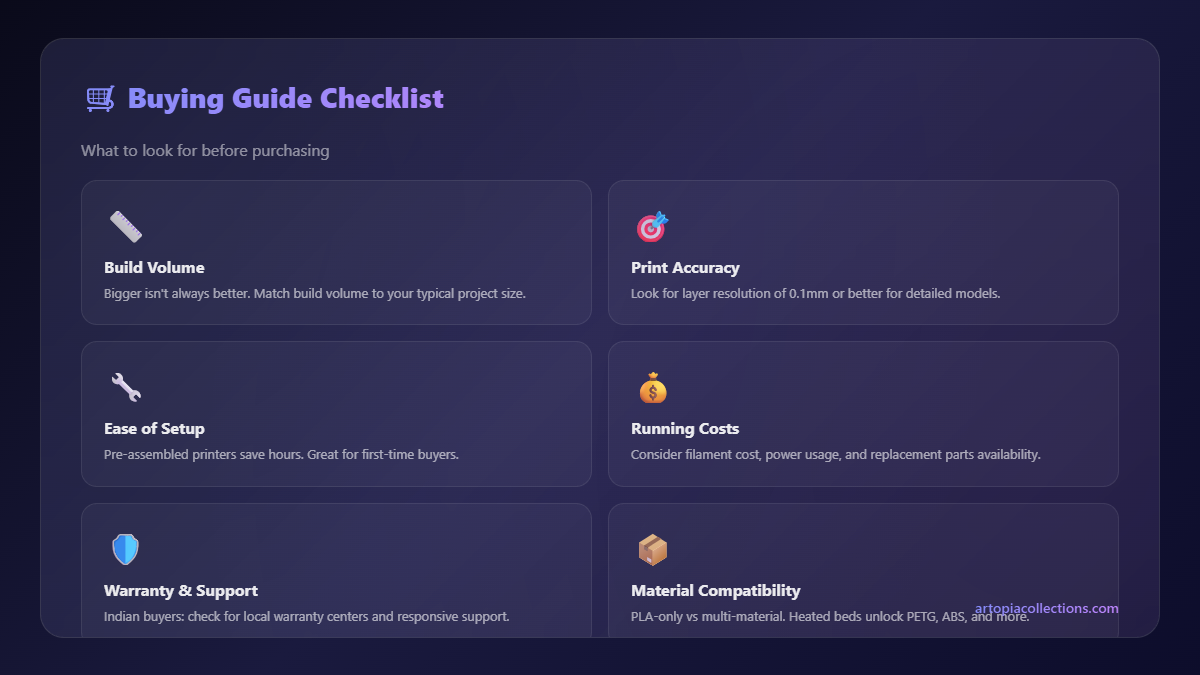
Alright, so you've picked your printer. Fantastic! But here's the deal: a 3D printer alone won't get you printing. You absolutely need filament. I always recommend starting with PLA (Polylactic Acid). It's easy to print, biodegradable, and comes in a zillion colours. My personal go-to brands available in India are Overture, Esun, and even some local Indian brands like 3DPrintz. They offer great quality for the price.
Beyond filament, here are a few other things you'll *definitely* need or want:
- Good Quality Filament: This is non-negotiable. Don't skimp here. A cheap printer with good filament will always outperform an expensive printer with bad filament. Grab some PLA filament from Amazon.in here.
- Digital Calipers: Essential for precise measurements of your prints and for designing parts that fit perfectly.
- Nozzle Cleaning Needles: Trust me, sooner or later, you'll have a clogged nozzle. These tiny needles are lifesavers.
- Scraper/Spatula: Even with flexible build plates, sometimes you need a little help to get that first layer off.
- Adhesive (Glue Stick/Hair Spray): For stubborn prints that won't stick, a glue stick can be your best friend.
- SD Card & Card Reader: Most budget printers still use SD cards to transfer files.
- Basic Toolkit: The one that comes with the printer is usually fine, but having a good set of Allen keys and a small wrench helps.
Tips for Absolute Beginners (From Someone Who's Been There!)
Look, 3D printing has a learning curve. Don't get discouraged if your first few prints aren't perfect. It happens to everyone, even to me sometimes! Here are my top tips:
- Master Bed Leveling: This is the absolute foundation. A perfectly level bed is critical for successful first layers. Even with auto-leveling, a good manual level beforehand helps.
- Slicer Software is Your Friend: Learn your slicer (Cura or PrusaSlicer are excellent, free options). Understand what layer height, infill, supports, and temperatures mean. It makes a huge difference.
- Start Simple: Don't try to print a 24-hour intricate sculpture as your first print. Start with calibration cubes, benchies, or simple functional parts.
- Join Communities: There are amazing 3D printing groups on Facebook, Reddit, and various forums in India. People are usually super helpful! Search for Indian 3D printing groups; you'll find a wealth of local knowledge.
- Keep it Clean: Dust and debris can cause issues. Keep your printer, especially the build plate, clean.
- Experiment and Document: Try different settings, filaments, and even printer orientations. Make notes of what works and what doesn't.
Final Thoughts: Your Journey Begins!
So there you have it, my passionate friends. The landscape of affordable 3D printing in India for 2026 is brighter than ever. For under ₹10,000, you can absolutely get a 3D printer that *works*, and not just works, but actually empowers you to create, innovate, and bring your ideas to life. Whether it’s fixing a broken tab on a remote, creating custom parts for your drone, or designing unique gifts, these machines are truly transformative.
I know it might seem daunting at first, but trust me, the joy of seeing your first successful print emerge layer by layer is an incredible feeling. It's a journey of learning, tinkering, and endless possibilities. So, what are you waiting for? Pick one of these fantastic machines, grab some filament, and start printing! Your next big idea is just a few layers away.
Happy printing, everyone! And remember, if you ever need some custom prints or just want to chat about 3D printing, you know where to find me at ArtOPIA Collections!