FDM vs SLA vs SLS: Which 3D Printing Technology Is Right for You?
Unsure which 3D printing technology best suits your needs? This guide breaks down FDM, SLA, and SLS, comparing their advantages, disadvantages, and ideal applications.
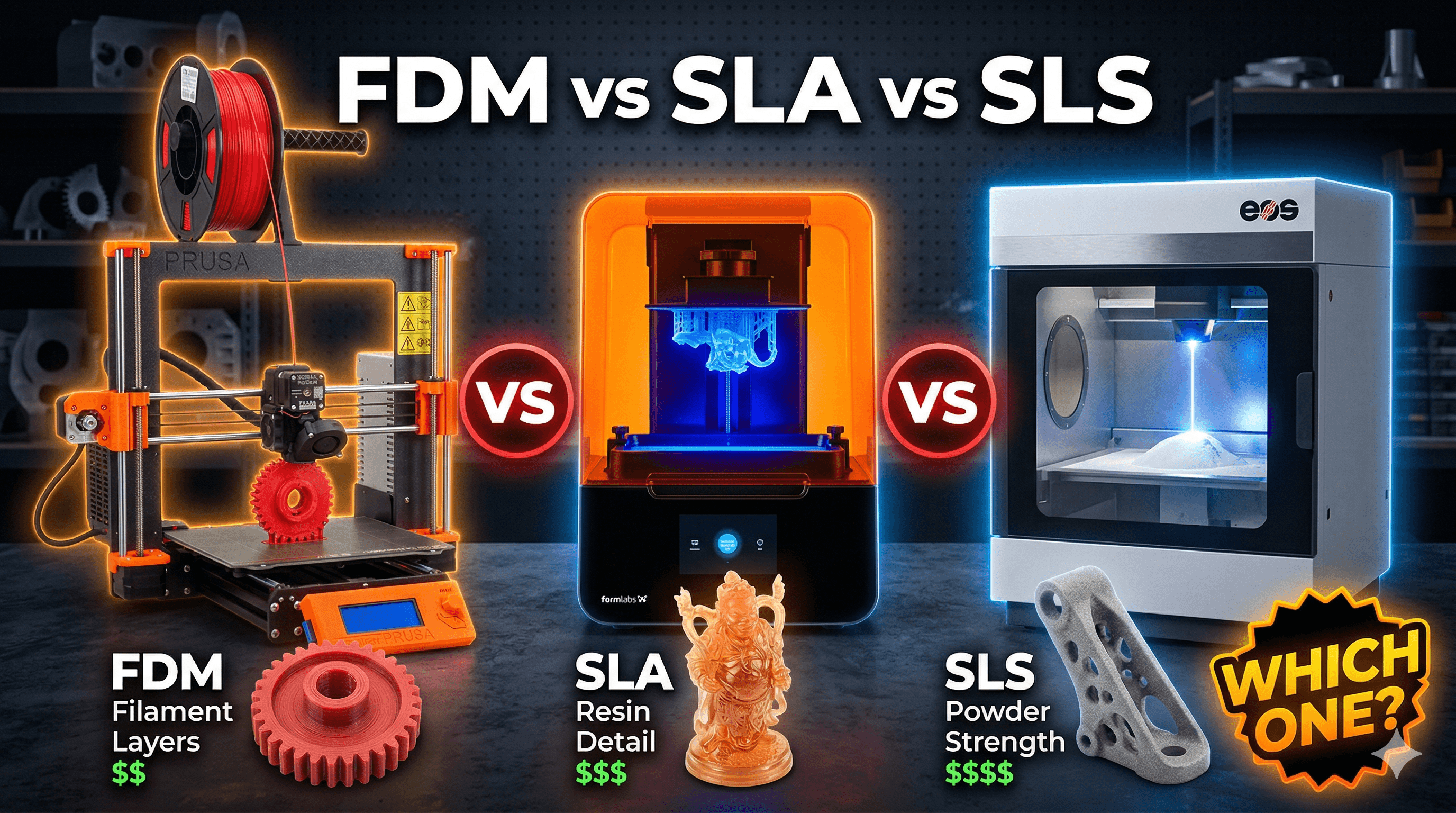
Alright, buckle up, my fellow makers and dreamers! Today, we're diving deep into the absolute heart of 3D printing, a topic that gets my gears grinding and my filament extruding â literally! We're talking about the big three: FDM, SLA, and SLS. And trust me, if you're even thinking about getting into 3D printing, or if you're like me and run a small business doing it (shoutout to my Artzopia crew!), understanding these differences isn't just important, it's absolutely crucial.
I remember when I first got my grubby hands on an Ender 3 (man, that was a game-changer back then!), the sheer joy of seeing something I designed on a screen come to life was unparalleled. But soon, I started seeing all these incredible, super-detailed prints online â miniatures with insane detail, prototypes with glass-smooth finishes â and I knew my trusty FDM machine, while amazing, wasn't quite hitting those notes. That's when I started down the rabbit hole of resin printers, and eventually, even exploring industrial services for SLS. ItâÂÂs a journey, isnâÂÂt it?
So, here's the deal: choosing the right 3D printing technology isn't just about picking a printer; it's about aligning your goals, your budget, and your project's demands with what each tech excels at. And honestly, there's no single "best" option. It's all about your "best" option. Let's break it down, desi-style!
FDM (Fused Deposition Modeling): The Workhorse You Can Afford
Ah, FDM. This is where most of us start, right? It's basically like a fancy hot glue gun, but instead of just globs of glue, it precisely lays down melted plastic, layer by microscopically thin layer, until your object forms. Think of it as building with tiny, molten plastic spaghetti strands. Simple, effective, and oh-so-satisfying to watch.
How it Works:
A spool of thermoplastic filament (PLA, PETG, ABS, etc.) is fed into a heated nozzle. This nozzle melts the plastic and extrudes it onto a build plate, following a path defined by your 3D model. The nozzle moves in X and Y directions, and the build plate (or the nozzle itself) moves down in Z after each layer is complete. Rinse and repeat a thousand times, and boom! You have a physical object. While there's a learning curve, getting a basic print going on an FDM machine is generally less intimidating than,
Looking for unique 3D printed products? Browse our collection at Artopia Collections.