How Much Does 3D Printing Really Cost Per Print?
Understanding the true cost of 3D printing per part goes beyond just the filament price. This guide helps you factor in all expenses, from electricity to machine depreciation, ensuring you budget accurately.
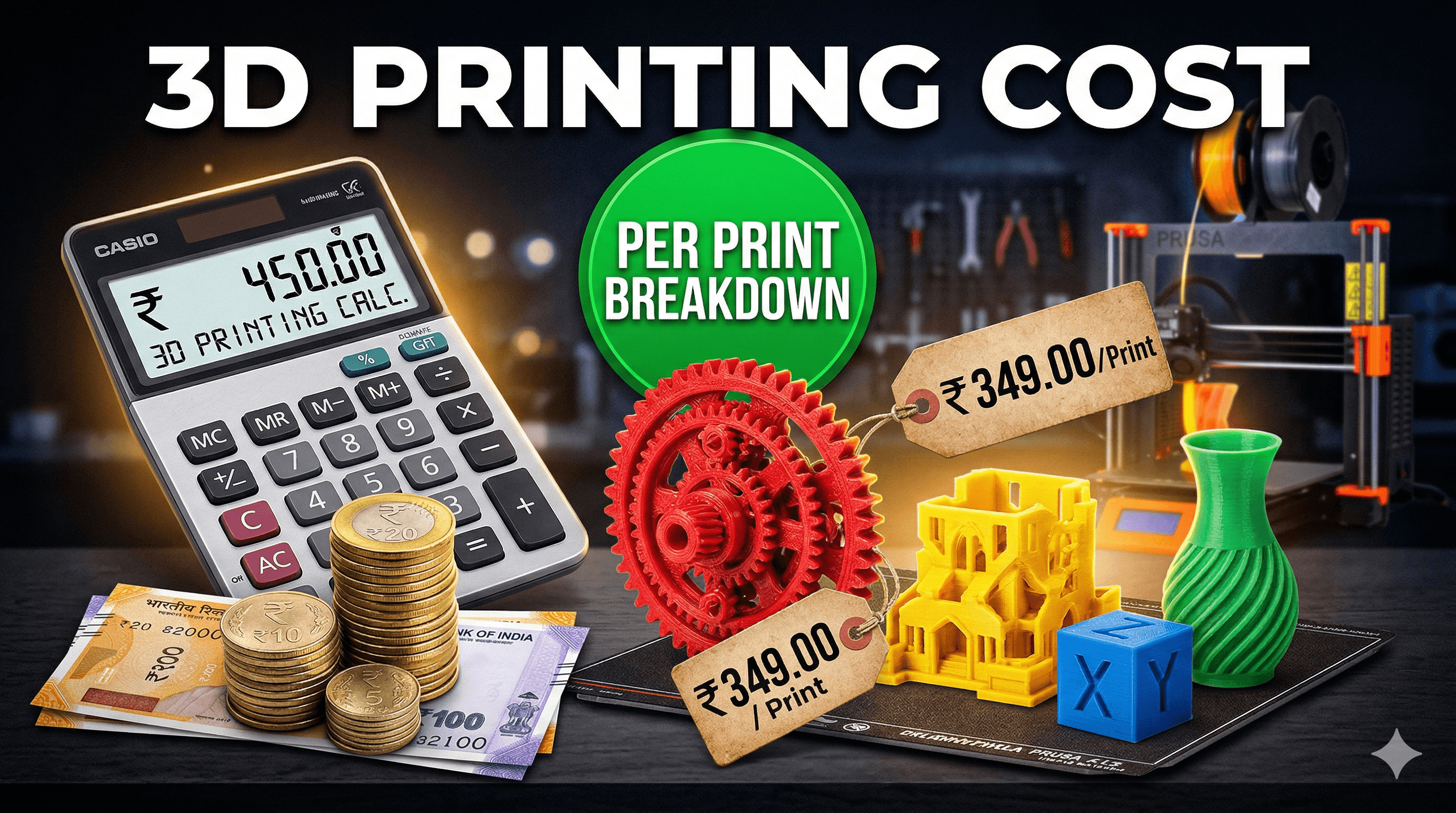
Chalo, let's be real for a minute. If I had a rupee for every time someone asked me, "Bhai, yeh ek cheez print karne mein kitna lagta hai?" (Bro, how much does it cost to print this one thing?), I'd probably be able to buy another filament dry box, maybe even a fancy new Prusa! And it's not a simple question, is it? Most people, bless their innocent hearts, think it's just the cost of the plastic. Oh, if only it were that simple! Running a small 3D printing business here in India, I've learned a thing or two about what really goes into that final price tag. It's way more than just a roll of plastic. Way more.
So, today, I want to pull back the curtain a bit and talk to you like a friend, from my workshop to your screen, about the true cost of 3D printing per print. Because honestly, it's a whole ecosystem of expenses that even I sometimes forget to properly factor in until I'm doing my books. And trust me, it's not always pretty.
The Obvious One: Filament â The Plastic Gold
Okay, let's start with the one everyone thinks about: the filament. This is your raw material, right? For most hobbyists and small businesses like mine, we're talking about PLA, PETG, or maybe some ABS. Prices in India have fluctuated a bit, but generally, a good quality 1kg spool of PLA will set you back anywhere from â¹800 to â¹1500. Brands like eSun, Overture, and even some decent local ones are readily available on Amazon.in. I personally use a mix â I find eSunâÂÂs PLA+ to be super reliable, but sometimes IâÂÂll grab a cheaper local brand for prototypes or less critical prints.
Now, a 1kg spool has, well, 1000 grams of filament. If you're paying â¹1000 for that spool, your cost per gram is â¹1. Simple math, right? But here's the kicker: prints are measured in grams, not always by their size. A tiny keychain might be just 5-10 grams, costing you â¹5-â¹10 in raw material. A decent-sized phone stand could be 50-70 grams, so â¹50-â¹70. But a complex, hollow vase, or one of those cool articulated dragons you see everywhere, that could easily be 150-300 grams, pushing your filament cost to â¹150-â¹300 or even more. And that's just for one colour!
What if the customer wants something in a specific, fancy colour? Or a specialty filament like wood-filled PLA or silk PLA? Those cost more, sometimes â¹1800-â¹2500 for a kilo. So, that â¹1 per gram suddenly becomes â¹1.8 or even â¹2.5 per gram. And it adds up fast. I had a client once who wanted a full-scale Iron Man helmet. We're talking multiple parts, significant infill, and specific colours. That alone ate through more than a kilogram of various filaments, pushing the raw material cost well into the thousands, just for the plastic.
The Silent Drainer: Electricity
This is the one that most people forget entirely, or just massively underestimate. Think about it: your 3D printer has a hotend, a heated bed (especially for PETG or ABS), stepper motors, a mainboard, and fans. All of these draw power. A typical FDM printer like my Creality Ender 3 S1 or an Anycubic Kobra 2 (great value for money, by the way, if you're starting out â you can find models like it here) might draw anywhere from 50W to 200W, depending on what's active and whether the bed is heating. Let's average it out to, say, 100W for a typical print run.

Now, electricity rates in India vary by state and even by consumption slab, but let's assume an average of â¹7-â¹10 per unit (kilowatt-hour) for household/small commercial use. If your printer runs at 100W (0.1kW) for 10 hours, that's 1 unit of electricity. So, a 10-hour print costs you â¹7-â¹10 just in power. Doesn't sound like much, right? But many of my prints, especially the intricate ones for ArtOpiA Collections, can easily take 20, 30, or even 50+ hours. A 50-hour print at 100W is 5 units, so â¹35-â¹50 in electricity. And I run multiple printers, often simultaneously. Suddenly, my monthly electricity bill for the workshop starts looking like a small car payment!
So, when someone asks me for a quote, I mentally add a certain percentage for electricity based on the estimated print time. ItâÂÂs a hidden cost that adds up, especially when you're printing 24/7 like I often do.
The Unsung Heroes: Wear and Tear & Maintenance
Your printer isn't a magical machine that runs forever without needing anything. It's a complex piece of robotics with moving parts that degrade over time. Nozzles wear out, especially if you're using abrasive filaments like wood-filled or glow-in-the-dark. I usually replace my brass nozzles every few weeks, or immediately if I notice print quality degrading. A pack of 10 brass nozzles might cost â¹300-â¹500. But if you're using hardened steel nozzles for abrasive stuff, those are much more expensive, easily â¹200-â¹500 for a single one!
Then there's the build plate. Glass beds can chip, PEI sheets can get scratched or lose adhesion. Replacing a PEI sheet for an Ender 3 can be â¹800-â¹1500. Belts stretch, bearings get noisy, hotend thermistors can fail, PTFE tubes need replacing, even the mainboard can give up the ghost. I've had to replace a hotend assembly on one of my printers because of a persistent clog that just wouldn't clear â that was a â¹1000+ expense right there.
This is what we call depreciation and maintenance. It's not a direct cost per print, but it's an overhead that needs to be amortized across all your prints. If your printer costs â¹25,000 and you expect it to last, say, 2 years of heavy use before needing significant upgrades or replacement, that's â¹12,500 a year, or roughly â¹1000 a month. How many prints do you do in a month? Divide that â¹1000 by your print count, and that's a small, invisible cost per print. It might be â¹5 for a small print, or â¹50 for a large, long one. But it's there. It's always there, lurking.
The Soul-Crushing Tax: Failed Prints
Ah, the bane of every 3D printer's existence. The dreaded failed print. No matter how good you are, how perfectly calibrated your machine is, failures happen. They just do. Power cuts (especially common in some areas), clogged nozzles mid-print, bad bed adhesion leading to a spaghetti monster, incorrect temperature settings, filament tangles... the list goes on. I've had prints fail 90% of the way through, turning hours of work and hundreds of rupees worth of filament into a tangled, useless mess. It's heartbreaking, honestly.

When a print fails, you're not just losing the filament; you're losing the electricity it consumed, and most importantly, your time. And for a business, time is money. That filament goes into the trash (or ideally, to a recycling facility if you can find one that accepts 3D print waste, which is a whole other challenge in India). You have to clean the printer, re-slice, restart. This is a significant, unpredictable cost that absolutely has to be factored into pricing. I usually build in a small contingency, maybe 5-10%, into my pricing to cover the inevitable failures. It's not a luxury; it's a necessity.
Once, I was printing a custom trophy for a client, a fairly large and complex piece. The print was going to take nearly 30 hours. Around the 25-hour mark, just as I was getting ready to jump for joy, the power flickered. Just a quick blip. My printer, unfortunately, didn't have power loss recovery enabled. Boom. 25 hours, ~200 grams of filament, gone. I had to reprint the whole thing. That's pure loss. It happens.
Your Time is Gold: Design, Slicing, and Post-Processing
This is probably the biggest, most overlooked cost, especially for a business. What's your time worth? For a hobbyist, it's a labor of love. For me, it's my livelihood. Before a single layer is printed, there's design work (if it's a custom piece), finding and verifying models, then the slicing process. Slicing might take 5 minutes or an hour depending on the complexity and adjustments needed.
Then there's print prep: cleaning the bed, loading filament, pre-heating, monitoring the first few layers. And after the print is done? Post-processing. Removing supports (which also consume filament, remember!), sanding, filing, gluing multiple parts, sometimes painting or priming. This can take minutes for a simple object, or hours for something intricate like a detailed figurine or a cosplay prop. IâÂÂve spent entire days just sanding and painting a single print to get it just right for a customer.
If you're charging â¹500 for a print, and it took you 2 hours of active work (design, slicing, prep, post-processing) on top of the print time, are you paying yourself a fair hourly wage after factoring in all the other costs? In my experience, probably not as much as you'd like unless you're very efficient or the print is truly high-value. This is why custom design work is often charged separately or carries a much higher premium. My time is my most valuable asset.
Other Business Overheads (for a business, obviously!)
While not strictly "per print," these costs influence my overall pricing strategy. Things like my workshop rent (even if it's a dedicated space in my home, there's an opportunity cost), internet connection, website hosting, marketing expenses, packaging materials for shipping, business registration, taxes... it all adds up. These fixed costs need to be covered by the revenue generated from prints. So, a small percentage of every print's cost goes towards keeping the lights on and the business running.
So, What's the Real Cost Per Print? Let's Break Down an Example.
Let's take a medium-sized, somewhat intricate print â say, a custom desk organizer.
1. Filament:
- Weight: 150 grams
- Cost per gram: â¹1.2 (assuming a slightly better quality PLA)
- Filament Cost: 150g * â¹1.2/g = â¹180
2. Electricity:
- Print time: 15 hours
- Average power draw: 120W (0.12kW)
- Electricity rate: â¹8/unit
- Electricity Cost: 0.12kW * 15h * â¹8/unit = â¹14.40
3. Wear & Tear / Depreciation:
- Let's estimate â¹10 per print for a medium item.
- Cost: â¹10
4. Failed Print Contingency:
- Let's add 10% of filament + electricity cost.
- Contingency: (â¹180 + â¹14.40) * 0.10 = â¹19.44
5. My Time (Design, Slicing, Post-Processing):
- Initial setup/slicing: 30 minutes
- Support removal/cleanup: 45 minutes
- Total active time: 1 hour 15 minutes (1.25 hours)
- My effective hourly rate (after considering I'm running a business, not just minimum wage): Let's say â¹300/hour for active work.
- Time Cost: 1.25 hours * â¹300/hour = â¹375
6. Business Overheads (Marketing, Rent, Internet, etc.):
- Let's add a small flat fee or percentage, say â¹20 for this print.
- Cost: â¹20
Total Estimated Cost for This Print: â¹180 + â¹14.40 + â¹10 + â¹19.44 + â¹375 + â¹20 = â¹618.84
So, a print that only used â¹180 worth of plastic actually *cost* me over â¹600 to produce, before even adding a profit margin. This is a very basic calculation, and I'm simplifying a lot, but it gives you a much clearer picture, doesn't it?
Conclusion: It's a Juggling Act
The thing is, pricing 3D prints isn't a straightforward "cost of plastic x 2" formula. It's a delicate balance of material costs, hidden operational expenses, the value of your time and expertise, and the inevitable risk of failure. For hobbyists, these costs might just be a mental note, something to justify the fun. But for someone like me, running a small business, it's about sustainability, about making sure I can continue to create and offer amazing custom pieces without running myself into the ground.
So, the next time you ask a 3D printer operator "how much?", remember that there's a lot more going on behind the scenes than just a spool of filament. We're not just selling plastic; we're selling our time, our skill, our machines' lifespan, and the magic of bringing a digital idea into the physical world. And that, my friends, is priceless.