How to Get Your First 100 Sales on Etsy as a 3D Printing Seller
Are you a 3D printing enthusiast looking to turn your passion into profit on Etsy? This guide breaks down essential strategies to help you secure your initial 100 sales and establish a strong foundation for your shop.

From Hobby to Hype: How I Got My First 100 Sales on Etsy Selling 3D Prints (and How You Can Too!)
You’ve got that amazing 3D printer humming away in your corner, right? Maybe it’s a trusty Creality Ender 3 V2 Neo, or perhaps a speedy Anycubic Kobra 2 Pro. You're churning out cool stuff, and your friends and family are impressed. But that little voice in your head, the one that whispers, "Hey, maybe I could actually *sell* these things?" – yeah, that’s the one we're listening to today. Because let me tell you, going from printing for fun to making your first actual sale, and then hitting that magical 100-sales milestone on Etsy, feels absolutely incredible. It’s like winning a small lottery, except you’ve earned every single rupee yourself.
I remember starting out, my heart pounding a little every time I clicked "publish" on a new listing. Etsy felt like this huge, intimidating marketplace, full of seasoned sellers. I mean, here I was, this guy from India, with a small setup in my spare room, trying to compete globally. It felt a bit crazy, honestly. My first few months? Crickets. Nothing. I was starting to think, "Maybe this isn't for me." But then, BAM! That first sale notification hit, and the dopamine rush was real. And from there, with a lot of trial, error, late nights, and way too much chai, I pushed through to 100 sales. It wasn't just luck; it was a system, a mindset, and a whole lot of learning. So, let's dive into how you can replicate that success, step by step.
Finding Your Niche (Or, What Even *Are* You Selling?)
Look, the first thing everyone asks is, "What should I print?" And honestly, that's the wrong question. The right question is, "What problem can my 3D prints solve, or what joy can they bring?" When I first started, I was printing everything under the sun – keychains, fidget toys, little statues. It was a mess. My shop had no identity. People got confused. That’s when I realized the power of a niche.
Think about it: who are you trying to sell to? Are they gamers looking for specific accessories? Are they plant lovers needing unique planters? Office folks wanting cool desk organizers? Mums looking for personalized gifts? Once you narrow it down, everything becomes clearer. For me, I found a sweet spot in practical, aesthetic home decor and personalized gifts. Things like custom-designed succulent planters (people *love* these, especially in India where plants are a big part of homes), unique desk tidies, and personalized nameplates. These aren't just trinkets; they’re useful, thoughtful items. And that's the thing: utility or strong aesthetic appeal is key.
Spend some time researching on Etsy itself. What's selling well in the 3D print category? Don't copy, but get inspired. Look at what people are charging. See the gaps. Maybe everyone's selling plain white planters; what if you offer them in cool dual-colour prints, or with a texture that mimics terracotta? Be unique, but don't stray too far from what people actually want to buy. This is probably the most crucial step, so don't rush it.
Product Photography: Your Shop Window to the World
 This is where many 3D printing sellers, especially us enthusiasts, fall short. We're great at printing, but not always at making things look pretty. But Etsy is a visual platform, man! Your photos are everything. They're basically your entire shop window, especially when you're selling digital assets or 3D prints.
Forget those blurry phone pictures on your workbench. No, really, stop it. Here’s the deal:
- Good Lighting: Natural light is your best friend. Set up near a window. If you're shooting at night, invest in a couple of cheap LED lights (even some powerful table lamps can work) and a light tent (you can get a decent one for ₹1000-₹2000 on Amazon).
- Clean Backgrounds: A plain white or light-coloured wall, a wooden surface, or even a simple grey fabric can work wonders. Avoid clutter. Your product should be the star.
- Multiple Angles: Show your product from all sides. If it has a special feature, zoom in on it. Show it in context – for example, if it's a planter, put a small plant in it. If it's a pen holder, put pens in it. This helps customers visualize it in their own space.
- High Resolution: Use the best camera you have. Modern smartphones are often good enough, but make sure your hands are steady or use a tripod.
- Lifestyle Shots: This is a game-changer. Don't just show the product; show it *being used*. A beautiful hand holding a custom coaster, a desk organizer actually organizing a neat desk. These tell a story and make people connect emotionally.
Crafting Listings That Convert: Titles, Descriptions, and Tags
Okay, you’ve got killer photos. Now, you need to tell Etsy and your customers what you’re selling. This is all about keywords, keywords, keywords!
- Titles: Think like a shopper. What would *you* type into the search bar? Start with your main keyword. "Personalized Desk Organizer, Custom Nameplate, 3D Printed Gift." Use descriptive words. Don't just say "thingy." Be specific: "Minimalist Planter," "Geometric Succulent Pot."
- Tags: Etsy gives you 13 tags. Use ALL of them. Brainstorm every possible keyword someone might use to find your product. Think broad and specific. For a planter, you might use: "3D printed planter," "succulent pot," "desk plant," "home decor," "gift for plant lover," "geometric planter," "modern design," "office decor," "unique planter," "plastic planter," "eco-friendly gift," "handmade planter." Mix it up!
- Descriptions: This is your chance to tell the product's story.
- Start with an engaging hook.
- Detail the product’s features: dimensions, material (PLA is biodegradable, durable!), colour options, any customization.
- Explain its benefits: "Helps organize your desk," "Adds a touch of modern elegance," "Perfect unique gift."
- Include your process: "Each piece is carefully 3D printed layer by layer," (this adds value and uniqueness).
- Crucially, include care instructions and shipping info clearly.
And for heaven's sake, double-check your spelling and grammar! It makes your shop look professional.
Pricing Your Prints: Don't Undersell Your Art!
 This is a big one, especially when you’re starting. It's so tempting to price low to get sales. Don't fall into that trap! You're not just selling plastic; you're selling your design time, your print time, your electricity, your post-processing, and your packaging. This isn't just a hobby anymore, right? It's a business.
Here's a basic formula I use:
(Material Cost + Electricity Cost + Time (design, print, post-process) + Packaging Cost) x 2.5 or 3 = Selling Price
Let's break it down:
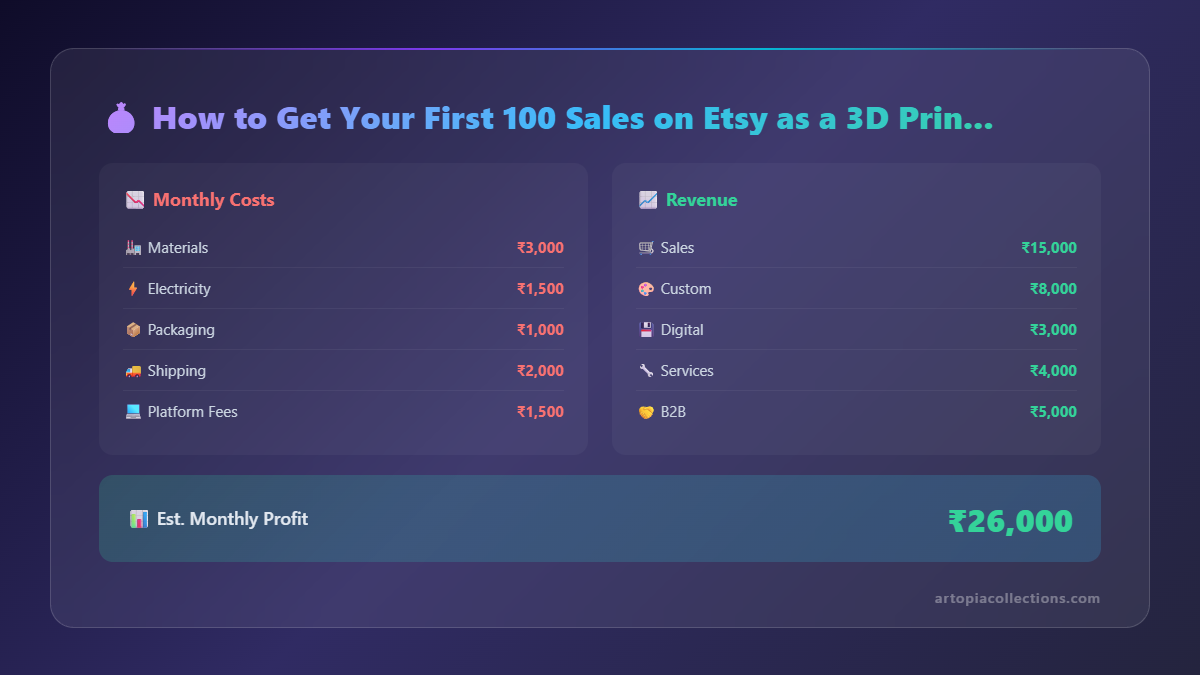
- Material Cost: A decent roll of PLA filament (like eSUN or Overture) might cost you ₹1500-₹2000 for 1kg. Figure out how many grams your print uses. If a 50g print costs ₹80 in material.
- Electricity: My printer uses around 50-100W. If a print takes 5 hours, that's roughly 0.5 kWh. At, say, ₹8-₹10 per unit in India, that's ₹4-₹5. Seems small, but it adds up!
- Time: This is where most people undervalue themselves. How long did you spend designing it? How long does it take to print (and babysit the printer)? How long to clean up supports, sand, package? Be honest. Even if it's ₹100/hour, that's still something.
- Packaging: A good sturdy box, bubble wrap, tape – that's easily ₹20-₹50 per order.
So, a small planter might cost you ₹80 (material) + ₹5 (electricity) + ₹100 (time) + ₹30 (packaging) = ₹215. Multiply that by 2.5 or 3, and you're looking at ₹537-₹645. Selling it for ₹300 means you're losing money or barely breaking even. Don't be afraid to price for profit. People on Etsy are looking for unique, handmade items, and they expect to pay a premium for quality and originality.
The First Few Sales: Be Patient, Be Persistent
Those first few sales are the hardest. Honestly, it's a grind.
- Promote, Promote, Promote: Don't just list and forget. Share your listings on Instagram, Facebook groups (relevant ones, not just spamming), even WhatsApp statuses. Use good hashtags. Talk about your process, show behind-the-scenes. People love that.
- Offer an Opening Discount: A small 10-15% off for your first few customers can grab attention.
- Friends and Family: Ask them to be your first customers. They'll give you honest feedback and (hopefully!) leave those crucial first reviews.
- Etsy Ads (Carefully): You can try a small budget for Etsy Ads (start with ₹100-₹200 per day), but monitor them closely. They can be good for initial visibility but don't just throw money at it. Target specific keywords.
And when that first order comes in, jump for joy! Then, immediately focus on delivering an amazing experience.
Shipping from India: The Logistics Lowdown
This is where things can get a bit tricky, especially for international sales. For domestic orders within India, you've got good options: India Post (affordable but slower), Delhivery, Bluedart, Xpressbees (faster, slightly more expensive). I generally use Delhivery for most domestic orders as they offer good tracking and reliable service, usually costing ₹80-₹150 for smaller packages depending on distance.
For international orders, India Post (Registered Airmail) is the cheapest but slowest. Expect 2-4 weeks. DHL or FedEx are fast but prohibitively expensive for small items, often ₹1500-₹3000+ for a small package. I generally offer India Post as the standard and sometimes a faster (more expensive) option, but make sure the customer is aware of the costs and timelines. Always declare the item correctly on customs forms to avoid issues.
The thing is, packaging securely is absolutely paramount. Your 3D prints can be delicate. Use plenty of bubble wrap, sturdy boxes, and maybe even some void fill (like shredded paper or packing peanuts). A broken item in transit is a nightmare for everyone involved, so don't skimp on this step. I’ve learned this the hard way, trust me. One time, a custom nameplate arrived in pieces – never again will I use thin cardboard!
Scaling to 100 Sales (and Beyond!)
Once you get those first few sales, the momentum builds. Here's how to hit 100:
- Amazing Customer Service: Respond quickly to messages. Be polite, helpful, and accommodating. If there's an issue, fix it promptly and professionally. Happy customers come back and tell their friends. They also leave 5-star reviews, which are gold on Etsy.
- Request Reviews (Nicely): After an order arrives, follow up with a polite message asking for a review. Something like, "Hi [Name], hope you're loving your new [product name]! If you have a moment, a quick review on Etsy would mean the world to my small business. Thank you!" Don't be pushy, but a gentle reminder helps.
- Expand Your Offerings: Once you know what sells, create variations. New colours, slightly different sizes, bundles. If your planters are a hit, maybe design matching coasters or a watering can. Keep those ideas flowing! Check out some of my own varied products for inspiration here: Artopia Collections Products.
- Optimize Your Workflow: As orders increase, you'll need to be more efficient. Can you print multiple items at once? Batch your post-processing? Create templates for your messages and shipping labels? Time is money, especially when you're busy. I've personally invested in a small print farm (just two extra printers) to handle peak demand, and it's been a lifesaver.
- Listen to Feedback: Both positive and negative. If multiple people suggest a change or complain about something, pay attention. It's an opportunity to improve.
Getting to 100 sales isn't just about making money; it's about proving to yourself that your passion project can actually be a viable business. It’s about building confidence and learning so much along the way. You'll learn about design, marketing, customer psychology, logistics, and even a bit about your local postal service – sometimes more than you ever wanted to know! The whole journey is a massive learning curve, but it's an incredibly rewarding one.
My Two Cents (and a bit of personal experience)
I won't lie, there were days I wanted to throw my printer out the window. Filaments getting tangled, prints failing halfway through, the dreaded "spaghetti monster" – you know the drill. And then dealing with an impatient customer or a package lost in transit... it's tough. But honestly, the good days far outweigh the bad. The joy of seeing someone appreciate something you made with your own hands (and printer!) is unparalleled.
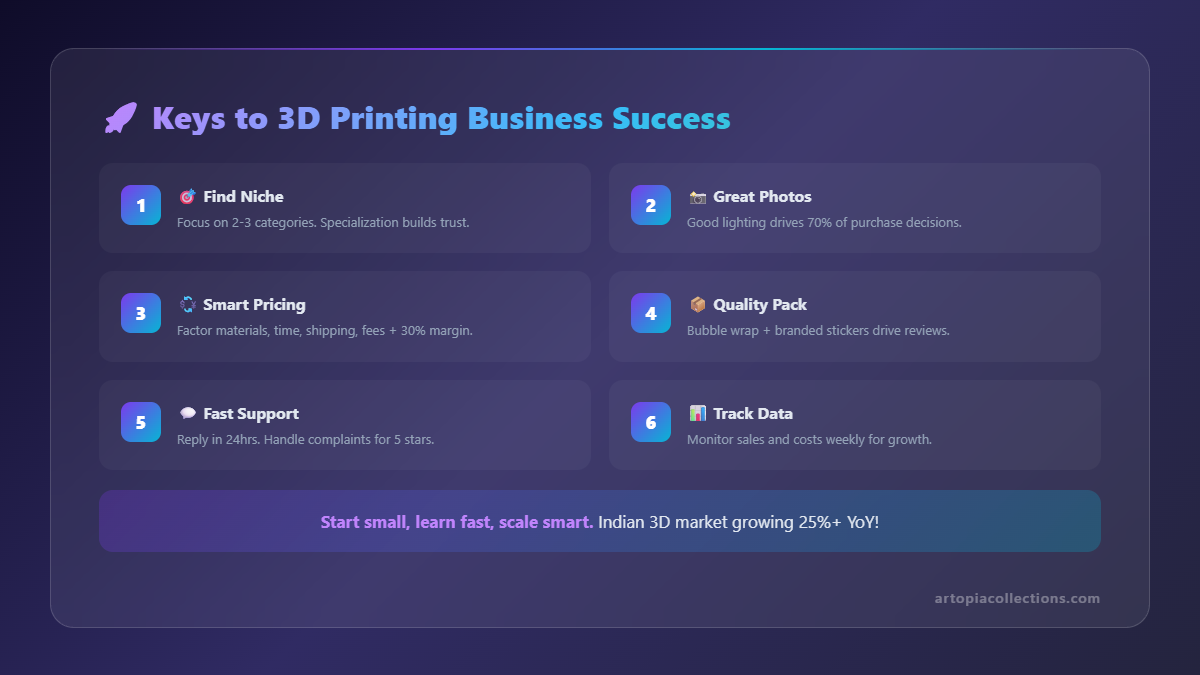
And remember, it's okay to start small. I started with one Ender 3 (the original, solid workhorse!) and just a few rolls of local filament. I learned as I went. Don't wait until everything is "perfect" because it never will be. Just start. Put your stuff out there. Get feedback. Adapt. Keep going. That's the real secret, my friend.
So, fire up those printers, get those designs ready, and let's get you to those first 100 sales. The Etsy world is waiting for your awesome 3D prints!