Returns and Refunds for 3D Printed Products in India: Seller's Legal Guide
Selling 3D printed products online presents unique challenges for returns and refunds. Learn how to establish clear policies, manage expectations, and streamline your process to protect your business and satisfy customers.
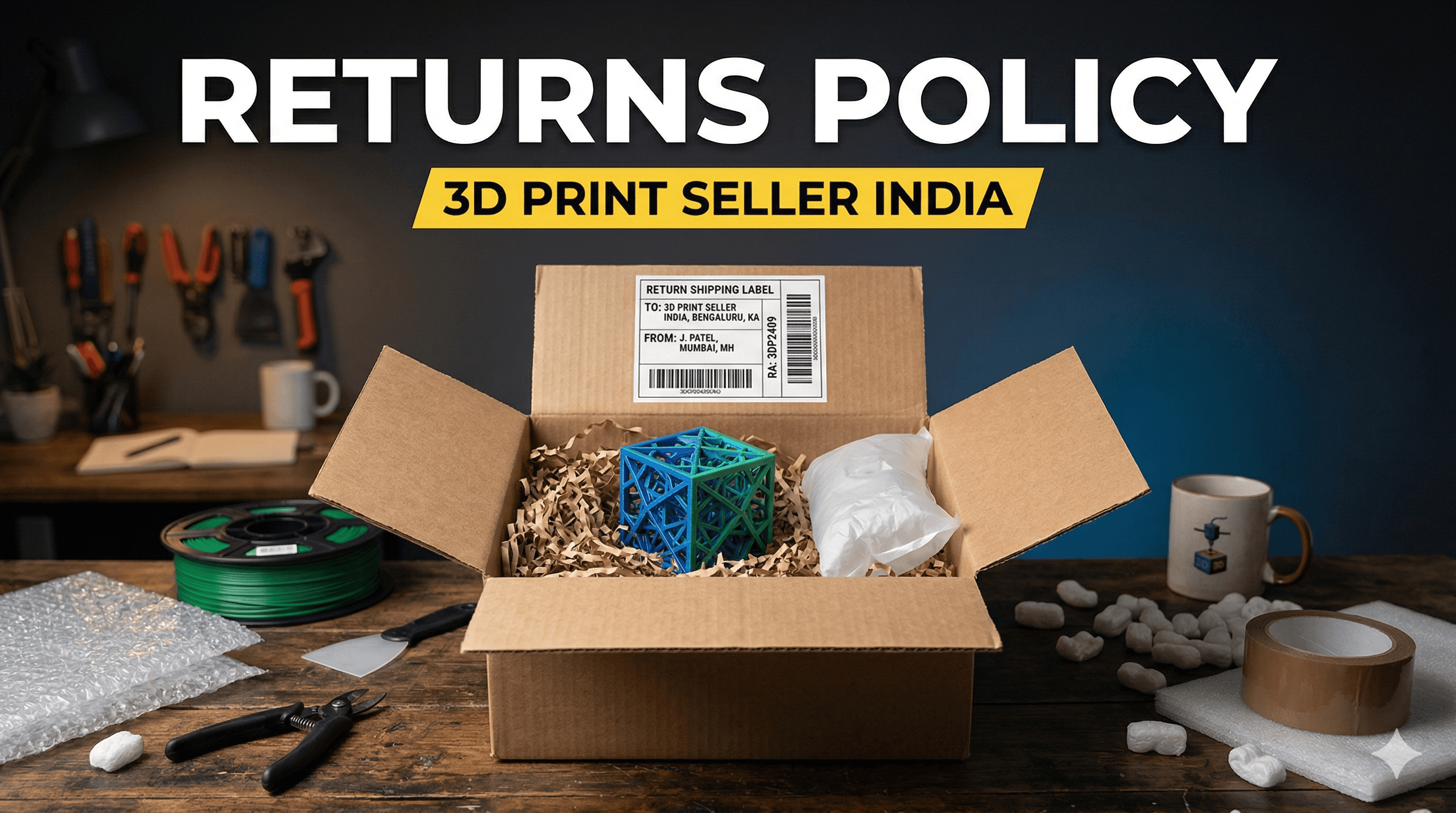
The Dreaded Return: How to Master Returns and Refunds for Your 3D Printed Products Online (Without Losing Your Mind or Your Money!)
Oh, the notification that makes every small business owner's heart sink a little – "New Return Request." Ugh. For us 3D printing folks, it hits a bit different, doesn't it? It’s not just an item off a shelf; it’s hours of design, slicing, the anxious wait as the printer hums away, the careful post-processing, and then the final packaging. When a customer says they want to send it back, it feels like a punch to the gut. I get it. I’ve been there, staring at my Creality Ender 3, wondering where I went wrong. But look, returns and refunds are an unavoidable part of doing business online, especially when you're selling custom or intricate items like 3D prints. And honestly, learning to handle them gracefully can actually *build* customer trust, not break it. That's the secret sauce, friends. My name is Vidyut, and I run a small 3D printing business right here in India, Artopia Collections, and I've learned a thing or two about navigating these tricky waters. Let me share some of my hard-earned wisdom with you.
Why Do 3D Printed Products Get Returned? It's Not Always What You Think!
Before we even get into the "how-to," let's chat about the "why." Understanding the common reasons can help you prevent returns in the first place, which is always the goal, right? For 3D prints, it's usually one of a few things:
- Expectation vs. Reality: This is a big one. Customers might not fully grasp what a 3D print *is*. They might expect injection-molded smoothness, not the subtle layer lines that are inherent to FDM printing. They might expect it to be indestructible, not understanding that PLA, while strong, isn't steel. I personally think this is where crystal-clear product descriptions and photos become your best friend.
- Perceived Flaws: Sometimes it's a minor print artifact – a tiny bit of stringing, a slight visible seam, or a support mark that you, the maker, might see as normal for the process, but the customer sees as a defect. We're our own worst critics, but customers can be even tougher!
- Shipping Damage: Ah, the bane of online sellers everywhere. Despite your best packaging efforts, sometimes our Indian courier services (bless their hearts) can be a bit... enthusiastic. A delicate print can easily snap or deform if not protected properly.
- Incorrect Order/My Mistake: Hey, we're human! Sometimes I've mixed up a color, forgotten an accessory, or even sent the wrong size. It happens. Own it.
- Customer Changed Their Mind: This one is tough because there's nothing "wrong" with the product. They just don't want it anymore. Maybe it doesn't fit where they planned, or the color isn't quite what they imagined in their home. This is the trickiest one to handle purely from a cost perspective.
Your Return Policy: More Than Just Legal Jargon, It's Your Shield!
 First things first, you need a clear, concise, and easy-to-find return and refund policy. Seriously, don't skimp on this. It's not just a legal requirement; it's a crucial communication tool that sets expectations and protects your business. Think of it as your instruction manual for customers on what to do if things go sideways.
What Your Policy MUST Cover:
- Timeframe: How many days does a customer have to initiate a return? 7 days? 14 days? 30 days? Be realistic for your business size and product type. For my custom prints, I usually go with 7 days for damage/defect and 3-5 days for change of mind (if I even offer it for custom work, which sometimes I don't).
- Conditions for Return: Can they return anything? Does it need to be unused? In original packaging? For a functional print like a custom organizer, maybe light use is acceptable if the issue is a design flaw. But for a decorative figurine, it probably needs to be pristine.
- Reasons for Return: Clearly state what reasons you accept. Damage, defects, wrong item sent – those are generally no-brainers. "Change of mind" is where you get to decide how generous you want to be. For highly customized items (like a personalized nameplate or a bespoke gift), I usually state "no returns accepted unless defective or damaged."
- Who Pays for Return Shipping: This is a big one. If it's your fault (defect, wrong item, shipping damage), you should absolutely cover the return shipping costs. If the customer changed their mind, it's generally accepted that they pay. But for small businesses, even ₹50-₹100 for return shipping can eat into your margins quickly.
- Refund Method and Timeline: Will you offer a full refund, partial refund, or store credit? How long until they see their money back? Be clear. I usually aim for processing refunds within 3-5 business days after receiving and inspecting the returned item.
- Contact Method: How should they initiate a return? Email? A contact form? Make it easy for them.
And where does this policy live? On your website's footer, linked clearly on every product page, and even included in your order confirmation emails. Don't hide it! Transparency builds trust.
When the Return Request Comes In: Stay Calm and Communicate!
Alright, the dreaded email or notification has arrived. Deep breaths. The first step is *always* to respond quickly and empathetically. The customer is already feeling frustrated; don't add to it by making them wait or feel ignored.
Here's my usual playbook:
- Acknowledge and Empathize: "Hi [Customer Name], I'm so sorry to hear you're having an issue with your order! That's definitely not what we want for our customers." Acknowledge their frustration.
- Ask for Details (and Photos!): This is crucial. "Could you please send me a couple of photos or a short video showing the issue? This really helps me understand what went wrong and how we can best fix it for you." Photos are your best friend here. They confirm the issue, help you diagnose it (was it print quality? shipping damage? a design flaw?), and prevent misunderstandings.
- Check Your Records: While waiting for photos, pull up their order. What material did they choose? What color? What printer did you use for that specific order? Sometimes the answer is right there. Was it printed with eSUN PLA+, or a tougher PETG? Maybe they ordered a delicate design in a less suitable material.
Resolution Options: Finding the Win-Win (or at least, the "Less Lose")
 Once you understand the problem, it's time to offer a solution. The goal here is to resolve the issue to the customer's satisfaction while also protecting your business from unnecessary losses. Here are the common routes I take:
1. The Full Replacement (When It's Your Fault or Shipping Damage)
If the print is clearly defective (major layer shifting, incorrect dimensions, significant warping that renders it unusable) or damaged in transit, a full replacement is usually the best option. And frankly, it’s the right thing to do. In these cases:
- Offer to send a new one immediately. Often, I don't even ask for the original back, especially if it's a small item (under ₹300-₹400) and the shipping cost to return it might be almost as much as the product itself. Sometimes, it's just not worth the hassle for either of us. For a tiny part, sending it back from, say, Coimbatore to Delhi might cost ₹70-₹100. That's a waste.
- Cover all shipping costs for the new item. Absolutely.
- Apologize sincerely. It goes a long way.
Remember, a new print means new filament, new print time (and electricity costs, which with an Anycubic Kobra Go running for 8 hours can add up!), and new packaging. Factor this into your initial pricing, a small buffer for these eventualities.
2. The Partial Refund (For Minor Imperfections)
Sometimes, the issue isn't a deal-breaker, but it's enough to annoy the customer. Maybe there's a small cosmetic blemish, a support mark that's a bit more prominent than expected, or a color that's slightly off from what they saw on screen (monitor calibration, man!). In these cases, a partial refund can be a great solution.
- Offer a discount on the current item. "We're truly sorry for this minor imperfection. How about we offer you a [e.g., 15-20%] partial refund, and you keep the item? We hope you can still enjoy it!"
- No return needed. This saves you and the customer time and money on return shipping.
- It acknowledges their complaint. You're showing you understand their concern, even if you don't believe it warrants a full replacement.
I find this option works particularly well for items priced between ₹500 - ₹1500, where a full refund might be too much, but a token gesture is appreciated. It turns a potentially negative experience into a neutral or even slightly positive one.
3. The Full Refund (When You Can't Fix It or It's a "Change of Mind")
If the product is beyond repair, or if the customer simply doesn't want it anymore and your policy allows for "change of mind" returns, then a full refund (minus shipping, if that's your policy for change of mind) is the way to go. Here's how I usually handle it:
- Request the item back. If it's a valuable item (say, over ₹500-₹700), you'll likely want it back to inspect it or potentially even salvage it for parts/recycling (though recycling 3D prints is still a challenge, isn't it?).
- Provide clear return instructions. Tell them exactly where to send it, how to package it, and if they need a return label from you or if they're responsible for generating one.
- Refund upon receipt and inspection. Make it clear the refund will be processed *after* you receive the item and confirm its condition. This prevents scams where people claim a refund without returning the item.
- Who pays return shipping? As I mentioned earlier, if it's your fault, you pay. If it's "change of mind," the customer usually pays. Be firm but polite about your policy here. If a customer ordered a ₹1200 architectural model and decided they don't like the color, asking them to pay the ₹150-₹200 return shipping is fair.
4. Store Credit (A Creative Alternative)
Sometimes, especially for change of mind or minor issues, a customer might be open to store credit instead of a cash refund. This keeps the money within your business and encourages them to shop with you again. "We understand it didn't quite work out. How about we offer you a store credit for the full purchase amount, plus a little extra (say, ₹50-₹100) as an apology for the inconvenience, for your next purchase?" It's a nice gesture.
Preventive Measures: The Best "Return Policy" is No Returns!
The goal, ultimately, is to minimize returns. Here’s what I do at Artopia Collections to keep those return notifications at bay:
- Superior Print Quality: This is non-negotiable. Invest in good printers (my Prusa i3 MK3S+ is a workhorse, but even my tuned Ender 3 Pro does wonders), quality filament (I swear by brands like eSUN, Overture, or even some good local Indian brands I've discovered), and master your slicing settings. Don't ship anything you wouldn't be thrilled to receive yourself.
- Accurate Product Descriptions & Photos: Over-communicate!
- State dimensions clearly.
- Mention the material (PLA, PETG, ABS, Resin) and its properties (e.g., "PLA is rigid but can deform in high heat").
- Crucially, *show* the layer lines! Use close-up photos. Be honest about the finish. Don't airbrush away the reality of FDM printing.
- Describe the post-processing steps (e.g., "sanded and painted," or "minimal support cleanup").
- Robust Packaging: My goodness, this is important. For delicate items, use plenty of bubble wrap, foam, or even crumpled newspaper. Box it snugly so it doesn't rattle around. I often use small custom-fit cardboard inserts for very specific shapes. Remember, it's travelling across India!
- Pre-Shipment Quality Check: Before *every* order goes out, I do a final visual inspection. Is it clean? Are there any obvious flaws? Does it match the order? This catches so many potential issues.
- Proactive Communication: Keep customers updated on their order status, especially for custom prints that take time. If there's a delay, tell them! A happy customer is an informed customer.
Learning From Your Mistakes (and Others'): The Return as a Teacher
Every return, painful as it might be, is a learning opportunity. Was it a recurring issue? Then maybe you need to adjust your printer settings, switch filament, or refine a design. Was it a misunderstanding of the product? Time to update your product description with more clarity or better photos. Was it shipping damage? Time to upgrade your packaging. Don't just process the return and forget about it. Analyze it. Use the feedback to improve your process, your products, and ultimately, your customer satisfaction. I once had a return for a very specific functional print, a little adapter for a camera tripod, because it was too brittle. Turns out, I had printed it in regular PLA with only 15% infill. A quick switch to PETG and 40% infill, and the problem was solved. That one return taught me a lot about material selection for specific applications.
It's Part of the Game, My Friend
Look, running an online business, especially one as hands-on and creative as 3D printing, means you're going to encounter returns. It’s not a reflection of your failure; it’s just part of the business landscape. The key is how you handle it. Be professional, be empathetic, be clear with your policies, and always, always strive for quality. When you do all that, even a return can become an opportunity to show a customer that your small Indian 3D printing business is one they can trust. And that, my friend, is priceless.
India Legal Framework: Under the Consumer Protection Act 2019 and E-Commerce Rules 2020, sellers must accept returns within 7 days for defective 3D printed products. GST implications: returns must be handled via credit notes. Platforms like Amazon India and Flipkart have their own return policies (typically 7-10 days) that sellers must comply with. Keep proof of product quality (photos before shipping) to dispute false return claims.


