Starting a 3D Printing Business in India 2026: Costs, Margins, and Tips
Are you planning a 3D printing business in India for 2026? This guide covers all the essential costs, expected profit margins, and practical tips for a successful venture.
Yaar, has the thought of turning your passion for 3D printing into a full-fledged business ever kept you up at night, scrolling through YouTube at 2 AM? Because it sure did for me, and honestly, it still does sometimes! We’re talking about 2026 here, but let’s be real, the foundation for starting a successful 3D printing venture in India is being laid right now, today. And believe me, it’s a seriously exciting time to jump in.
I mean, look, when I first got into this whole world, it was more of a hobby. Building those first few intricate models, the smell of warm PLA, the pure magic of watching an object materialize layer by layer – it was addictive. But then, friends started asking for custom gifts, small businesses wanted prototypes, and suddenly, a light bulb went off. “Hey,” I thought, “people actually pay for this!” And just like that, what started as a passion project slowly, organically, morphed into a proper small business. It wasn't an overnight thing, you know? It was a grind, a learning curve, and a whole lot of trial and error.
So, you’re thinking about taking that leap, huh? You’re probably wondering, "What's the real deal with costs in India?" and "Can I actually make a profit?" And trust me, those are the right questions. Let's dig into it, my friend, and I'll share what I've learned from the trenches, specifically with our vibrant Indian market in mind.
The Initial Investment: What You'll Spend to Get Started
Okay, first things first: you need a printer. Or two. Or three, if you’re ambitious! The beauty of 3D printing today is that the entry barrier is surprisingly low compared to what it was even five years ago. Prices have come down dramatically, and quality has shot up. This is great news for us!
The Printers Themselves
In India, you’ve got a fantastic range of options. For FDM (Fused Deposition Modeling), which is what most folks start with and is incredibly versatile, here are some thoughts:
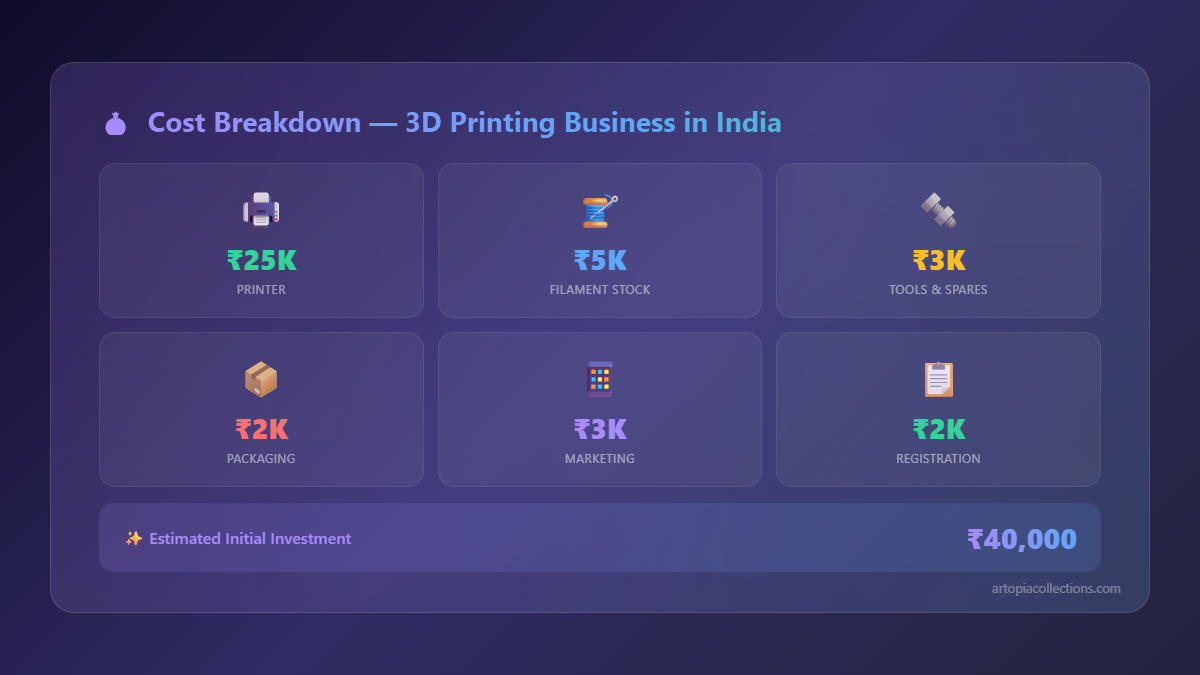
- Budget-Friendly Workhorses: You can easily pick up a solid, reliable machine like a Creality Ender 3 V3 KE or an Anycubic Kobra 2 Neo for around ₹20,000 to ₹28,000. These are absolute beasts for their price point. They’re fairly easy to set up, have decent build volumes, and there’s a massive community online if you ever run into issues. I personally started with an Ender 3 Pro and it taught me everything.
- Mid-Range Marvels: If you’ve got a bit more cash to splash, stepping up to something like a Bambu Lab P1S or even a Prusa MK4 (though Prusas can be harder to source directly in India and often carry a premium) will set you back anywhere from ₹60,000 to ₹1.5 Lakhs. These printers offer multi-color printing, faster speeds, and often better reliability right out of the box. If you’re serious about throughput and want fewer headaches, this is where you might want to aim eventually.
- Resin (SLA/DLP) Printers: Now, if you’re thinking about highly detailed miniatures, jewelry prototypes, or intricate functional parts where precision is paramount, you'll need a resin printer. An Anycubic Photon Mono M5S or an Elegoo Mars 4 Ultra can be bought for roughly ₹35,000 to ₹55,000. Just remember, resin printing involves more post-processing (washing, curing) and has a different workflow, plus the resin itself is more expensive and you need to handle it safely.
So, for a basic FDM setup, you’re looking at ₹20,000-₹30,000 as your core printer cost. If you're going for a dual-printer setup for redundancy or different material capabilities, double that, obviously.
Tools, Materials, and Software
You can’t just have a printer and call it a day, boss! You'll need some essentials:
- Filament/Resin: This is your bread and butter. PLA is the most common and cheapest. You can get good quality 1kg spools from brands like eSUN, Overture, or even local Indian brands for ₹1,000 to ₹1,500 per kg. PETG, which is stronger and more temperature resistant, will be ₹1,200 to ₹1,800. ABS for tougher functional parts is in a similar range. For resin, expect to pay ₹2,000 to ₹3,500 per liter. Stock up on common colors initially!
- Basic Toolkit: A good pair of flush cutters, spatulas for removing prints, pliers, calipers for accurate measurements, maybe some nozzle cleaning needles, and a set of Allen keys. All this shouldn't cost you more than ₹2,000-₹3,000. For resin, add gloves, masks, isopropyl alcohol (IPA), and a UV curing station (some printers come with one, or you can DIY one with a cheap UV lamp).
- Software: Honestly, the barrier here is virtually zero. Slicer software like Cura or PrusaSlicer are free and incredibly powerful. For 3D modeling, TinkerCAD is great for beginners, and Fusion 360 has a fantastic free personal license. If you want to get into organic sculpting, Blender is free. So, no major software costs upfront, which is brilliant!
- Workspace: You'll need a dedicated, well-ventilated space. Maybe a sturdy table, some shelves for filament, and good lighting. This is often overlooked but super important for workflow.
So, total initial outlay for a single FDM printer setup, including some filament and basic tools, could be anywhere from ₹25,000 to ₹35,000. Add another ₹10,000-₹15,000 if you factor in things like a good UPS (uninterrupted power supply) in case of power cuts – a common, but manageable, challenge in India.
The Running Costs: Keeping the Printers Humming
Once you’re set up, your biggest recurring costs will be:
- Filament/Resin: This is obvious. It directly correlates with how much you print.
- Electricity: Printers aren't huge power hogs, but they run for hours. A typical FDM printer might consume 150-250W. If it runs for 10 hours, that's 1.5-2.5 units of electricity. At an average of ₹8-₹10 per unit in India, a long print could cost you ₹15-₹25 in electricity. It adds up, so factor it into your pricing.
- Maintenance & Spares: Nozzles wear out (₹50-₹100 each), PTFE tubes need replacing, sometimes a thermistor or a fan fails. Keep a small stock of common spares. Budget ₹1,000-₹2,000 every few months, depending on usage.
Show Me the Money: Understanding Margins and Pricing
Here's where it gets interesting, and where you really need to be smart. Pricing in 3D printing isn't just about material cost; it's about time, design, complexity, and your expertise.
How I Price My Prints (and how you can too!)
In my experience, you can't just slap on a fixed multiplier. It varies wildly. But generally, here's the deal:
- Material Cost: Calculate exactly how much filament or resin a print uses. For a 1kg spool of PLA at ₹1,200, each gram costs ₹1.20. A print weighing 50g would have a material cost of ₹60.
- Electricity Cost: As calculated above, add this in.
- Print Time: This is crucial. Your printer is tied up. Time is money. I usually factor in a "machine hourly rate" that covers depreciation, maintenance, and basic overheads. It might be ₹50-₹100 per hour, depending on the machine.
- Design Complexity/Value: Did you spend hours designing it from scratch? Or was it a quick download from Thingiverse? Custom design work commands a premium. I’ve charged anywhere from ₹500 to ₹1,500 per hour for complex design projects, or a fixed project fee.
- Post-Processing: Does it need sanding, painting, support removal, or assembly? This all takes human effort and time. Factor it in!
- Market Value: What are others charging? What is the perceived value to the customer? A unique, custom gift can fetch a higher price than a common phone stand.
Example: Let's say a decorative item, like a medium-sized vase from Art Topia Collections, takes 6 hours to print and uses 100g of PLA.
- Material: 100g * ₹1.20/g = ₹120
- Electricity: 6 hours * (200W/1000) * ₹10/unit = ₹12
- Machine Time: 6 hours * ₹60/hour = ₹360
- Total Cost: ₹120 + ₹12 + ₹360 = ₹492
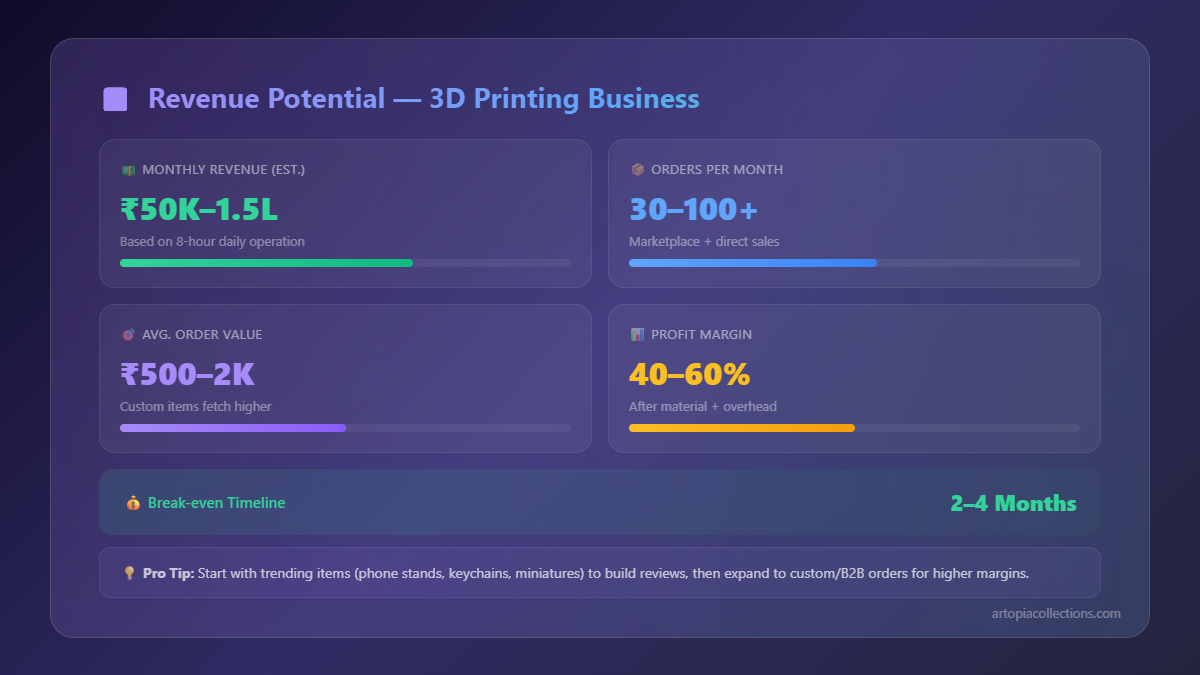
Now, I wouldn’t sell this for ₹500! I’d probably aim for ₹1,200 to ₹1,800, giving me a healthy margin to cover my time, marketing, and the inevitable failed prints (oh, they happen!). For simpler prints, you might aim for 3-5x your material and electricity costs. For highly detailed, custom, or functional parts, your margins can easily be 5-10x.
Honestly, the trick is to understand your true costs and then price based on the value you're providing. Don't undersell yourself!
Tips for Kicking Ass in the Indian 3D Printing Market (2026 Edition)
Alright, so you’ve got the lowdown on costs and margins. Now for the good stuff – how to actually succeed.
1. Find Your Niche (or Niches!)
Don't try to print everything for everyone. It's overwhelming and you'll spread yourself too thin. Think about where 3D printing adds unique value:
- Custom Gifts & Home Decor: Personalized items, unique planters, lampshades. Huge market during festivals!
- Prototyping & Functional Parts: Small businesses, startups, engineering students always need custom jigs, fixtures, or quick prototypes. This is a very lucrative area.
- Miniatures & Cosplay Props: The gaming and pop culture scene in India is booming. Gamers, collectors, cosplayers are often willing to pay good money for high-quality prints.
- Architectural Models: Architects love quick, relatively inexpensive models for client presentations.
- Education: Schools and colleges are increasingly looking for 3D printed models for science, geography, and art classes.
And you know, sometimes I wonder if I should have gotten into resin printing earlier specifically for the miniatures market, but then again, FDM is just so versatile, right? It really depends on where your passion and skills lie.
2. Quality Over Quantity (Always!)
This is non-negotiable. A bad print reflects poorly on your business. Invest time in calibrating your printers, understanding your materials, and perfecting your settings. Offer post-processing like sanding or painting where it adds value. A perfectly smooth, well-finished print will always fetch a better price and more repeat customers than a stringy, rough one.
3. Master the Art of Marketing (Especially Online)
India is a digital-first country. Your online presence is EVERYTHING.
- Instagram & Facebook: Visuals are key. Post high-quality photos and videos of your prints, behind-the-scenes glimpses, time-lapses. Use relevant hashtags like #3DPrintingIndia #CustomPrints #MadeInIndia.
- Local Groups: Join local Facebook groups, WhatsApp communities. Offer your services directly to people in your city.
- Word-of-Mouth: Nothing beats a happy customer telling their friends. Encourage reviews and testimonials.
- Tie-ups: Collaborate with local artists, designers, small businesses, even event planners. They might need custom awards, props, or unique decor items.
Don’t underestimate the power of showing people what's possible!
4. Customer Service is King
Be responsive, clear, and manage expectations. Give realistic timelines. If a print fails (it will happen, trust me!), be upfront about it, explain the delay, and offer solutions. A good relationship with your customer is worth its weight in gold.
5. Diversify Your Offerings
Beyond just printing, consider:
- Design Services: If you're good at CAD, offer to design custom models.
- 3D Scanning: Offer to scan objects for replication or modification.
- Workshops: Teach others the basics of 3D printing. There’s a huge appetite for learning!
- Selling Your Own Designs: Create unique products and sell them directly.
6. Power Fluctuations? Plan for Them!
In India, power cuts are a reality. A good UPS is a wise investment for longer prints, preventing print failures and wasted material. Some modern printers have "print resume" functions, which are lifesavers, but a UPS is still the safest bet.
7. Continuous Learning
The 3D printing world evolves at lightning speed. New filaments, new technologies, new software features. Stay curious, read blogs, watch YouTube, experiment. Attend local maker fests if you can. Being at the forefront keeps you competitive.
So, Is It Worth It?
Absolutely, 100%, without a doubt! Starting a 3D printing business in India in 2026, or even now, is an incredible journey. It demands dedication, patience, and a willingness to learn, but the rewards are immense. You get to be creative, solve problems for people, and build a business around something you truly love.
The market in India is still relatively nascent compared to some Western countries, which means there's huge potential for growth. People are becoming more aware of what 3D printing can do, from personalized gifts to rapid prototyping for startups. And you, my friend, could be one of the pioneers helping to shape that future.
It won't always be easy. You'll have failed prints, frustrated moments, and days when you question everything. But then you'll see a perfectly finished print, a happy customer, or a cool new design come to life, and you'll remember why you started. It's that feeling, that pure unadulterated joy of creation, that makes it all worthwhile.
Go for it, yaar! The future of manufacturing is calling, and it's being printed, layer by layer, right here in India.


